


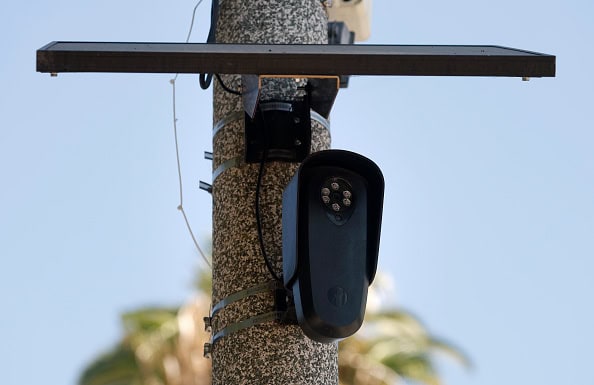
Brookfield police officers drew their guns and stopped a vehicle on Interstate 94 after a Flock camera flagged it in connection with a Milwaukee homicide investigation. It turned out to be the wrong car and the wrong people.
Video from the scene in Waukesha County shows multiple squad cars surrounding the vehicle, officers with weapons drawn, and a passenger holding their hands out the window. Brookfield police said a Flock camera had alerted them to the vehicle’s link to the Milwaukee case. When officers contacted the Milwaukee Police Department, MPD said it no longer needed the car or its occupants. The people were released.
FOX6 News reached out to Milwaukee police for an explanation of why the vehicle remained active in the Flock system but did not immediately receive a detailed response in the initial reporting.
The incident has fueled ongoing debate over Flock Safety’s network of AI-powered automated license plate readers. The cameras scan plates, vehicle make, model, color, and other visible features such as bumper stickers or damage, then feed the data into a searchable database that law enforcement agencies can access, often without a warrant. Flock systems are widely used across Wisconsin and the country.
Critics point to repeated reports of misuse. In Milwaukee, two police officers have faced criminal charges for improperly using the Flock system to track individuals for personal reasons. Dane County supervisors previously voted to pull funding for the sheriff’s Flock contract, citing privacy concerns and reports that the company and some partner agencies had violated public trust.
County Board Chair Patrick Miles said communities around the country and closer to home had seen problems with the technology. The board later restored funding for a different license-plate-reader system with stronger privacy controls.
Milwaukee Police Chief Jeffrey Norman has defended the technology as a useful tool for getting violent criminals off the street, preventing crime, and building cases that can lead to charges.
Flock Safety responded to questions about the controversy and Dane County’s earlier decision. The company rejected the “proven bad actor” characterization, stating that its cameras capture point-in-time images of vehicles in public view, do not use facial recognition or collect personal details such as names or addresses, and create permanent audit trails for every search.
Flock said more than 40 courts have upheld the constitutionality of properly deployed license-plate-reader systems and that the technology has helped solve serious crimes. It added that any misuse is unacceptable and that agencies should hold violators accountable.
The company said it remains open to working with communities and that its platform is designed around local control, with data ownership by agencies, required reasons for searches, automatic deletion after 30 days by default in many cases, and tools to flag unusual search patterns.
Separately, Waukesha police are investigating damage to one of their Flock cameras. Authorities believe a person of interest used a metal pole to strike the device.
The I-94 stop is the latest high-profile example of how errors or outdated information in the expanding Flock network can escalate into armed confrontations with innocent drivers. Supporters continue to highlight the cameras’ role in recovering stolen vehicles, locating missing people, and solving violent crimes. Opponents argue the system enables warrantless mass tracking and is vulnerable to abuse, both by individual officers and through data-sharing practices.
As of 2025, at least 221 Wisconsin law enforcement agencies including numerous county sheriff’s offices were using Flock Safety cameras, according to a Wisconsin Examiner analysis. Documented county-level users have included Waukesha, Dodge, Jefferson, Columbia, Fond du Lac, Brown, Eau Claire, Kenosha, Rock, Walworth, Winnebago, Portage, Sawyer, Ozaukee, Calumet, Monroe, Jackson, and Vernon counties, among others. Dane County ended its Flock contract in 2026 and has since pursued a different ALPR vendor, while several cities and villages statewide have also terminated or declined to renew agreements amid privacy and data-sharing concerns.
As more Wisconsin communities reassess their contracts, the tension between public-safety benefits and privacy protections remains unresolved.
