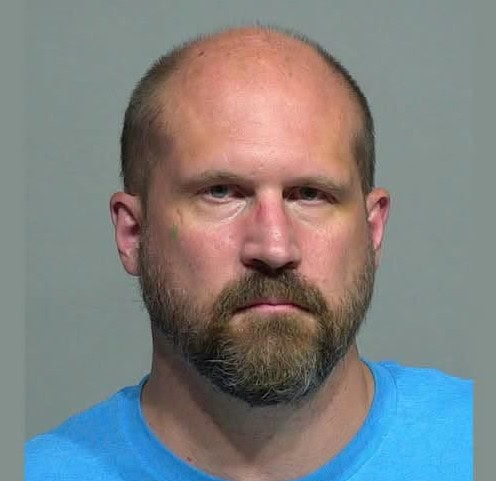


A Milwaukee man with a decades-long criminal record and an open Milwaukee County case was formally charged Monday in the Sept. 20 killing of a Kenosha father of three and the attempted murders of two Kenosha police officers who answered the call minutes later.
Adam Scott Threlkeld, 45, of Milwaukee, faces seven felonies in a nine-page criminal complaint filed by the Kenosha County District Attorney’s Office: first-degree intentional homicide while using a dangerous weapon in the death of Antero Medina III, 33; two counts of attempted first-degree intentional homicide while using a dangerous weapon, naming Officers Samuel Gibbons and Nikki Schend; two counts of first-degree recklessly endangering safety while using a dangerous weapon; possession of a firearm by a felon; and felony bail jumping.
Court Commissioner Daniel E. Kellum set cash bail at $5 million. Threlkeld remains hospitalized and in custody from gunshot wounds suffered in the street fight with police. His initial appearance was adjourned to Friday, Oct. 2, at 1 p.m. First-degree intentional homicide carries a mandatory life sentence if he is convicted. Each attempted-homicide count carries up to 60 years.
Threlkeld is presumed innocent until proven guilty. The complaint sets out the state’s version of what happened inside Shenanigan’s, 2427 52nd St., and a block away at 53rd Street and 24th Avenue.
A bar argument, then one shot
Police were dispatched to Shenanigan’s about 8:25 p.m. Sunday, Sept. 20. Officers found Medina on the floor near a pool table, bleeding from a chest wound and without a pulse. They tried to revive him until Kenosha Fire Department crews arrived. He was pronounced dead at the scene. A preliminary autopsy found a bullet entered his chest, traveled through the chest wall, mediastinum and left upper lung, and caused bleeding around the heart and left chest.
Investigators do not believe Threlkeld and Medina knew each other before that night.
According to the complaint, Threlkeld arrived at the bar with another man. Witnesses described an escalating confrontation in which Threlkeld said he was “from Milwaukee” and related to a gang, pressed his forehead against Medina’s, and refused to back off. Medina tried to de-escalate, telling Threlkeld not to touch him. A woman told police she had been outside smoking marijuana with Medina when Threlkeld and the other man approached offering to sell marijuana; she declined. Medina later walked away on the phone, called his girlfriend to pick him up. Source: Kenosha County Eye
Surveillance video timed the shooting to the second, prosecutors say. At 8:24:50 p.m., Threlkeld reached into his waistband or pocket and drew a handgun, concealing it behind his right leg. At 8:25:04 p.m., he raised the gun and fired one round into Medina’s chest. Medina stumbled about six steps to the pool table and collapsed. Threlkeld followed, then walked out the north door trying to reholster the gun.
After the shooting, Threlkeld told officers he was “from Milwaukee, not Kenosha,” that “we don’t play games,” and that he “should have never got off in this town.” Those statements have reignited local discussion of rail travel between Milwaukee–Chicago (Amtrak) and Chicago–Kenosha’s Metra station.
Although it’s unclear how Threlkeld arrived to Kenosha that night, public transit between Milwaukee (bus from MKE to Kenosha or Amtrak rail to Chicago, and Chicago’s Ogilvie station and Kenosha’s Metra terminal) makes that trip possible without a car. Prosecutors have not, in the published complaint excerpts, laid out tickets, cameras or a named traveling companion beyond “another man” at the bar. A source tells The Heartland Post Threlkeld arrived by train out of the Metra station.
Ambush of responding officers
Threlkeld was found near 53rd Street and 24th Avenue. Officers Gibbons and Schend arrived in marked squads with emergency lights on. Prosecutors say Threlkeld opened fire on them, advancing on Gibbons as the officer took cover, then continuing as Schend arrived and took cover. A squad was hit in the hood, windows and tires. Both officers returned fire. Threlkeld fell after running out of ammunition. Gibbons ordered him to surrender.
Kenosha Police Chief Patrick Patton said the suspect “ambushed officers, firing at them while they were inside their patrol vehicles” and “continued to fire at officers while moving toward them as they exited their cars.” Neither officer suffered significant physical injury. Both were placed on paid administrative leave, standard protocol after an officer-involved shooting.
Investigators recovered a 9mm semi-automatic Derya pistol with an empty magazine designed for 15 rounds (16 with one in the chamber). They say one round was fired inside the bar and 15 were fired at officers. A spent 9mm casing was found under a high-top table inside Shenanigan’s.
The Kenosha Police Department is investigating the bar homicide. The Kenosha-Racine Area Investigative Team, led by the Racine County Sheriff’s Office, is investigating the officer-involved shooting.
“I hope he dies. I had to teach him a lesson.”
Body-worn cameras and hospital statements form a large part of the complaint. On scene about 8:36 p.m., Threlkeld first said, “I shot center mass,” then, “I wasn’t trying to kill anyone except the [expletive] I shot.”
At the hospital, according to the complaint, he said he was “supposed to die,” that he “didn’t want to hurt anybody, only the [expletive] who deserved to die,” that he “tried to shoot at the cops” and “did shoot the cops,” and that he “emptied an entire 15 round clip into their tires and lights.” He said Medina told him he “wasn’t going to shoot him,” that he hoped Medina died, and that he “had to teach him a lesson.” He also said he wished he had another magazine.
A prohibited firearm, an open Milwaukee case, and no-cash release
The felon-in-possession count rests on a May 24, 1999, Milwaukee County felony conviction for taking and driving a vehicle without the owner’s consent. That conviction barred Threlkeld from having a gun.
The bail-jumping count is tied to a pending Milwaukee County case that began Sept. 2, 2024. Prosecutors there alleged Threlkeld approached a uniformed Milwaukee officer at a security desk smelling of alcohol, carved into bulletproof glass with a small knife, and punched the officer in the right eye, damaging the officer’s glasses. He was charged with felony battery to a law enforcement officer and misdemeanor criminal damage to property. He was released on a $2,500 signature bond with a condition that he commit no new crimes. He later entered a deferred prosecution agreement tied to Drug Treatment Court; judgments were withheld. Kenosha’s complaint alleges those conditions were still in effect on Sept. 20.
The day after the Kenosha shootings, Threlkeld had been due in a Milwaukee courtroom on a “non-compliant” Drug Treatment Court report.
Chief Patton said Threlkeld’s record in Milwaukee includes arrests for sexual assault, strangulation, suffocation, exposing himself to a child, battery, disorderly conduct, vehicle theft and burglary, plus the pending officer-battery case. Arrests are not convictions. The Kenosha complaint specifically uses the 1999 vehicle-taking felony as the basis for the gun prohibition.
Spillover into Kenosha
The charging documents cast the case as more than a tavern fight. A Milwaukee man, already prohibited from possessing a firearm and already free on a Milwaukee signature bond after an alleged attack on a Milwaukee officer, is accused of carrying a loaded pistol into a Kenosha neighborhood bar, killing a local father, and emptying a magazine at two Kenosha officers.
That revolving door judicial system is the problem Solis has made central to his tenure. He has said Kenosha absorbs violent crime that starts in larger metros. On Illinois and the Chicago corridor, he has called Illinois “the biggest problem in Kenosha County” and said a majority of violent felonies in the county have direct ties to the Chicago area.
On Milwaukee, his office has often said Kenosha “will not become Milwaukee County.”
Threlkeld remains hospitalized under guard. He is scheduled to appear Oct. 2 before Commissioner Kellum. The two officers remain on administrative leave while Racine County leads the use-of-force review. The Heartland Post will continue to follow this case. Photo: KPD