


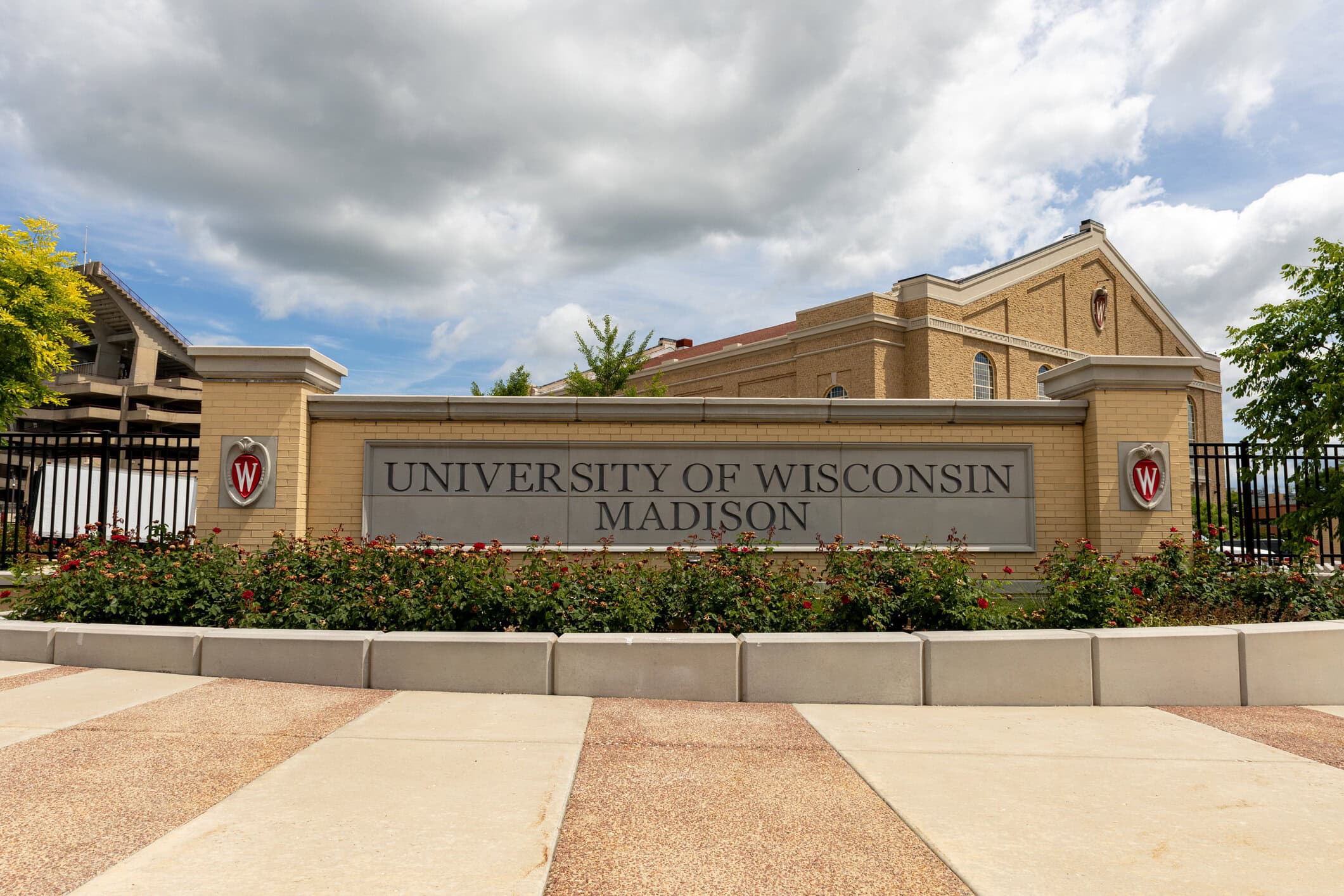
Francis Halzen, a University of Wisconsin–Madison physicist, has won the 2026 Nobel Prize in Physics for turning a cubic kilometer of Antarctic ice into a telescope that catches particles almost nothing else can see.
The Royal Swedish Academy of Sciences awarded the prize to Halzen “for decisive contributions to the IceCube Neutrino Observatory and the discovery of high-energy neutrinos of astrophysical origin.” The award is 12 million Swedish kronor, about $1.2 million. He is the sole laureate — the first physics prize given to one person since Georges Charpak in 1992. It will be presented in Stockholm on Dec. 10.
Neutrinos are sometimes called ghost particles. They have almost no mass, barely interact with matter, and stream through the Earth as if it were not there. The same violent objects that produce cosmic rays — supermassive black holes and other extreme accelerators — also produce neutrinos. Cosmic rays are charged, so magnetic fields scramble their paths. Neutrinos travel almost straight. Catch one, and you can point back toward where it came from.
Halzen’s idea, first laid out in 1988, was to use the clear ice under the South Pole as the detector. When a neutrino hits an atom in the ice, it can produce a flash of light. Strings of sensors buried deep in the ice record that flash and reconstruct the particle’s direction.
Francis Halzen leads IceCube, a telescope built under the ice at the South Pole. The U.S. National Science Foundation paid for it. Scientists from many countries run it, with the home base at the University of Wisconsin–Madison. The finished detector, ready around 2011, is a grid of 5,160 light sensors hanging on 86 cables inside about a cubic kilometer of ice — a block a little over half a mile on each side. An earlier, smaller version called AMANDA never caught the high-energy neutrinos from deep space that Halzen was looking for. IceCube did.

In 2013 IceCube reported the first of those neutrinos from outside our solar system. Physics World named that its breakthrough of the year. In 2017 the team traced one neutrino back to a blazar, TXS 0506+056 — a distant galaxy firing a jet of energy toward Earth. That was the first time scientists could point to a specific object as the source of one of these particles, and the first solid link between a known object and the high-energy cosmic rays that have puzzled physicists for a century. Later, IceCube found signs of the same particles from a galaxy about 47 million light-years away, in 2022, and from our own Milky Way, in 2023. A much larger version, IceCube-Gen2, about eight times the volume, is planned to start running in 2033.
Halzen, 82, was born in Tienen, Belgium, in 1944. He earned a master’s in physics from the University of Louvain in 1966 and a PhD there in 1969, worked at CERN, and joined the UW–Madison faculty in 1972. He is a Vilas Research Professor and the Gregory Breit Distinguished Professor of Physics, and is now a U.S. citizen. Speaking by phone from Italy, he called the prize a surprise and said few people, including himself, thought the project would work. “I have to emphasise how lucky I was,” he told the academy. He also credited the early collaborators and said he hoped the prize would help a proposal he was still working on.
UW–Madison interim Chancellor Eric Wilcots called IceCube unlike any other telescope and said Halzen’s plan to bury a detector under nearly a mile of ice had shifted how scientists think about the universe. Halzen is the sixth physicist tied to the university to win a Nobel, and the 23rd laureate associated with UW–Madison overall. The last active faculty member to win was Howard Temin, in 1975, for reverse transcriptase.
Mark Pearce, chair of the Nobel Committee for Physics, said Halzen’s tenacity and leadership produced “a fantastic instrument” and “a new kind of astronomy.” The collaboration he led now includes more than 450 people at 58 institutions in 14 countries. Halzen has said the main results are still ahead.
