


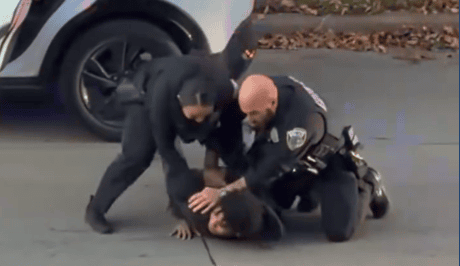
Thirty-five seconds.
That’s apparently all it takes these days for some people to become experts in police defensive tactics, use-of-force law, and the split-second decisions officers must make when confronting an armed individual who refuses to comply.
A cellphone video circulating across Milwaukee shows police officers taking a handcuffed man to the ground and delivering several strikes during an arrest on October 8 near North Palmer Street and East Keefe Avenue. Accusations of police brutality quickly followed. Civil rights attorney B’Ivory LaMarr, representing 24-year-old Nicholas Beamon, has publicly condemned the officers’ actions and suggested litigation is forthcoming. But there’s an important distinction between what a video appears to show and what officers were actually confronting. That distinction is central to determining whether the force was justified.
Handcuffs are not magical restraints. They do not render someone unconscious, eliminate a person’s ability to resist, or necessarily prevent someone from reaching a weapon. They certainly do not guarantee an officer’s safety. An individual can continue struggling, kicking, attempting to escape, or reaching for a weapon even after being handcuffed. The notion that an individual automatically becomes harmless the moment those cuffs click into place is simply not grounded in the realities of police work.
According to the Milwaukee Police Department, officers initially stopped a vehicle for a missing front license plate. During the encounter, they discovered that Beamon was armed with a concealed firearm. Police say Beamon became combative, continued resisting officers, and repeatedly attempted to reach for his firearm, including after being handcuffed and taken to the ground. That last allegation is critically important. If
accurate, officers weren’t simply struggling with a handcuffed individual. They were attempting to control an armed individual who continued reaching toward a potentially deadly weapon. Those are two dramatically different circumstances, and any fair evaluation of the officers’ actions must recognize that distinction.
Handcuffs are not magical restraints. They do not render someone unconscious, eliminate a person’s ability to resist, or necessarily prevent someone from reaching a weapon.
Police defensive tactics are intended to overcome resistance, establish control, and protect human life. Controlled strikes are among the techniques officers may be trained to employ when circumstances justify their use. Such techniques are not intended as punishment. Their purpose is to gain control of an individual whose actions present an immediate threat or who continues actively resisting lawful police commands. Whether those tactics were justified in this particular encounter will depend on the complete
evidence, including the nature of Beamon’s resistance and whether he continued attempting to access his firearm when the strikes occurred.
The law does not require police officers to wait until a suspect successfully retrieves a firearm before responding to a credible threat. Under the United States Supreme Court’s landmark decision in Graham v. Connor, an officer’s use of force must beevaluated according to an objective reasonableness standard. That evaluation considers the circumstances confronting a reasonable officer at the scene, not merely what someone watching a video might conclude afterward. The severity of the offense matters, as does whether the individual poses an immediate threat to officers or others and whether the individual is actively resisting arrest or attempting to evade arrest.
These considerations are especially important when officers are attempting to control an individual who may have access to a firearm.
The encounter reportedly began with a minor traffic violation. But an encounter that begins with a missing license plate does not necessarily remain a routine traffic stop. Circumstances can change in seconds. The discovery of a firearm, combined with alleged physical resistance and attempts to access that weapon, fundamentally changes the officer-safety assessment. Lawfully possessing a firearm is not a crime,
and exercising one’s Second Amendment rights does not justify police force. But lawful firearm possession does not grant anyone the right to physically resist officers or attempt to access a weapon during a lawful detention.
The issue isn’t simply whether Beamon had a legal right to possess that firearm. The issue is whether his actions, as described by police, created an immediate and objectively reasonable perception of
danger.
The law does not require police officers to wait until a suspect successfully retrieves a firearm before responding to a credible threat.
Police defensive tactics are not designed to look attractive on cellphone videos. They’re designed to establish control, overcome active resistance, and protect human life. A focused strike may be appropriate under certain circumstances when lesser measures have failed or when an immediate threat demands action. Whether a particular strike is justified depends on the threat, the available alternatives, the individual’s behavior, and the circumstances at that precise moment.
The number of officers involved doesn’t automatically determine whether someone is under control, either. Three officers struggling with one individual does not necessarily mean the individual has stopped resisting. When a firearm remains accessible, the consequences of losing control can be catastrophic.
Does that mean every strike delivered during this arrest was justified? Not necessarily, and anyone claiming to know that conclusively from a short video is getting ahead of the evidence. The officers’ body-camera recordings, their reports, the sequence of commands, the positioning of the firearm, and the precise movements of everyone involved must be examined.
If the evidence establishes that Beamon was no longer resisting, posed no immediate threat, and could not access his firearm when the strikes occurred, that would materially change the analysis. But if the department’s account is corroborated, particularly its allegation that Beamon continued reaching toward his firearm while resisting, then the officers’ actions must be evaluated in that context. That is how a legitimate use-of-force review should work, not through public outrage, social media commentary, or the assumption that every forceful arrest involving a handcuffed suspect constitutes police brutality.
There is a growing expectation that officers must somehow control dangerous encounters without ever using force that appears unpleasant to the public. That is simply not how physical confrontations work. Police officers are not expected to absorb unlimited resistance, surrender control of an armed individual, or gamble with their lives because someone might later find their defensive tactics visually disturbing. Accountability and officer safety are not mutually exclusive. The public can demand that officers follow the law and their training while recognizing that not every violent struggle can be resolved through verbal persuasion.
One additional fact deserves consideration. Beamon was reportedly released without criminal charges following the encounter. Some may interpret that as evidence that the officers’ actions were unwarranted, but those are separate legal questions. A prosecutor’s decision not to pursue criminal charges does not, by itself, establish whether an officer’s use of force was reasonable. That determination must be based on
the circumstances confronting officers when the force was used, including the nature of the resistance and any immediate threat to safety.
A thorough, impartial investigation is appropriate. The evidence should determine whether the force was justified, and officers should be held accountable when it is not. But that standard must work both ways. Officers who act reasonably and within the law deserve fairness, due process, and protection against premature judgment.
Before condemning the Milwaukee officers involved in this arrest, the public should consider one important question: If an armed individual is actively resisting and attempting to reach his firearm, how long should an officer be expected to wait before taking decisive action to stop him?
In police work, the difference between hesitation and decisive action can be measured in fractions of a second. Sometimes, those fractions of a second are the difference between life and death.
Michael S. Murphy is a retired Milwaukee Police Officer with 26 years of law enforcement
service and currently serves as President of the Fraternal Order of Police, Cream City Lodge #8
