


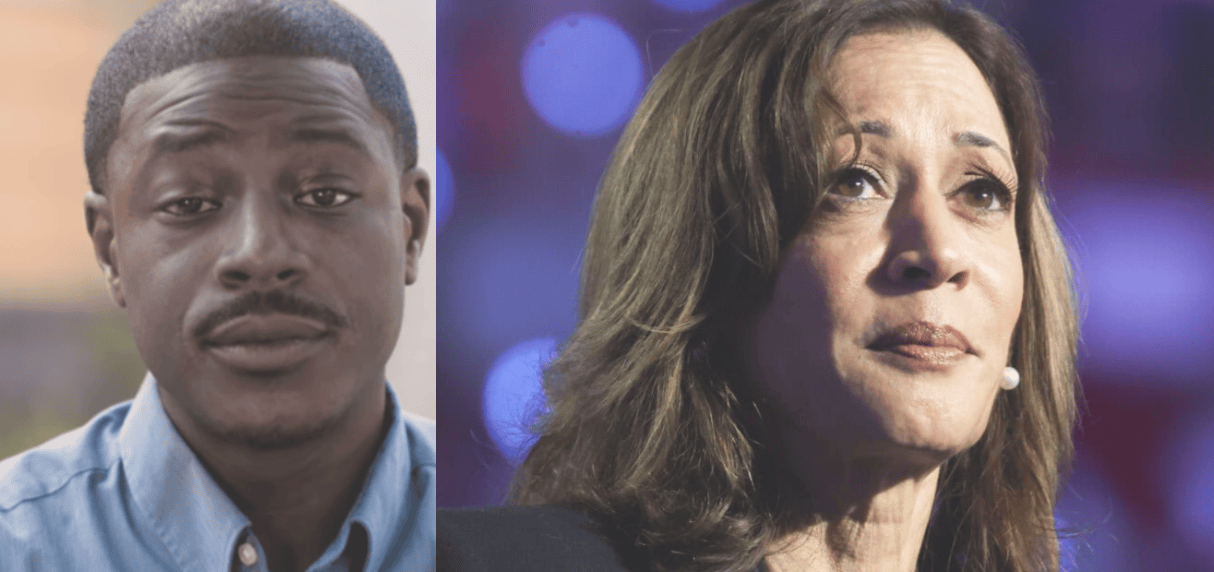
Eight days before voters head to the polls in Wisconsin’s gubernatorial election, Milwaukee County Executive David Crowley is hitting the campaign trail with former Vice President and 2024 Democratic presidential nominee Kamala Harris.
Harris, who lost Wisconsin to President Donald Trump just two years ago, consistently ranked among the most liberal senators in the U.S. Senate before becoming Joe Biden’s vice president in 2021. Her record became a central issue during the 2024 presidential election after Biden withdrew from the race and Democrats rallied around Harris as their replacement nominee.
Harris campaigned frequently across Wisconsin, including appearances alongside Crowley in Milwaukee County and a controversial stop in La Crosse, where she told protesters who interrupted her speech, reportedly shouting “Jesus is Lord!,” that they were at the wrong rally.
Now, Harris returns to Wisconsin to campaign for Crowley, a candidate whose political career and policy positions offer several points of comparison with her own.
Both candidates also benefited from their party’s political establishment during unusual nomination contests, with their respected party machines effectively installing each as the eventual nominee. Harris became the Democratic presidential nominee after Biden withdrew in July 2024. Crowley, meanwhile, reentered Wisconsin’s gubernatorial race after suspending his campaign, received the endorsement of Gov. Tony Evers, and ultimately defeated Democratic socialist Francesca Hong in a closely contested primary.
Throughout the general election, Republican Tom Tiffany has sought to portray Crowley as a tax-and-spend Milwaukee Democrat whose record on immigration, public safety, and social issues is out of step with Wisconsin voters.
But beyond the campaign rhetoric, how closely do Harris’s and Crowley’s records actually align?
Illegal Immigration
Illegal immigration was one of the biggest issues in the 2024 presidential election, with unlawful border crossings reaching historic highs during the Biden-Harris administration.
Harris, who was assigned responsibility for addressing the root causes of migration from Central America, faced criticism over the administration’s handling of the border. In a June 2021 interview with Lester Holt, she acknowledged that she had not visited the southern border as vice president, prompting her widely criticized response that she hadn’t been to Europe either.
The administration also faced scrutiny over fentanyl trafficking, crimes committed by individuals unlawfully present in the United States, and its broader immigration enforcement policies.
Harris’s positions on immigration extended beyond her time as vice president. During her 2019 presidential campaign, she supported decriminalizing unauthorized border crossings and providing government-funded health coverage to undocumented immigrants. She also criticized Immigration and Customs Enforcement, although she did not adopt an unequivocal position in favor of eliminating the agency.
Milwaukee County Executive David Crowley has likewise supported several policies expanding services and protections for undocumented immigrants. Crowley has backed driver’s licenses and in-state college tuition for undocumented immigrants and opposed certain forms of local cooperation with federal immigration enforcement.
During a campaign discussion about immigration, Crowley declared, “I’m not an ally. I’m an accomplice. I’m going to be with you no matter what.”
The statement became the centerpiece of a Tiffany campaign advertisement, which juxtaposed Crowley’s remarks with three Wisconsin criminal cases involving undocumented immigrants. Crowley has also compared aspects of the nation’s immigration system to slavery, according to a previous Heartland Post report.
His record extends beyond campaign statements. As previously reported by the Heartland Post, Milwaukee County’s administration registered support for legislation that would have established a continuing $300,000 annual appropriation for immigration-related legal services, including assistance available regardless of immigration status.
The county also supported legislation limiting certain forms of cooperation between state or local authorities and federal immigration enforcement.
Crowley has expressed opposition to ICE detainers and immigration enforcement partnerships, and has said he would restrict state agency cooperation with federal immigration authorities.
The comparison between Harris and Crowley is not exact: Harris’s responsibilities involved federal immigration policy, while Crowley’s record largely concerns the role of state and local government. Nevertheless, both have supported expanding access to services for undocumented immigrants and limiting some immigration enforcement practices.
Gender Policies, Racial Equity, and Crime
So-called “culture war” issues featured prominently in the 2024 presidential campaign, including one of the most memorable advertisements produced by Trump and his allies, which declared that Harris was “for they/them, not you.”
Harris faced scrutiny over her positions on transgender rights, including her previous support for taxpayer-funded gender-transition medical care for incarcerated individuals and immigration detainees.
Her running mate, Minnesota Gov. Tim Walz, earned the nickname “Tampon Tim” from conservative critics after signing legislation requiring Minnesota public schools to make menstrual products available to students. The law did not specifically require products to be placed in every boys’ restroom, although some schools could satisfy its requirements that way.
As a state lawmaker, Crowley backed similar legislation concerning taxpayer-funded menstrual products in government buildings and public schools.
Crowley also co-authored legislation that proposed gender-neutral terminology in portions of Wisconsin’s reproductive health laws, including replacing references to mothers with terminology such as “inseminated person.”
He also supported legislation establishing a state Transgender Equity Task Force, has opposed restrictions on transgender participation in school sports, and has touted the endorsement of an organization that supports access to gender-affirming medical care for minors.
The two Democrats also share a history of supporting government initiatives focused on racial equity.
As a U.S. senator, Harris introduced legislation expanding implicit-bias and anti-racism training for health care professionals responding to the COVID-19 pandemic.
Around the same time, newly elected Milwaukee County Executive David Crowley was advancing a similar emphasis on racial disparities in public health.
Milwaukee County had already declared racism a public health crisis before Crowley took office. Crowley subsequently outlined a broader vision for addressing racial disparities throughout county government, including in the response to COVID-19.
Under Crowley, the county expanded the use of a Racial Equity Budgeting Tool, requiring departments to consider racial equity and underserved communities when developing their budgets.
Crowley’s administration applied equity considerations to matters ranging from COVID-19 vaccine distribution to decisions involving county recreational facilities, including swimming pools.
Previous Heartland Post reporting also examined Crowley’s statements about racial disparities in the use of county amenities, including beer gardens and golf courses.
The county’s approach extended to employee compensation. According to another Heartland Post investigation, Crowley’s 2021 and 2022 budgets included a combined $5.367 million intended to address racial and gender pay disparities among county employees.
The publication questioned whether the allocations complied with federal anti-discrimination law. That legal conclusion, however, should be distinguished from the budget allocations themselves; the reporting did not establish that a court had ruled the spending unlawful.
As vice president, Harris similarly called for incorporating racial equity considerations into federal government programs and economic policy.
The parallels also extend to policing and criminal justice.
During the 2020 protests following George Floyd’s death, Harris advocated criminal justice reforms, expressed support for eliminating cash bail, and promoted a Minnesota bail fund that assisted people arrested during the demonstrations.
Crowley used similar language about systemic racism following the police shooting of Jacob Blake in Kenosha, saying that Blake’s wounds were the “result of systemic racism.”
Crowley also participated in a lawsuit alleging racial discrimination by Milwaukee police officers and expressed openness to discussing police funding reforms following Floyd’s death.
More recently, the Heartland Post reported that Crowley’s administration used county lobbying resources to support legislation to remove police officers from schools.
Taken together, their records show substantial overlap in their emphasis on systemic racism, racial equity initiatives, and changes to traditional policing practices, although the specific policies and offices involved differ.
Taxes, Spending, and Data Centers
Republican Tom Tiffany has repeatedly criticized David Crowley’s tax and spending record throughout the gubernatorial campaign.
As Milwaukee County executive, Crowley oversaw increases in the county’s property tax levy and supported a significant increase in the county sales tax.
The sales tax increase became a particularly memorable controversy when Crowley participated in a cake-cutting celebration marking the change, after arguing that the increase would not impose an unreasonable burden on taxpayers.
Crowley’s gubernatorial platform includes expanded child care assistance, a BadgerCare public option, and the so-called “fully funding” of public education.
Those proposals raise questions about their costs, funding sources, and potential effects on Wisconsin taxpayers.
Harris offered a similarly expansive federal spending agenda during her 2024 presidential campaign, including housing assistance, expanded tax credits, and additional federal support for families.
An analysis by the Committee for a Responsible Federal Budget estimated that Harris’s proposals would increase federal borrowing by trillions of dollars over ten years, depending on the assumptions used.
Milwaukee County, meanwhile, has faced persistent structural budget pressures, including a projected $51 million deficit. While a county operating budget is not directly comparable to the federal government’s borrowing capacity, both records have prompted debate over the affordability of proposed government programs.
The two Democrats have also emphasized the potential of artificial intelligence and large-scale data center development.
Crowley has expressed support for making Wisconsin a major hub for AI and data infrastructure, while advocating environmental and labor conditions on large data center projects. His proposal to require hyperscale data centers to operate using 100% clean energy has drawn particular scrutiny.
Tiffany’s campaign has dubbed him “Data Center David,” arguing that meeting the electricity demands of two proposed hyperscale data centers in Port Washington and Mount Pleasant entirely through solar power could require approximately 93,000 to 130,000 acres of land.
The campaign detailed its calculations in a Heartland Post article. The acreage estimate is a campaign projection, not an established forecast of how much Wisconsin farmland would actually be converted.
Crowley has also faced questions over taxpayer subsidies for data center development, and his position on restrictions and incentives has evolved during the campaign.
Harris similarly endorsed developing large-scale AI infrastructure during her time as vice president.
In January 2025, the Biden administration announced an executive order intended to accelerate federal permitting and support infrastructure development for advanced artificial intelligence, including data centers and related energy facilities.
Harris praised the administration’s efforts to strengthen American leadership in AI and expand domestic infrastructure.
While both Democrats have supported AI development, Crowley’s proposed energy requirements and the Biden-Harris administration’s federal infrastructure policies are distinct approaches. Their shared interest in data centers does not necessarily establish agreement on subsidies, energy sourcing, or land use.
A Familiar Political Partnership
Kamala Harris may have lost Wisconsin in 2024, but many of the policies she championed have found a political home in David Crowley’s gubernatorial campaign.
From immigration enforcement and taxpayer-funded government programs to racial equity initiatives, transgender policies, and the expansion of government spending, the similarities between the two Democrats extend well beyond their shared party affiliation.
And the parallels don’t end with their policy records. Both emerged from unusual nomination contests with the backing of powerful Democratic Party figures, and both have faced questions about how they would pay for their ambitious policy agendas.
Now, with just eight days until Election Day, Harris is back in Wisconsin campaigning for Crowley.
Her appearance puts a familiar set of policy debates back in the spotlight—and raises a question for Wisconsin voters: How much of the Biden-Harris policy agenda would find its way into the governor’s office under David Crowley?
If one were to draw a Venn Diagram to highlight the overlap of their policy priorities and governance styles, it would likely be a flat circle.
