



Following a rough Election Day for conservatives, Monday-morning quarterback sessions have landed on an unfortunate target: canvassing.
While the value of canvassing is being debated on X, direct conversations remain one of the few ways to learn what a significant swath of the electorate actually cares about. National concerns, affordability, property taxes, healthcare, and the day-to-day effects of state policy came up on doors for both state and local races in ways that aggregated data doesn’t always capture. Polls and digital outreach capture snapshots, but a conversation at the door captures context and local concerns that don’t always show up in surveys. It also provides data that can be relied upon to draw trends between past and future elections.
The strongest evidence comes from a series of randomized field experiments spanning more than two decades. In a landmark 2000 study published in the American Political Science Review, Alan Gerber and Donald Green found that personal contact at the door raised turnout by roughly 8 to 9 percentage points among the voters who were actually reached, substantially outperforming direct mail and phone calls. Subsequent meta-analyses of dozens of U.S. experiments have put the average effect at about 2.5 percentage points once contact rates are taken into account, with larger gains often observed in lower-salience races and among voters with moderate turnout histories. Across these studies, face-to-face canvassing has consistently ranked as one of the most effective get-out-the-vote methods tested, even as the research also shows the effect is real but modest and depends heavily on targeting and the quality of the conversation. The full study can be found here.
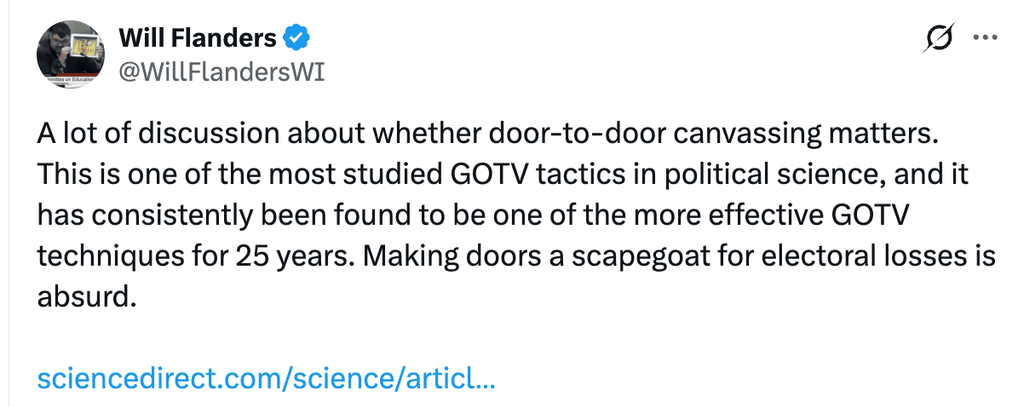
That being said, the practice needs to be done intentionally. Targeted lists focus on residents who are persuadable or need a reminder to vote. A friendly, professional approach lets the voter associate the canvasser with someone who listens and cares about their concerns. That personal connection can’t be replicated through mail or text…and it’s also much more difficult to ignore.
And as rough as Tuesday was, among governors’ races in states Trump won in 2024, the roughly 9-point movement toward Democrats in Wisconsin was the smallest. Republican candidates in competitive legislative districts, including Mike Roberts in the 5th Senate District, retained higher shares of the vote than many counterparts elsewhere who faced steeper national headwinds.
District 5 was an open seat covering parts of the Milwaukee suburbs and eastern Waukesha County, where Republican Mike Roberts ran against Democrat Robyn Vining. The district leaned Democratic in the 2024 presidential contest by roughly 6 points and was widely viewed as one of the most competitive seats on the map. Americans for Prosperity – Wisconsin invested significant door-knocking effort in the district, and canvassers reported much positive feedback from residents who didn’t know who was running. Roberts, a first-time candidate and small-business owner, secured about 43 percent of the vote. In a cycle that produced a Democratic wave and flipped control of both chambers of the Legislature, that share stood out relative to other Republican candidates in contested Senate races.
Canvassing obviously isn’t a silver bullet, but writing it off as theater ignores what it still uniquely delivers: real-time insight into voter priorities, personal connections that mail and texts cannot match, and the ability to identify and reach the narrow slice of the electorate that remains open to persuasion or needs a reminder to vote.
