


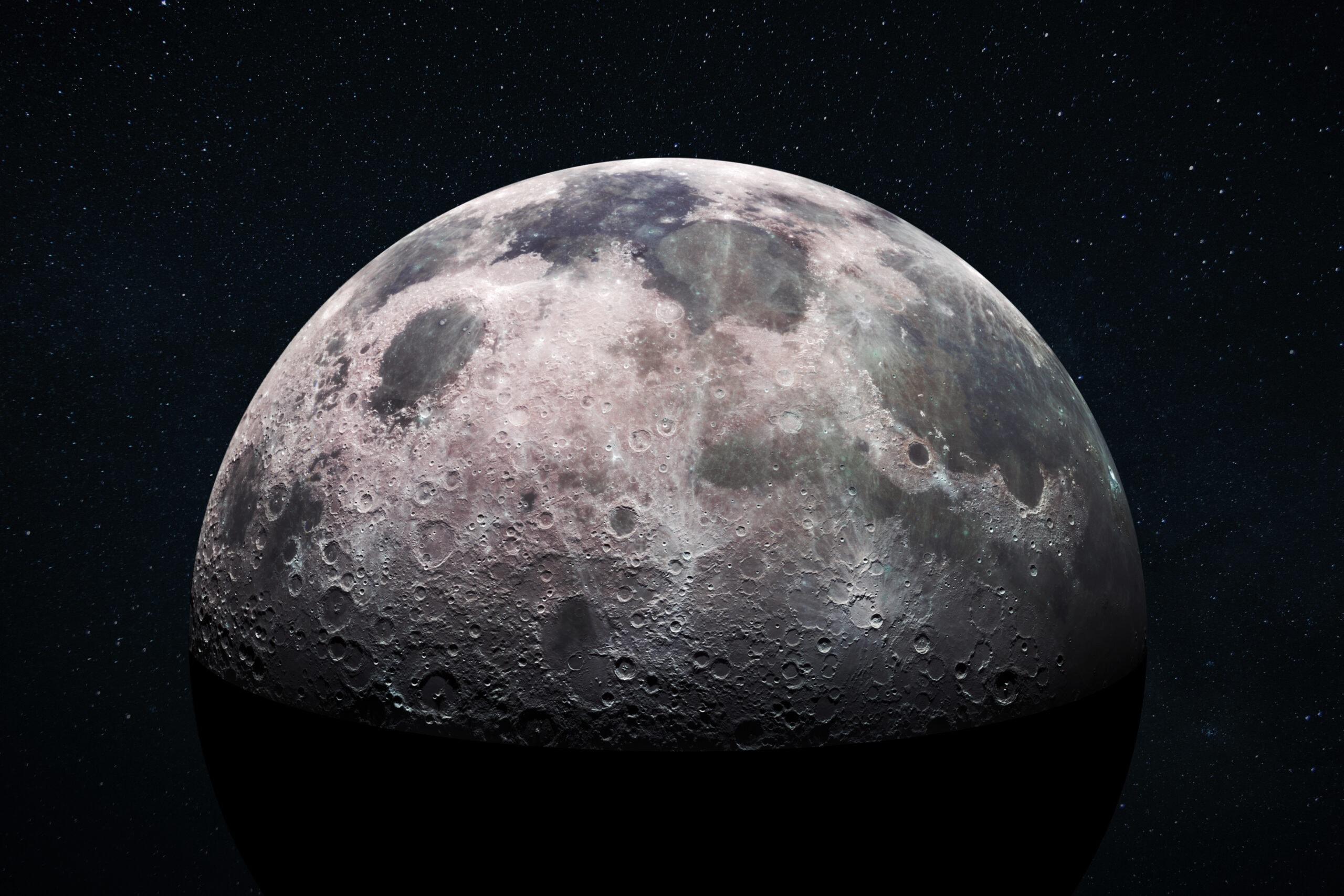
America is racing toward an artificial intelligence revolution that promises to transform our economy, reshape national security, and consume extraordinary amounts of electricity. Meanwhile, China is preparing for a future in which the Moon becomes more than a destination for astronauts.
But what if one of America’s next great economic frontiers lies approximately 238,900 miles above our heads? What if American companies eventually began building data centers on the Moon?
It sounds like science fiction. Yet researchers, including a scientist at the University of Wisconsin–Madison, have already examined the possibility of storing humanity’s information on the lunar surface.
And that raises a much bigger question: What would it take to establish a functioning industrial economy beyond Earth?
Imagine nuclear power plants, robotic mining operations, automated factories, communications networks, and commercial infrastructure operating on the Moon. Suddenly, we’re no longer talking about computers. We’re talking about an entirely new marketplace.
More than half a century ago, Americans accomplished what generations considered impossible. We landed men on the Moon, planted our flag, and returned home. Then, largely, we stopped going.
The next chapter of American space exploration shouldn’t simply be about planting another flag. It should be about creating something worth staying for.
America’s Growing Energy Challenge
Artificial intelligence is transforming the economics of electricity. According to the International Energy Agency, data centers consumed approximately 415 terawatt-hours of electricity worldwide in 2024, roughly 1.5% of global consumption. That demand is projected to more than double to approximately 945 terawatt-hours by 2030.
Some proposed data center campuses approach or exceed one gigawatt of electrical demand. Operating continuously at that level would consume 8.76 billion kilowatt-hours annually.
That electricity must come from somewhere. Across America, utilities face growing demands for generating capacity, transmission infrastructure, and cooling resources. Meeting those demands requires substantial investment, potentially affecting electricity costs for households and businesses.
America cannot afford to retreat from artificial intelligence. Its applications in national defense, medicine, manufacturing, and scientific research are too important.
But what if some specialized computing could eventually operate beyond Earth’s electrical grid?
Moving computing to the Moon wouldn’t eliminate its energy requirements. Electricity would still have to be generated there, and transporting and maintaining the equipment would be enormously expensive. Whether lunar computing could ever compete economically with terrestrial facilities remains uncertain.
Still, the possibility deserves examination.
Why the Moon?
The Moon possesses several characteristics that make it an intriguing candidate for specialized computing infrastructure.
Near its south pole, certain elevated locations receive sunlight for extended periods, potentially supporting solar installations. Nearby permanently shadowed craters experience some of the coldest temperatures in the solar system.
But cooling computers in space isn’t as simple as placing them somewhere cold. Without an atmosphere, waste heat must be transferred through engineered cooling systems and radiated into space. Large facilities would require substantial thermal-management infrastructure.
The Moon also offers physical separation from terrestrial disasters and electrical grid failures, potentially benefiting archival storage and specialized backup systems.
Communications present another obstacle. Radio signals take approximately 1.3 seconds to travel between Earth and the Moon, making lunar facilities impractical for many applications requiring instantaneous responses. However, certain scientific calculations, archival operations, and AI training workloads could tolerate those delays.
The engineering challenges are formidable. Yet the concept is no longer confined to science fiction.
Wisconsin Is Already Part of the Conversation
Here is where the story becomes particularly interesting for Wisconsin.
In November 2022, University of Wisconsin–Madison astronomy professor Alexandre Lazarian joined Harvard University researchers Carson Ezell and Abraham Loeb in publishing A Lunar Backup Record of Humanity.
Their research explored establishing a lunar data-storage system capable of preserving important records of human civilization, potentially protecting information from catastrophic events affecting Earth.
This wasn’t a proposal for a massive artificial intelligence campus. It was a scientific examination of the Moon’s potential as a secure, long-term repository for humanity’s information.
Nevertheless, it demonstrates something worth recognizing: Wisconsin researchers are already contributing to serious scientific discussions about extending humanity’s information infrastructure beyond Earth.
In 2024, an international research team, including scientists affiliated with IBM Research and the European Space Agency, presented Designing (Not Only) Lunar Space Data Centers at an IEEE scientific conference. Their work examined distributed computing, data analysis, and potential architectures for processing information generated by lunar and deep-space missions.
These studies do not establish that industrial-scale lunar computing is commercially feasible. They establish that the underlying concepts are legitimate subjects of scientific investigation.
Private enterprise has begun experimenting as well.
In February 2025, Florida-based Lonestar Data Holdings launched its Freedom data-storage payload aboard Intuitive Machines’ Athena lunar lander. The company reported successful operations during transit and lunar orbit. Following landing, Lonestar’s chief executive reported that the payload also operated briefly on the surface before the mission ended prematurely because of the lander’s unfavorable position and loss of power.
It was a small experimental system, not an industrial data center. But it represented another step toward testing data infrastructure beyond Earth.
What once belonged exclusively to science fiction is now being examined in research laboratories and tested through commercial space missions.
Building an Industrial Foundation
The first practical lunar data center would likely be far smaller than America’s enormous terrestrial computing campuses.
Robotic equipment could prepare a site near the lunar south pole, install electrical infrastructure, and position modular computing systems delivered from Earth. Solar arrays could generate electricity during extended periods of sunlight, while nuclear reactors could eventually provide dependable power when sunlight is unavailable.
NASA and the Department of Energy have pursued designs for lunar fission systems capable of generating at least 40 kilowatts of electricity. The agencies have also identified lunar nuclear power as an important technology for sustained surface operations.
That capacity would be nowhere near sufficient for industrial-scale AI computing, but it could help establish the foundation for permanent lunar infrastructure.
Servers could operate inside protective enclosures, potentially covered with lunar soil to reduce radiation exposure and micrometeorite damage. Liquid-cooling systems would transfer waste heat to external radiators. Radio and laser communications would connect facilities to Earth, while autonomous robots could perform inspections and maintenance.
Every stage would require breakthroughs in reliability, transportation costs, and infrastructure.
But here’s where the economic possibilities become far more interesting.
The Real Opportunity Isn’t the Computers
Imagine robotic mining operations extracting useful materials from lunar soil. Manufacturing facilities producing construction components. Solar farms generating electricity. Nuclear reactors supplying industrial power. Transportation companies delivering equipment and communications providers connecting facilities across the lunar surface.
Instead of shipping every structure and support system from Earth, companies could eventually manufacture an increasing share of their infrastructure locally.
Sophisticated computer chips would still require imports for the foreseeable future. Producing advanced electronics on the Moon would be vastly more difficult than manufacturing basic construction materials. Nevertheless, even partial local production could change the economics of lunar development.
A functioning lunar economy would require electricity, communications, transportation, construction, maintenance, and investment. These are the same foundational industries supporting economic activity here on Earth.
And the companies establishing that infrastructure could enjoy substantial commercial advantages.
Perhaps the most valuable company operating on the Moon someday won’t be the one training artificial intelligence. Perhaps it will be the company selling electricity to everyone else.
That is the larger opportunity. Data centers could become one potential customer in an entirely new industrial marketplace.
Private Enterprise Must Lead
America’s greatest technological achievements have repeatedly demonstrated the power of innovation, investment, and competition.
Commercial aviation, personal computing, telecommunications, and the internet developed through combinations of foundational research, entrepreneurship, private capital, and market competition.
Lunar development should follow a similar trajectory.
NASA has an important role in exploration, scientific research, and developing technologies private investors might initially consider too risky. But creating a permanent lunar economy should not become another open-ended taxpayer-funded construction project.
Private companies should compete in transportation, energy production, communications, robotics, manufacturing, and computing. Government should establish predictable rules, protect legitimate American interests, and support foundational research without attempting to operate every enterprise.
Under the 1967 Outer Space Treaty, nations cannot claim sovereignty over the Moon. American law, meanwhile, recognizes rights to possess, use, and sell space resources lawfully recovered by U.S. citizens, subject to applicable law and international obligations.
Ownership of recovered resources is not ownership of lunar territory. The legal framework for sustained commercial activity will continue to evolve.
America doesn’t need to own the Moon to become a leader in its economic development. It needs an environment where American ingenuity and private investment can flourish.
China Understands the Strategic Stakes
The national security implications are difficult to ignore.
Artificial intelligence, advanced computing, satellite communications, and space infrastructure are increasingly important to economic and military capabilities.
China has announced plans to establish a basic International Lunar Research Station near the Moon’s south pole by 2035, with expansion envisioned during the 2040s. Its proposed infrastructure includes transportation, communications, navigation, energy systems, scientific facilities, and limited resource utilization.
These remain ambitious plans, not completed installations. But they demonstrate China’s long-term interest in sustained lunar operations.
Nations that develop reliable lunar transportation, communications, energy, and industrial capabilities could eventually gain significant economic and strategic influence.
America should recognize that possibility without assuming every technological challenge demands another enormous federal spending program.
Commercial competition, private investment, predictable regulations, and protection of intellectual property offer a foundation for long-term development.
American leadership should be built through innovation, not government monopoly.
Earth Orbit May Come First
There is another possibility worth acknowledging.
Before lunar data centers become commercially practical, computing facilities in Earth orbit may prove more economical. Orbiting platforms could potentially access solar electricity without the additional expense of landing equipment on the Moon, while communications delays would be considerably shorter.
Radiation, cooling, orbital debris, maintenance, and transportation costs would remain substantial challenges.
It is entirely possible that orbital computing will become viable first. It is equally possible that advances in terrestrial nuclear power, cooling technology, and computing efficiency will keep most data centers firmly on Earth.
Those outcomes should be determined through engineering, experimentation, and market competition rather than political declarations.
The Moon may not ultimately be the best location for large-scale computing. But the technologies developed while exploring that possibility could support other commercial activities beyond Earth.
The Next Industrial Revolution May Not Be on Earth
When Americans began constructing railroads across the continent, few could have imagined the industrial economy those transportation networks would eventually support. The same was true of electrification, aviation, and the internet.
Infrastructure creates opportunities that are often impossible to predict when the first investments are made.
A lunar data center might initially appear to be an expensive technological curiosity. But supporting one would require electricity, communications, construction, maintenance, and transportation. Those capabilities could eventually support industries that have little to do with computing.
None of this guarantees commercial success. Transportation costs, engineering limitations, and the economics of operating beyond Earth may keep lunar data centers impractical for decades.
But the larger opportunity deserves attention.
America should continue expanding reliable energy production at home while allowing entrepreneurs to explore opportunities beyond Earth. The two objectives are not mutually exclusive.
The Moon may never replace America’s terrestrial data centers. Instead, it could become something considerably more valuable: the foundation of an entirely new industrial economy.
And somewhere in that emerging scientific conversation, the University of Wisconsin–Madison has already made a contribution.
More than fifty years ago, Americans demonstrated that we could reach the Moon. The next question is whether we can build something there worth staying for.
The next great American frontier may not be about discovering new land, but discovering what free enterprise can accomplish beyond the limits of Earth.
