


Four days.
That’s all the time that passed between a defendant receiving leniency in a Wisconsin courtroom and a life being taken on Milwaukee’s Water Street.
It’s a timeline that’s as troubling as it is instructive—and unfortunately, one that those of us in Southeastern Wisconsin have become all too familiar with.
We’ve grown accustomed to soft sentences from far-left judges in blue counties like Milwaukee and Dane. But what’s more troubling is how those same soft-on-crime policies have begun to seep into courtrooms in red counties across Wisconsin—often without any opposition at all.
Just weeks ago, Lincoln County Judge Jessica Fehrenbach made a decision that has since come under national scrutiny. As first reported by The Heartland Post, Fehrenbach stayed a 60-day jail sentence for 18-year-old felon Deonta Rashad Harmon after he admitted to committing felony battery behind bars. Instead, he received 24 months of probation and was allowed to walk free. Just four days later, Harmon shot and killed a 22-year-old man on Water Street in Milwaukee.
The details are disturbing. But the broader lesson is even more so.
This wasn’t an unpredictable tragedy—it was a completely avoidable one. It was the result of a judicial philosophy that places a premium on second chances—even in situations where public safety may demand something more. Increasingly, many liberal judges and prosecutors operate from the belief that the justice system should adapt to the circumstances of the criminal, rather than holding criminals fully accountable for their actions.
This kind of suicidal empathy often leads to disastrous outcomes, leaving the rest of society to deal with the consequences of misplaced compassion.
Fehrenbach’s background offers important context. Before taking the bench, she spent roughly 15 years as a public defender. She was also celebrated as the first female circuit court judge in her county’s history.
But her record also reflects a worldview shaped by years of advocating on behalf of criminal defendants. And increasingly, that perspective is showing up not just in large, liberal jurisdictions—but also in deeply conservative parts of Wisconsin.
Just 60 miles to the south, Wood County is now facing a situation strikingly similar to the one it faced.
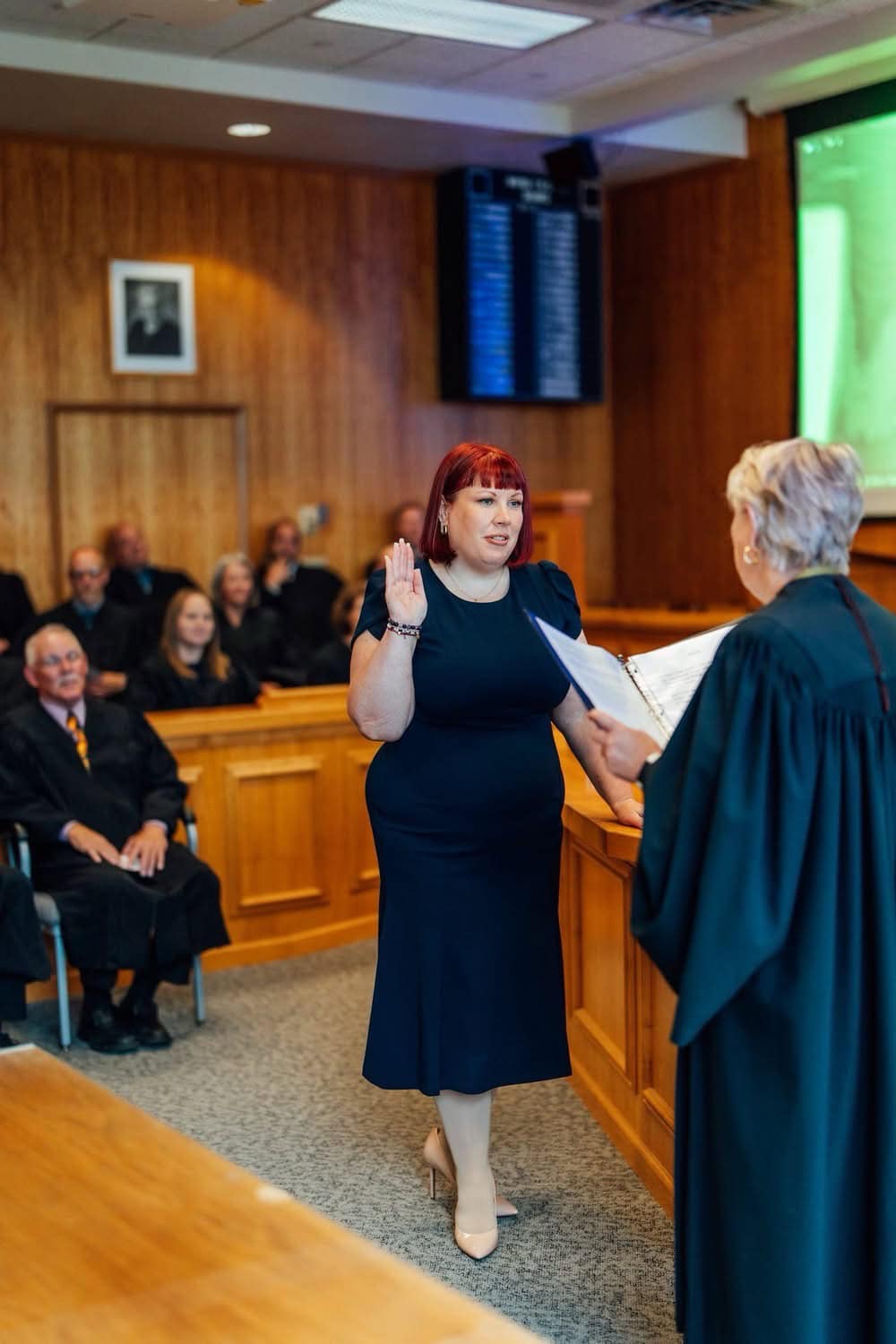
Judge Emily Nolan-Plutchak, appointed in 2025 by Governor Tony Evers, brings a nearly identical résumé to the bench. Like Fehrenbach, Nolan-Plutchak spent the better part of two decades—approximately 18 years—as a public defender. She, too, was celebrated as the first female circuit court judge in her county’s history.
Like Fehrenbach, she has signaled her alignment with Wisconsin’s progressive wing of the legal and political establishment. Nolan-Plutchak—whose application to the bench highlights more than 20 years of Democratic Party political activism, including campaigning for Tammy Baldwin, Barack Obama, Joe Biden, and Kamala Harris—also endorsed liberal Supreme Court candidate Chris Taylor and was sworn in at her investiture by outgoing liberal Supreme Court Justice Ann Walsh Bradley.
The parallels are difficult to ignore.
Both judges rose from long careers defending criminal offenders. Both now sit on the bench in counties where voters have historically taken a far more conservative view on law and order. In the most recent presidential election, Donald Trump carried Lincoln County by roughly 25 points and Wood County by nearly 20.
Yet the key difference between these two situations may prove decisive.
Fehrenbach faced no opposition when she ran for the bench in 2025. Voters were never given a choice.
Wood County voters, however, are.
Nolan-Plutchak is being challenged by Elizabeth Gebert, the former Republican district attorney of Langlade County. Gebert’s background as a prosecutor offers a clear contrast—not just in résumé, but in perspective. Where public defenders are trained to advocate for the accused, prosecutors are tasked with protecting victims and upholding public safety.
That distinction matters.
Judges wield enormous discretion in bail, sentencing, and supervision decisions. Those decisions are not abstract. They determine, in very real terms, who remains behind bars—and who is released back into the community.
The Water Street case underscores what can happen when that discretion is exercised without sufficient regard for risk.
As former public defenders, both Fehrenbach and Nolan-Plutchak have spent years working within a system focused on defending the accused. That experience can be valuable—but it can also shape how judges view accountability and risk.
In a candidate primer by the Wisconsin Justice Initiative, Nolan-Plutchak described the biggest barrier to “true justice” as a lack of defense attorneys. She also suggested that judges should take a more active role in addressing broader social issues like addiction, arguing that judges should move beyond a reactive role toward one of “leadership and support” in solving these problems.
To be clear, no single decision exists in a vacuum, and no judge can predict the future with certainty. Public defenders serve an important role in the justice system, and many go on to become fair and capable jurists.
But when patterns emerge—when judicial philosophy consistently leans toward leniency in cases involving serious concerns—voters have a responsibility to take notice.
What happened in Milwaukee was not just a local story. It was a reminder of the stakes involved in judicial elections, even in communities far removed from the state’s largest cities.
Wood County now stands at a crossroads.
The choice before voters is not about personalities or résumés alone. It is about the direction of their local justice system—and whether it will prioritize second chances above all else, or balance those considerations with a firm commitment to public safety.
Unlike Lincoln County, Wood County has the opportunity to make that choice at the ballot box.
The question is whether voters will.
