


In a special guest column for The Heartland post, the Wisconsin Institute for Law & Liberty’s Will Flanders illustrates just how much property taxes will increase in just a few short years if this state doesn’t change course.
Over the past couple years, Wisconsin liberals have presented a Christmas list of new education spending ideas. Governor Evers’ snowballing 400-year veto. A proposed repeal of Act 10. A school funding lawsuit demanding (among other things) increases to district revenue limits. All of these ideas have negative implications for Wisconsin taxpayers. But what would they actually cost if implemented?
Recently, the Wisconsin Institute for Law & Liberty answered this question with an analysis of how these proposals could affect property taxes for Wisconsin residents. Taken together, these plans would significantly increase property taxes that are already the 10th highest in the nation.
The first issue, the possible repeal of Act 10, is a major cost driver. Although Act 10 has been upheld multiple times in both state and federal courts, it was recently challenged again and is now awaiting action by the Court of Appeals. Several Democratic candidates for governor have also pledged to repeal the law if elected.
As discussed in our report on this topic last year, restoring collective bargaining rights could lead to significantly higher compensation for public school employees. Estimates suggest that returning to pre-2011 compensation levels would require an average increase of about $17,000 per employee, resulting in approximately $1.6 billion in additional costs for school districts and another $500 million for local governments. These increased costs would likely be passed on to taxpayers over time.
The second factor, the “400-year veto,” refers to Governor Evers’ controversial use of his partial veto powers that allows school districts to raise property taxes incrementally until the year 2425. Lawmakers originally approved a two-year increase of $325 per pupil per year, but the Governor used selective deletions to extend that increase for an additional 400 years.
It’s important to emphasize that this mechanism snowballs annually, meaning the financial impact grows over time. By 2030, estimates suggest that the veto could allow an additional $2,600 in revenue per student across districts, contributing further to rising in taxpayer costs.
The third component involves changes to school revenue limits. School revenue limits are state-imposed caps on the total amount of money a district can raise from state aid and local property taxes combined, on a per-pupil basis. These limits have been largely credited with keeping a lid on Wisconsin’s already high property tax burden.
However, a recent lawsuit brought by several public-school districts, teacher unions and taxpayers, along with related policy proposals, argues that current limits have not kept pace with inflation and should be increased. Increasing these limits to match 2010–11 inflation-adjusted levels would require about $3,190 more per student on average. While proponents see this as necessary for “adequate” school funding, other forms of state aid have increased since 2010 that largely make up for any inflation-adjusted decreases in revenue limit authority.
To illustrate these combined effects, we at the Wisconsin Institute for Law & Liberty introduced an interactive calculator that estimates potential property tax increases by 2030. It provides two scenarios: one in which the state increases aid to offset some of the costs, and another in which local taxpayers bear the full burden. Even in the more optimistic scenario, it is important to note that taxpayers ultimately still pay through other forms of taxation, such as state income taxes.
To illustrate the extent of costs we’re talking about, below we highlight projected cost increases on a $300,000 home in various parts of the state. These represent a “best case” scenario for homeowners where state aid is also increased.
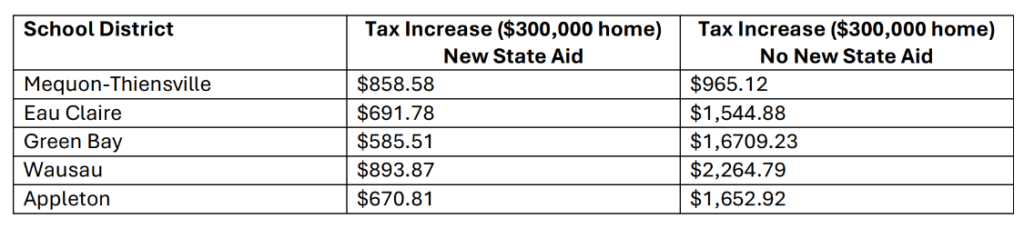
Home ownership is already a struggle for many young families in today’s housing market. It is not an exaggeration to say that the dramatic tax increases under these plans might put that dream out of reach for many.
These policy changes could undo over a decade of fiscal restraint and return Wisconsin to a position of having some of the highest property taxes in the nation, but none of this is set in stone yet. A recent poll of parents by WILL and 50Can showed that a majority of parents think education spending is “enough” or “too much” when told how much is actually spent per student in the state.
And a recent Marquette Poll showed that respondents are no longer as willing to trade property tax increases for more school funding. If voters are already fed up, our calculator makes clear that proposals guaranteed to further increase property taxes are a political loser. The key is making sure voters understand that there is no such thing as a free lunch when it comes to education spending.
Will Flanders. PhD, is the Research Director at the Wisconsin Institute for Law & Liberty (WILL)
