



David Crowley wants to repeal Act 10 in full. That would dismantle one of Wisconsin’s most important controls on government labor costs and reopen decisions about wages, pensions and health insurance that state law has kept largely outside of collective bargaining for 15 years.
Mr. Crowley has been explicit about who would gain power from that change. He has said far less about who would bear its cost.
That silence is striking from a candidate who has made affordability the centerpiece of his campaign. Mr. Crowley is not offering a symbolic objection to a law passed 15 years ago. He is genuinely promoting its repeal as part of his governing agenda. Wisconsin businesses and taxpayers deserve to understand what that promise could cost before it becomes policy.
Act 10 is usually framed as a law resulting from wage and benefit disputes between public employees and government officials, but that framing leaves out the people who ultimately finance whatever agreement is negotiated.
Taxpayers and business owners do not get a seat at the negotiating table, but they will be asked to finance the result through property taxes, lease expenses and other taxes.
Before Act 10’s passage in 2011, public-sector unions could bargain over wages, pensions, health insurance,and other employment conditions. The 2011 law limited bargaining for most public employees to base wages, with negotiated increases above inflation generally requiring voter approval. It also required many employees to contribute more toward their pensions and health insurance.
Those provisions gave school districts, municipalities and counties greater control over personnel costs. Mr. Crowley’s platform calls for restoring “full collective bargaining rights,” and after a July court decision he promised to “repeal Act 10 in full.”
Full repeal is a clear political promise rooted in bad fiscal policy.
The potential scale becomes apparent with health-insurance contributions alone. Act 10 generally requires state employees to pay at least 12.6% of the average costof their premiums.
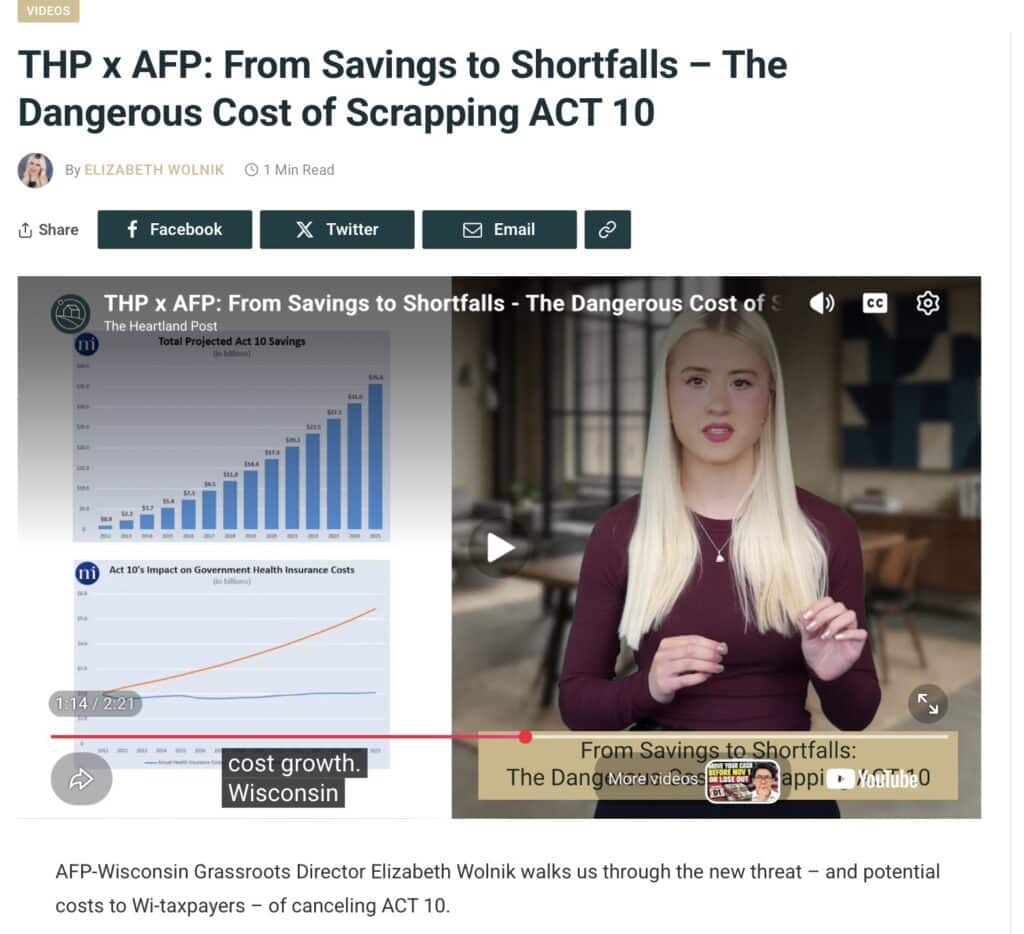
Applied to a $10 million annual premium bill, that employee share equals $1.26 million. No future contract is predetermined, but shifting even one benefit expense can reach seven figures before wages enter the discussion.
A promise to restore bargaining power is also a promise to change who has leverage over public money.
A manufacturer must pay its property-tax bill after losing a major order. A restaurant tenant pays property taxes through its lease to a landlord but increases in food, labor and utility costs squeeze its margins. Money committed to taxes is unavailable for payroll, equipment, or expansion.
Mr. Crowley’s Milwaukee County record shows how he responds when government obligations exceed available revenue. As county executive, he helped negotiate an agreement under Act 12, which gave Milwaukee County additional taxing authority. He then supported increasing the county sales-tax rate from 0.5% to 0.9%, effective in 2024..
After an 80% tax increase under Crowley’s leadership, Milwaukee County now has the highest county sales tax in Wisconsin. Mr. Crowley has also signed county budgets that increased Milwaukee County’s property-tax levy five times.
What do taxpayers have to show for it? Today, Milwaukee County is still staring down a projected $50.8 million budget gap. Now, Mr. Crowley wants to lead the state and repeal the law that helps local Wisconsin governments control labor costs.
The pattern is difficult to miss. When government spendingoutran revenue, Mr. Crowley supported higher taxes. Repealing Act 10 would weaken restraints on another major public expense before officials face the familiar choice among tax increases, service reductions and more state aid.
For businesses, none of those options is painless. Higher sales-tax rates increase the final price customers pay, require customers to to postpone purchases, or even to drive them to move elsewhere. Property taxes arrive as fixed bills or lease expenses even when sales and profits fall.
A manufacturer must pay its property-tax bill after losing a major order. A restaurant tenant pays property taxes through its lease to a landlord but increases in food, labor and utility costs squeeze its margins. Money committed to taxes is unavailable for payroll, equipment, or expansion.
Using additional state aid to finance the costs is often brought up as a solution, but that would only transfer the expense to the taxpayer-funded state budget. Government can move a cost from one tax bill to another, but that does not make the cost disappear for the taxpayers.
Mr. Crowley has told public-sector unions what they could gain from repealing Act 10. Wisconsin businesses and taxpayers will not negotiate the contracts, approve the terms or sign the agreements.
But they will be told to pay the bill.
Amy Loudenbeck is the State Director of Citizens for Free Enterprise.
