


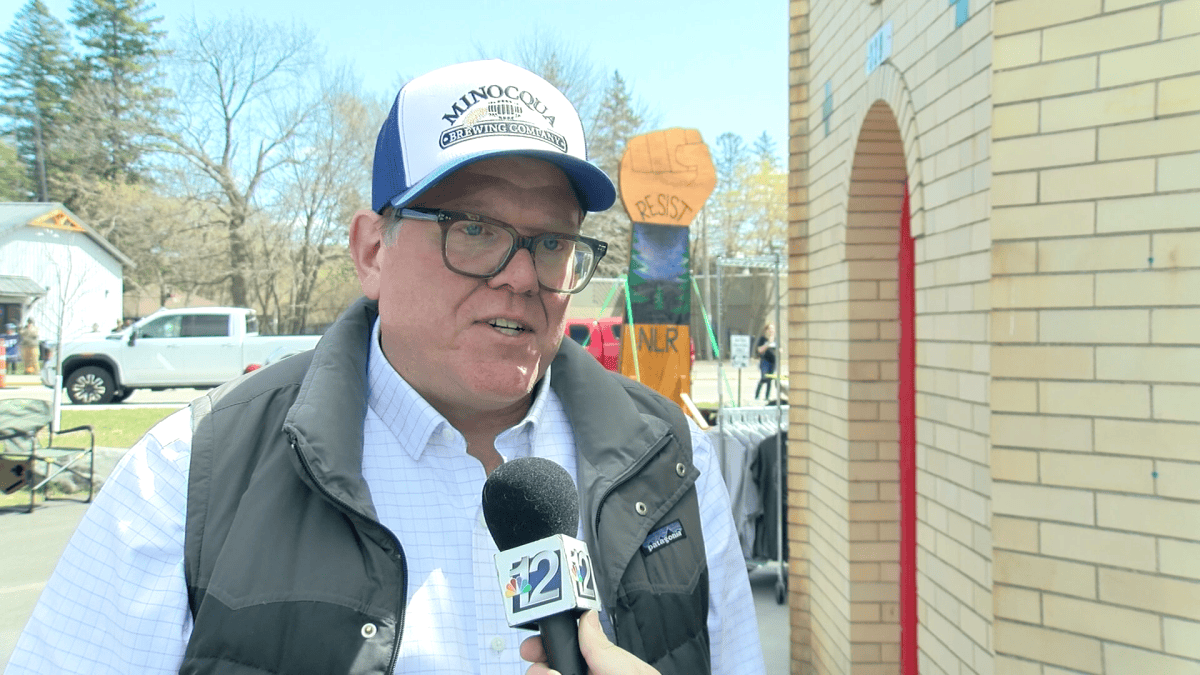
Just weeks after Democratic insiders reportedly discussed challenging his nomination papers, gubernatorial candidate Kirk Bangstad has been denied a speaking slot at next weekend’s Wisconsin Democratic Party convention.
Bangstad, the owner of Minocqua Brewing Company who has promised free beer the day Trump dies, filed enough nomination signatures on Monday to qualify for the Democratic gubernatorial primary ballot. Yet according to multiple campaigns, Bangstad was not included in the speaking lineup announced by the party for the June 14 convention in Madison.
The candidates scheduled to address delegates are Lt. Gov. Sara Rodriguez, former Department of Administration Secretary Joel Brennan, Milwaukee County Executive David Crowley, state Sen. Kelda Roys, former Lt. Gov. Mandela Barnes, state Rep. Francesca Hong, and former Wisconsin Economic Development Corporation CEO Missy Hughes.
The decision to deny Bangstad a speaking slot at convention comes on the heels of reports from WisPolitics that Democratic insiders were already exploring ways to challenge Bangstad’s nomination papers and potentially remove him from the ballot altogether. Those challenges can still be filed through June 4.
Bangstad, in an interview with WISN’s Matt Smith, previously vowed “I will win the primary if they don’t let me speak” and promised to “speak outside the front door” of the convention hall if he was denied a spot on the stage. That prediction may now get tested.
The efforts on the part of Democrat Party insiders to silence Bangstad are not happening in isolation. Across the country, the Democrat establishment has increasingly found themselves at odds with insurgent progressive candidates who refuse to stay within the party’s preferred ideological and political boundaries and whose rhetoric and personal actions pose serious political challenges this November.
In Wisconsin, reports have circulated of party insiders working behind the scenes to derail Francesca Hong’s gubernatorial campaign amid concerns about her viability in a general election. Within the last two weeks, stories have come out about Hong’s past comments calling for defunding and abolishing the police, as well as her ideal world without prisons.
Meanwhile, in Maine, Democratic leaders spent months trying to clear the field for then-Gov. Janet Mills rather than the Bernie Sanders-endorsed candidate Graham Plantner. Even after Plantner surged to the front of the race, party operatives continued searching for alternatives as a series of controversies engulfed his campaign, including revelations about explicit text messages sent while married, resurfaced social media posts, and scrutiny over a tattoo linked to Nazi imagery.
In the wake of the recent scandal, Janet Mills–who had suspended her campaign against Platner–reminded voters that she is still on the ballot.
For a party that frequently campaigns on protecting democracy and expanding participation, the optics are difficult to ignore.
First came discussions about challenging Bangstad’s ballot access. Now comes his exclusion from the convention stage.
Whether Democratic leaders ultimately move forward with a formal challenge to Bangstad’s nomination papers remains to be seen. But as the June 4 challenge deadline approaches, the party establishment continues to look less like a neutral referee and more like an active participant in shaping the outcome of its own primary.
And for Bangstad, that may be exactly the argument he wants to make.
