


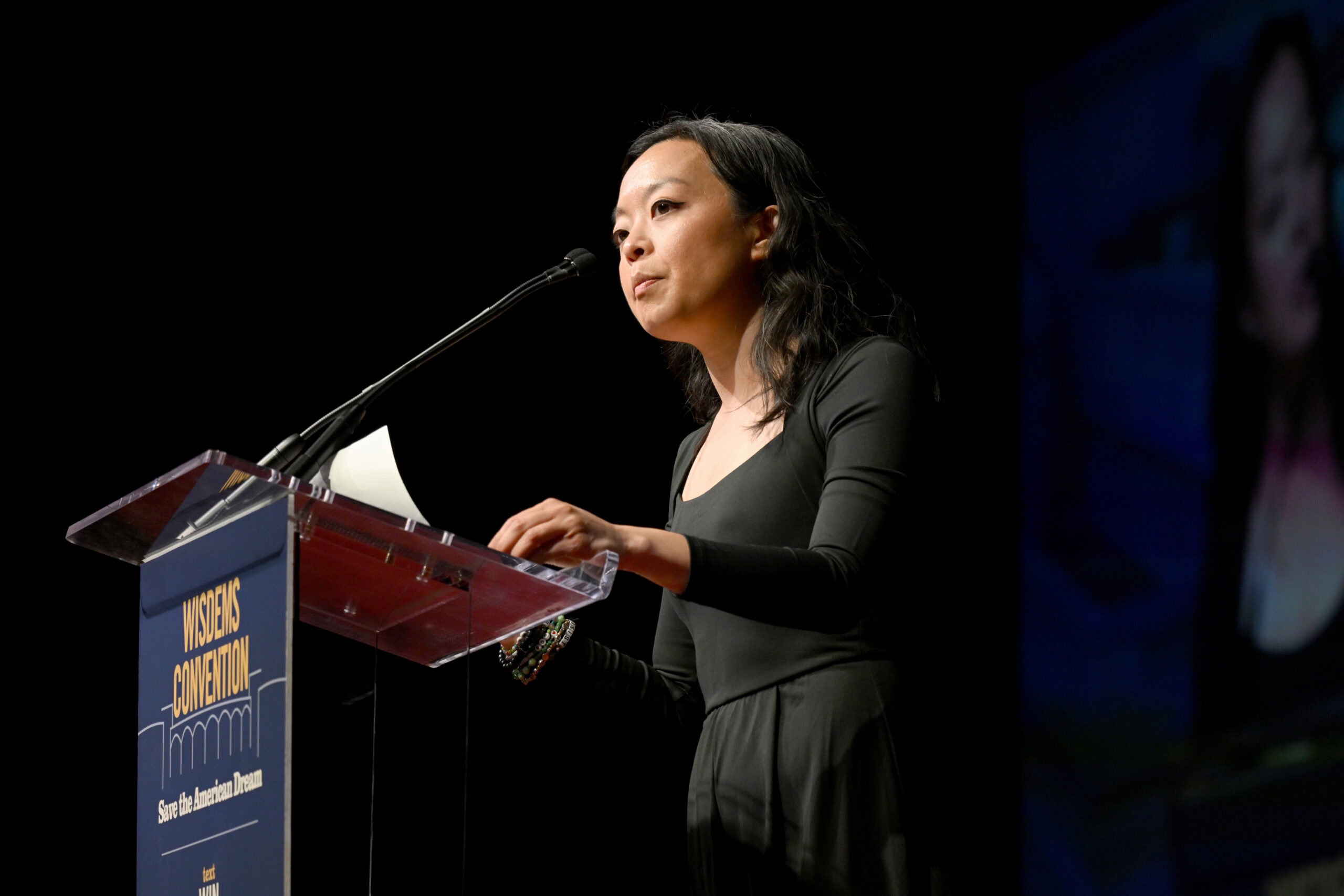
For months, Wisconsin Democrats have quietly searched for a strategy to stop Francesca Hong.
The Madison assemblywoman’s rise from little-known Democratic Socialist to frontrunner for governor has forced party leaders, donors, and rival campaigns to grapple with a question they never expected to ask: What happens if the Democratic Socialist actually wins?
That question extends well beyond the August primary.
Across the country, Democratic Socialists and DSA-backed candidates have steadily expanded their influence within the Democratic Party. They have knocked off establishment incumbents in states like New York and Colorado, while DSA-backed Michigan Senate candidate Abdul El-Sayed has emerged as the likely favorite in that key primary. Wisconsin is increasingly viewed as the next proving ground. A Hong victory wouldn’t simply reshape the race for governor—it would signal that Democratic Socialism has broken through in the nation’s premier swing state.
That prospect has Democrat insiders deeply uneasy. The problem is that recognizing the threat has turned out to be much easier than figuring out how to stop it.
For months, Hong has defied nearly every conventional rule of modern political campaigns. Once dismissed as an ideological longshot, she has built one of the most energetic grassroots operations in the race while relying heavily on recurring small-dollar donations instead of corporate PAC money and traditional establishment fundraising networks.
At the same time, she has dominated the one commodity every political campaign covets: earned media.
While her opponents spend hundreds of thousands of dollars introducing themselves through television commercials and digital advertising, Hong has become one of the most talked-about candidates in the country without spending a single cent (at the time of writing this) on TV ads. National media outlets have profiled her campaign. Political reporters continue to gravitate toward her candidacy because, whether they agree with her politics or not, she’s the story.
Francesca Hong has described both her campaign and the current state of Democrat politics nationally as a “movement moment.” While some may shrug this off as corny campaign jargon, it provides insight into why her campaign has been able to defy the odds thus far and why the criticisms of her candidacy have struggled to land amongst an increasingly progressive and socialist primary base.
Candidates can be attacked. Movements are much harder to attack.
Her past support for abolishing police and prisons generated headlines but has done little to slow her momentum. Stories highlighting her personal credit card debt arguably made her more relatable to younger voters than less. Criticism surrounding her appearances with controversial online personalities sparked backlash in some corners of the party, but it also reinforced Hong’s image among supporters as an anti-establishment candidate under siege from party insiders.
Whether intentional or not, many of these attacks have validated the very argument Hong has been making throughout the campaign—that the Democratic establishment is determined to stop a movement it cannot control.
That reality helps explain one of the most fascinating dynamics of this race. The candidates best positioned to stop Hong increasingly seem unwilling to confront her directly.
Take Lt. Governor Sara Rodriguez.
Rodriguez has largely built her campaign around electability, presenting herself as the Democrat best positioned to defeat Republican Tom Tiffany in November. Yet when recently asked whether she still believed Hong faced electoral challenges in a general election—a concern Rodriguez herself had previously voiced in hot mic comments—she softened her position, suggesting that every Democrat in the field could win.
For a candidate whose central argument is that she offers Democrats their best chance in November, it was an astonishingly weak answer.
The same pattern emerged following Hong’s appearances with Hasan Piker and Mike From PA. While Milwaukee County Executive David Crowley and State Senator Kelda Roys publicly criticized Hong’s decision to appear alongside the controversial online personalities, Rodriguez largely stayed out of the fight.
Former Lt. Governor Mandela Barnes finds himself caught in a different version of the same dilemma.
Barnes entered the race hoping to bridge two worlds. To establishment Democrats, he offers statewide name recognition and experience as a former lieutenant governor and U.S. Senate nominee. To progressive activists, he remains one of the most recognizable figures on the party’s left.
The problem is that Hong increasingly occupies the lane Barnes once expected to dominate.
An aggressive campaign against Hong risks alienating the progressive grassroots Barnes would almost certainly need if the race narrows. Remaining largely silent, however, allows Hong to continue consolidating those same voters. At the same time, Barnes has increasingly focused his criticism on Rodriguez, hoping to emerge as the consensus alternative should establishment Democrats eventually consolidate behind a single candidate.
Rather than aggressively prosecuting the case against the current frontrunner, both Rodriguez and Hong increasingly seem focused on winning the battle to become the establishment’s preferred alternative if Hong ever stumbles.
Republican political observers have seen a similar dynamic play out within their own party in the not-so-distant past.
During the 2016 Republican presidential primary, party leaders struggled to contain Donald Trump as his insurgent campaign gathered momentum. Every conventional attack—whether centered on temperament, controversial statements, or electability—often reinforced Trump’s argument that the political establishment feared him because he threatened the status quo.
Francesca Hong is obviously a very different candidate with a different ideology. But the campaign dynamic bears a resemblance, as both candidates centered their campaigns on populist ideals, anti-establishment sentiment, and working class struggles. Her supporters increasingly view criticism from party insiders not as a reason to abandon her, but as confirmation that she’s challenging a political establishment resistant to change.
While Hong’s nomination is far from inevitable, the likelihood of her becoming the nominee grows with each day that passes. Absentee ballots have already hit mailboxes, and voters are beginning to make their decision. The next three weeks will be critical, and will ultimately determine whether Democrats can change the trajectory of this race—or whether the dynamics that have defined it become impossible to reverse.
The first major test comes on July 15, when campaign finance reports are released. Those filings will reveal which candidates still possess the financial resources to compete through the closing weeks of the primary. If one or more campaigns emerge with significantly less cash than expected, pressure to consolidate behind a single alternative will only intensify.
Hong’s report may be scrutinized more closely than anyone else’s. Unlike Rodriguez and Barnes, who have benefited from more traditional fundraising networks, Hong has built her campaign around recurring small-dollar donors and grassroots enthusiasm. She doesn’t need to outraise every establishment-backed rival dollar for dollar. But she does need to demonstrate that her grassroots coalition can generate enough financial support to sustain her momentum through the campaign’s final weeks.
One week later comes what may be the campaign’s most consequential public measurement: the next Marquette Law School poll. The last Marquette survey, conducted in mid-March, found Hong leading the field with 14 percent support while roughly 65 percent of Democratic primary voters remained undecided. Four months later, after months of campaigning and millions of dollars in spending, the July poll should provide the clearest indication yet of whether Hong has transformed attention into durable support—or whether the race remains far more fluid than many assume.
Finally, on July 28, the candidates will meet for what is currently the campaign’s only scheduled televised debate. It represents perhaps the last major opportunity for Hong’s opponents to reshape the race before voters begin making their final decisions.
If Hong posts another strong fundraising report, maintains her advantage in the Marquette poll, and emerges from the debate without significant damage, Democratic insiders may find themselves confronting a reality they have quietly feared for months.
The challenge facing Wisconsin Democrats has never been recognizing why Francesca Hong has become the candidate they most fear. The challenge is that, with time running short, they still haven’t discovered how to stop her without strengthening the movement that’s driving her campaign.
