


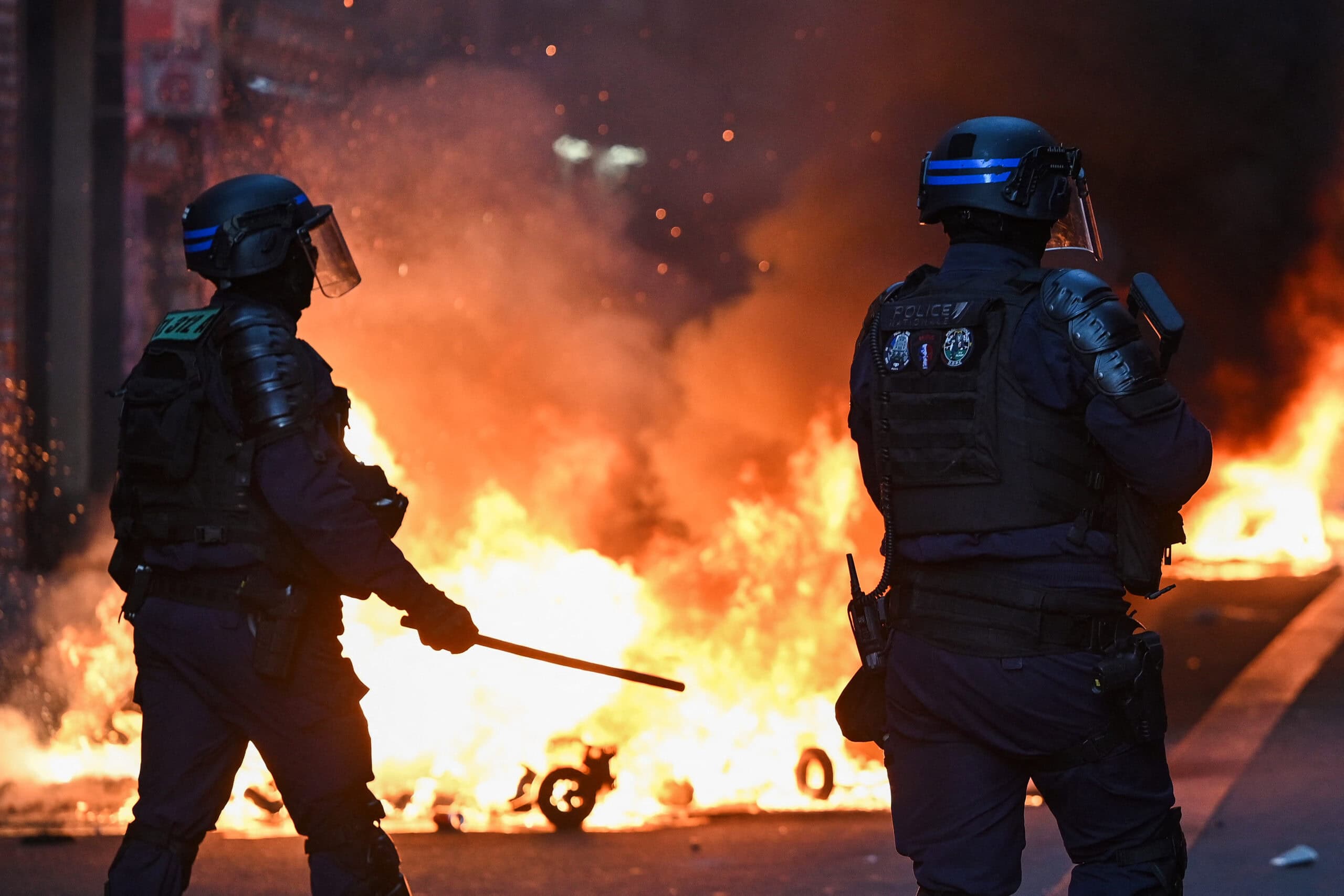
The images coming out of France are disturbing. Police officers facing violent crowds, emergency responders coming under attack, fires burning in the streets, and businesses caught in the chaos.
The officers behind those shields didn’t write the budgets, create the programs, or make the political promises fueling frustration. Yet they’re taking the abuse while politicians remain removed from the violence.
Some commentators prefer to call these scenes “civil unrest”, as though a softer phrase somehow makes the violence more acceptable. Let’s call it what it is. When people attack police officers, throw rocks, set fires, and destroy property, that’s not peaceful protesting. That’s rioting!
Peaceful protest is a fundamental right. Violence and destruction are not. We shouldn’t sanitize criminal behavior because it occurs during a demonstration.
But beyond the violence lies a much larger issue. What happens when a government makes promises to its citizens that it can no longer afford to keep? France may be providing us with a glimpse of the answer.
France has one of the world’s most extensive social welfare systems. Government-funded healthcare, retirement benefits, unemployment assistance, and housing subsidies are deeply embedded in French society. These benefits aren’t free. They’re financed through taxation, government borrowing, and the wealth generated by the country’s economy.
And therein lies the problem.
France’s public debt reached 115.6 percent of its gross domestic product in 2025, while government spending amounted to 57.2 percent of GDP. Government spending equals more than half the value of everything France produces annually. France now faces pressure to control deficits while maintaining the benefits and services citizens expect.
Peaceful protest is a fundamental right. Violence and destruction are not. We shouldn’t sanitize criminal behavior because it occurs during a demonstration.
That leaves politicians with some unpleasant choices. Raise taxes, cut spending, borrow more money, or some combination of the three. None are particularly popular.
France’s demonstrations involve grievances including education, living costs, and government policies. Not every protest or violent act can be blamed on welfare spending. Nevertheless, the country’s financial struggles expose a fundamental problem.
Governments can promise almost anything. Paying for those promises is another matter entirely. And once people become accustomed to receiving something from government, taking it away becomes politically explosive.
One school of economic thought helps explain this dilemma. It’s called the Austrian School of Economics.
Despite its name, it isn’t about modern-day Austria. These ideas emerged among economists in Vienna more than a century ago. Two of its most influential thinkers were Ludwig von Mises and Friedrich Hayek. This economic philosophy emphasizes free markets, individual liberty, private property, and limited government interference.
One central argument is straightforward. Government intervention can create unintended consequences that worsen the problems politicians intend to solve. Consider an expensive government benefit. Initially, people receive assistance, politicians receive praise, and the costs appear manageable.
Over time, that benefit becomes an expectation. Families, workers, and institutions make decisions around it. Eventually, economic reality catches up. Government must raise taxes, borrow more, reduce benefits, or cut spending elsewhere.
The problem isn’t necessarily that every government program fails. It’s that political promises create obligations that become extremely difficult to reverse. Mises and Hayek warned that intervention can distort incentives and interfere with how markets function.
Put simply, politicians can make promises, but they cannot legislate away the economic consequences.
Supporters of expansive social programs argue that these benefits provide security and reduce poverty. Those are legitimate considerations. But good intentions don’t eliminate economic trade-offs. France’s financial difficulties don’t prove welfare programs caused its riots. They do illustrate the risks of obligations that become harder to finance.
Before Americans dismiss France’s troubles as another European political crisis, perhaps we should examine our own finances. The United States has accumulated more than $40 trillion in federal debt. That’s trillion, with a T.
Washington continues spending considerably more than it collects. The federal deficit approached $2 trillion in fiscal year 2026, while interest payments consume an enormous portion of the federal budget. Meanwhile, Social Security and Medicare face serious long-term financing challenges.
Sound familiar? Like France, America has spent generations making financial commitments that future taxpayers are expected to honor.
Republicans and Democrats disagree about spending priorities, taxes, and government programs. Yet both parties have contributed to our growing debt. The uncomfortable truth is that government cannot indefinitely spend beyond its means without consequences.
Borrowing shifts costs into the future. Higher taxes can discourage private economic activity. Spending reductions create opposition among people who have come to depend on government programs. That doesn’t mean Americans receiving Social Security or Medicare are responsible for our fiscal problems. They’ve organized their lives around commitments made by their government, often after paying into those systems for decades.
The responsibility belongs to the politicians making those promises. And that brings us back to Austrian economics.
Prosperity doesn’t originate in government offices. It comes from people working, producing, investing, innovating, and voluntarily exchanging goods and services. America’s Founding Fathers understood the importance of limiting government power. Austrian economics emerged later, but its emphasis on liberty, property, and economic freedom shares ground with those principles.
The question isn’t whether government should do anything. It’s whether we’ve allowed government to promise more than our economy can reasonably support.
France’s riots aren’t justified by economic frustration or caused by any single policy. But its financial struggles warn of the consequences of promises that become difficult to fulfill. The police officers standing in France’s streets didn’t create those problems. They’re simply dealing with the violence erupting amid a frustrated society.
America still has an opportunity to confront its fiscal challenges through responsible policy and honest debate rather than waiting for a crisis.
Because sooner or later, economic reality collects on every political promise.
And when that bill finally comes due, it isn’t the politicians who bear the greatest burden. It’s the people.
Michael S. Murphy retired from the Milwaukee Police Department after 25 years of service, having previously served as a probation and parole agent with the Wisconsin Department of Corrections. He is a former chairman of the Wisconsin Republican Liberty Caucus and served as Fourth Congressional District vice chairman of the Republican Party of Wisconsin during Governor Scott Walker’s administration.
