


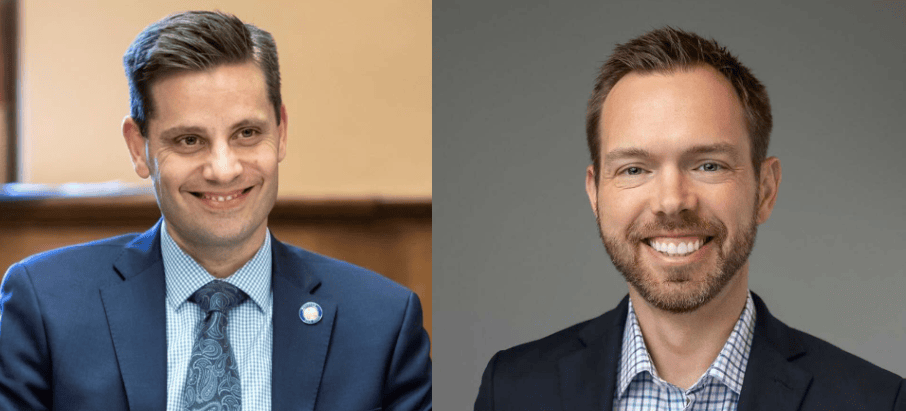
State Rep. Adam Neylon told a November 12 Business Alliance forum that Waukesha County is “run lean” and has no “mass bloat” to cut. State Sen. Chris Kapenga said that is “not true,” citing the fight over a county sales tax. Voters decide the special election December 15.
“I completely disagree that the county is run as efficiently as it could be. That’s not true, because otherwise we wouldn’t have fought the sales tax.”
Waukesha County’s next executive will inherit a $391.5 million budget. The two Republicans on the December 15 ballot disagree on whether that budget has fat left to cut.
At a November 12 Waukesha County Business Alliance forum, state Rep. Adam Neylon, R-Pewaukee, said the county is already tight.
“I truly believe Waukesha is run lean,” Neylon said. “I don’t find there to be a lot of waste and abuse. I’ve taken a close look at the budget, and we run lean. And when it comes to finding inefficiencies, I don’t think there’s just mass bloat anywhere that we’re able to come in and reduce.”
“My goal is to make things more efficient,” he said, “but I’m not going to tell you that we’re going to come in and be able to cut all this money because Waukesha County is run lean, and it will take time.” He said he is proud of the county board, interim County Executive Tom Farley, and staff who have upheld Paul Farrow’s legacy.
State Sen. Chris Kapenga, R-Delafield, rejected that reading. He pointed to the county’s recent push for a sales tax and to more than 30 years in private business.
“One of the main reasons I’m here is because the county got to a point where they didn’t know what to do,” Kapenga said. “They were saying financially, we’re not sure what to do, and so the solution was to raise taxes on people. So, I completely disagree that the county is run as efficiently as it could be. That’s not true, because otherwise we wouldn’t have fought the sales tax.”
He said he would “start looking at this stuff, just like I do with the businesses that we buy, and figure out what the priority should be.”
The special election will finish the term of County Executive Paul Farrow, who died July 7 at 61. Farrow had led the county since 2015. Farley, sworn in July 30, is not running. The winner serves until the April 6, 2027, spring election.
Farrow signed the $391.5 million 2026 budget in November 2025. It raised the property tax levy 1.79 percent to $117.6 million while the tax rate fell from $1.35 to $1.27 per $1,000 of property value. The county attributed the lower rate to tax-base growth. The budget also reduced levy-funded positions by 6.83.
Waukesha County is one of two Wisconsin counties, along with Winnebago, with no county sales tax on top of the state’s 5 percent rate. Farrow proposed a half-percent tax, then declared the plan “officially dead” on January 28, 2025. Both candidates oppose adding one.
At a Waukesha Young Republicans event in Sussex on November 19, Kapenga again tied the race to that fight. “Give me a chance to lead to show you that we don’t need to go raise the sales tax,” he said. “There is a lot of government that we don’t need to be doing, but the government we do need to do, we can do it really well, efficiently and effectively.”
Neylon, at the same event, said he would use his work on regulatory reform to “make sure Waukesha County is more efficient.” In an October 19 campaign release, he said, “Families and businesses make choices every day about what they can afford. County government should bring that same discipline to its budget.”
Both candidates confirmed after the November 12 forum that they would resign their legislative seats if elected. State law does not allow a legislator to hold both jobs. Voters will decide the race on Tuesday, December 15.
