


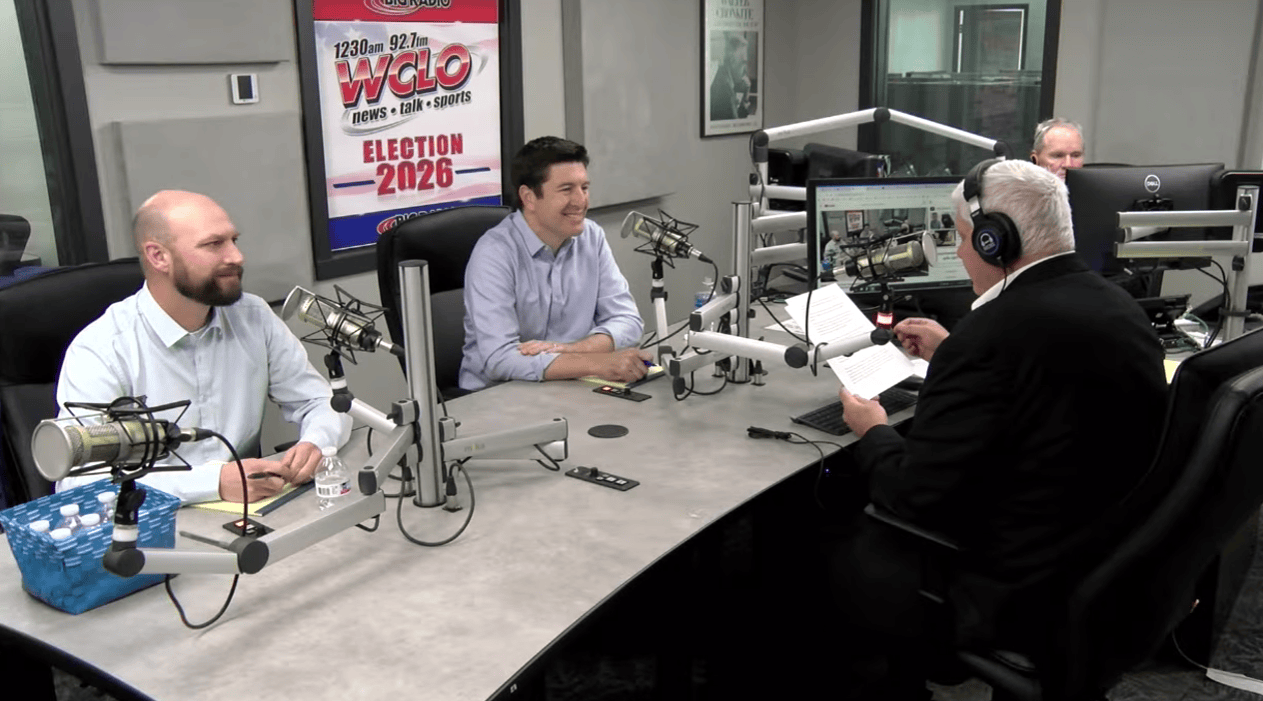
Republican U.S. Rep. Bryan Steil and Democratic challenger Mitchell Berman clashed over healthcare costs, federal spending, immigration, election integrity and the cost of living during an October 20 debate hosted by WCLO-AM 1230 in Janesville and moderated by Tim Bremel. Full Debate:
The debate gave the candidates opportunities to outline their priorities and challenge each other’s records ahead of the November election.
Steil, who won a coin toss to determine speaking order, opened by acknowledging that the “cost of living is too high,” while pointing to tax relief on overtime and tips, an expanded permanent child tax credit, and protecting Social Security and Medicare. He also emphasized the need to “continue our work to clean up Washington.” He discussed his manufacturing background in Rock County and fully understands the living wage and cost of living issues.
Berman, an emergency-room nurse who described growing up in a rural, working-class community and being the first in his family to graduate from college, said he understood what it meant to “struggle and live paycheck to paycheck.” He argued that healthcare had been “gutted” and accused Steil of working at the behest of corporate donors and special interests.
Cost of Living and Healthcare Dominate Exchanges
Asked to identify a specific policy that would improve constituents’ lives, Berman called the cost of living the top concern and urged lawmakers to “repeal these blanket tariffs.” He accused Steil of voting eight times to maintain tariffs, arguing that trade disputes with allies hurt consumers and farmers.
Steil agrees cost of living is too high and countered that he helped reduce the tax burden — no tax on tips, overtime, reduce taxes on social security, and made permanent and expanded the child tax credit for families. Steil said expanding domestic energy production were essential to lowering costs. He criticized the cancellation of the Keystone pipeline and called increased U.S. oil and gas production critical to reducing energy prices.
Berman questioned why tax relief was not permanent for everyone, arguing that the tax legislation favored billionaires while working families continued to struggle.
Healthcare produced some of the strongest positions throughout the debate.
Berman drew on his nursing experience, saying, “I’ve seen patients who cannot afford the medication we prescribe them,” putting their health at risk. He warned that federal healthcare cuts would affect communities across the district.
Steil defended his approach to Medicaid, arguing that he pushed to pass a law that increased funding by $1 billion, roughly 10% increase, and that changes were intended to return the program to its original purpose — preventing illegal immigrants taking advantage of the program, and putting place work requirement, and reinvested cost savings back into the Medicaid program. He accused Berman of trying to frighten voters rather than tell them the truth. Steil reiterated his position on a fully-funded Medicaid and Medicare programs and discussed legislation he backed to support this position. He also pointed to his record on pushing to increase investment in medical research.
Berman dismissed the administration’s approach as “putting a Band-Aid on a bullet hole.”
The candidates both supported Social Security and Medicare. Berman raised concerns about impending Social Security cuts and the need to fully fund Social Security offices. Steil called the programs essential and argued that rooting out “waste, fraud and abuse” was necessary to protect them for future generations.
Federal Debt, Elections and Campaign Money
On the national debt, Steil said the federal spending process had been broken for decades. He proposed changing the budgeting process, moving toward two-year budgeting, preventing government shutdowns and establishing a bipartisan debt commission.
Berman argued that Congress needed to act immediately, address the tax code and ensure billionaires paid their fair share. He criticized legislation he said had added trillions to the national debt and called for a budget that would not increase it further.
The candidates also sparred over election integrity.
Berman maintained that “our elections are free, fair and secure” and accused Steil of sowing mistrust in the system. Steil called for baseline election standards across all 50 states, including voter identification, citizenship verification, updated voter rolls and determining election results on Election Day.
Campaign financing prompted another exchange. Berman argued that special-interest spending should be removed from politics and emphasized grassroots contributions to his campaign. Steil accused Berman of taking corporate PAC money while running television advertising connected to corporate PAC spending. Berman repeatedly denied accepting corporate PAC money, but the evidence is clear on his tv ads that they were paid for by the DCCC PAC that supports democrat candidates.
Asked where they disagreed with their own parties, Steil called for accountability for any and all illegal actions and bipartisan cooperation, saying voters were frustrated with Washington’s “tone and tenor.” Steil said “no party has monopoly on good ideas” and would “work with anyone to get the job done.” He referenced his bipartisan work on housing legislation earlier this year and work to reform the spending process in Washington.
Berman cited disagreements with Democrats over former President Joe Biden’s border policies and criticized the party’s failure to make healthcare more affordable.
Immigration and Willingness to Compromise
On immigration, Berman called for a “safe, secure and strong border,” greater transparency and accountability in enforcement, and comprehensive immigration reform that includes a path to citizenship. He argued that people who follow the rules, pay taxes and keep their records clean should have an opportunity to obtain legal status.
Steil described both the illegal and legal immigration systems as broken. He advocated enforcing immigration laws, removing violent criminal illegal aliens and tying legal immigration more closely to workforce needs, including the seasonal labor demands and year-round needs for Wisconsin dairy farms. He also pointed to what he described as progress in reducing fentanyl and a sharp drop in crime stats across the country. He says an enforceable system for a legal pathway is necessary.
When asked how they would work with a Congress controlled by the opposing party, Steil said he would work with anyone willing to advance policies that benefit Americans. He cited his disagreement with the president over funding for the National Institutes of Health, emphasizing his support for healthcare and medical research funding. Steil referenced his record of serving as a staunch supporter of health care, notably both Medicaid and Medicare programs, and Social Security for those on fixed income like his 102-year-old Grandmother who often appears with Steil on the campaign trail.
Berman agreed that cooperation was necessary but said he would not compromise on “compassion and caring for people.” Drawing on his emergency-room experience, he emphasized ensuring people receive care even when political disagreements persist. He called healthcare his top priority and cited medical debt as a leading cause of bankruptcy.
Steil closed by accusing Berman of continuing to misrepresent his Medicaid position, describing his opponent’s campaign as “built on a stack of lies.” He returned to his central message of reducing the cost of living, expanding the child tax credit, protecting Social Security and Medicare, and continuing efforts to “clean up Washington.”
The debate highlighted the candidates’ competing approaches to economic policy and healthcare, with both seeking to convince First District voters that their priorities would better serve working families.
