



State Sen. Jodi Habush Sinykin is asking supporters to donate money so she can “stand up against big tech and defend our communities against data centers.”
Just a few years ago, however, Habush Sinykin authored legislation specifically designed to help bring a controversial data center project to her own district.
The contradiction is raising eyebrows in Ozaukee County, where a proposed data center in Port Washington has become one of the most contentious local political issues in recent memory.
In a recent fundraising email, Habush Sinykin warned supporters that “in 2025 alone, at least eight major data centers were approved or proposed across Wisconsin, and that number has continued to grow throughout 2026.”
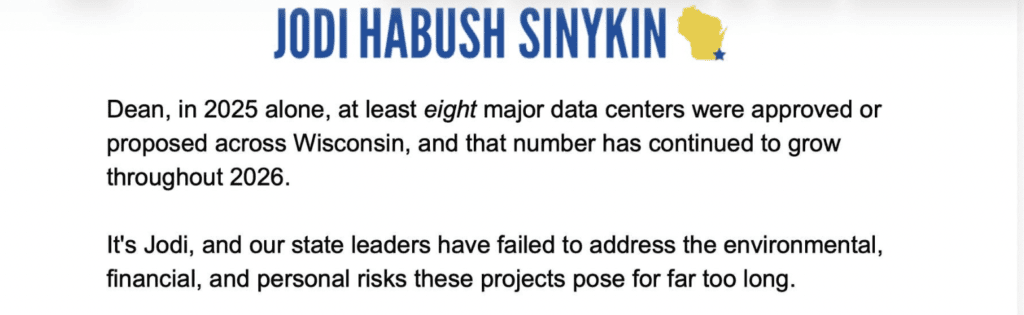
“Meanwhile big tech companies are pushing ahead with massive developments that threaten our environment, strain our energy grid, and drive up costs for Wisconsin families,” she wrote.
Habush Sinykin went on to claim that she is “fighting for stronger protections and a future where Wisconsin communities—not billion-dollar corporations—have a say in what happens in their own backyards.”
The email concluded with a direct fundraising appeal asking supporters to “chip in today to help us lead a grassroots movement that stands up against big tech and defends our communities against data centers.”

The problem? Habush Sinykin herself authored legislation creating a special exemption in state law for Port Washington’s proposed data center development.
The bill created a carveout from Wisconsin’s normal tax incremental financing restrictions, exempting Port Washington’s Tax Incremental District Number 5 from the state’s 12 percent TIF valuation cap. The legislation was sought because the scale of the proposed data center project would have pushed the city beyond the threshold otherwise allowed under state law.
At the time, the legislation was viewed as a critical step toward advancing the project.
Since then, public sentiment in Port Washington has shifted dramatically.
Opposition to the data center became so intense that activists launched a recall effort against Port Washington Mayor Ted Neitzke over his support for the project. Although organizers ultimately fell short of collecting enough signatures, the effort underscored the political backlash surrounding the proposal.
This spring, Port Washington voters approved a referendum restricting future data center development by roughly a two-to-one margin. National media outlets described the vote as the nation’s first anti-data-center referendum.
The issue carries particular political significance for Habush Sinykin because Port Washington sits within one of Wisconsin’s most competitive Senate districts. Habush Sinykin narrowly defeated former state Sen. Duey Stroebel in 2024 after millions of dollars poured into what became the most expensive state legislative race in Wisconsin history.
She will not face voters again until 2028, but the data center debate shows no signs of disappearing.
That leaves Habush Sinykin facing an increasingly uncomfortable political reality. As she seeks donations by promising to “stand up against big tech and defend our communities against data centers,” voters in her own district are being reminded that she previously authored legislation specifically designed to help clear the way for Port Washington’s controversial data center project.
In a district she won by a narrow margin in 2024, and one she will have to defend again in 2028, the question may not be whether voters oppose data centers. The question may be whether they believe Habush Sinykin’s newfound opposition is genuine.
