


There’s no other way to put it: Last Tuesday night’s election results were devastating. It’s hard to put into words the impact those results will have on Wisconsin and America as a whole. What a difference two years can make.
The 2024 presidential election seems like a lifetime ago, as do the feelings of elation that swept across the country on election night. Republicans reclaimed the U.S. Senate, retained control of the House, and Donald Trump returned to the White House with a decisive Electoral College victory, winning the popular vote as well. There was renewed hope for the country.
Americans had grown weary of the Biden-Harris administration. High inflation, soaring gas prices, foreign policy failures, and the ongoing crisis at our southern border had left voters frustrated and ready for change. In 2024, they delivered that change at the ballot box.
But two years later, the political winds had shifted once again.
Despite efforts to bring inflation under control, many Americans weren’t feeling relief quickly enough. Taking action against Iran after nearly 47 years of hostility may have been justified, but it came at a political cost as Americans were angry with soaring gas and diesel prices, and some remained reluctant to see America drawn into another foreign conflict that involved mixed messaging on the progress made and how long it would last.
And while tariffs were intended to create fairer trade relationships with other nations over the long term, they also contributed to higher prices on certain goods in the short term (there’s an economic lesson in there for Democrats regarding raising taxes on businesses). Several economic metrics actually improved under Trump including wages rising and the poverty rate dropping, but voters were less interested in wonkish economic arguments when they were still facing legit financial pressures.
And history was not on our side. Midterm elections have long presented challenges for the party in control of congress and the White House. Voters frequently use these elections to express their anger and dissatisfaction with the party in power, and 2026 was no exception. Candidates knocking on doors across Wisconsin were encountering a percentage of voters who were angry with the current state of affairs. The anger was coming from a percentage of people who had voted for Trump and Republicans in the past.
Some would end up voting Democrat. Some weren’t motivated to vote at all. And no matter how much we tried to redirect the conversation to what was at stake in Wisconsin—higher taxes/cost of living, school choice, “woke” and socialist policies, and harmful immigration policies—those messages weren’t resonating with enough voters the way they typically would. For some, their immediate frustration outweighed concerns about the long-term consequences of electing Democrats.
Putting Wisconsin’s Election Results Into Perspective
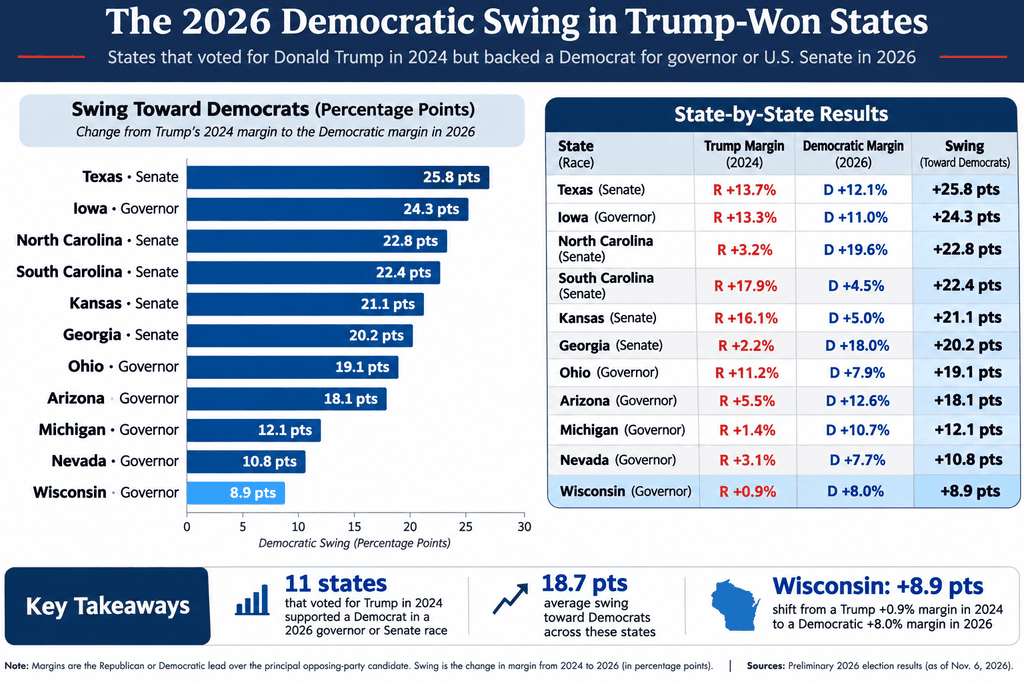
As disheartening as Tuesday night’s election results were in Wisconsin, it’s important to examine them in the context of what happened across the country. In 2024, Donald Trump carried Wisconsin by approximately 0.9 percentage points. Two years later, Democrat David Crowley defeated Republican Tom Tiffany in Wisconsin’s gubernatorial race by approximately 8 percentage points. That’s a shift of roughly 8.9 percentage points toward Democrats. On its face, that’s a significant shift. But Wisconsin was hardly alone.
Consider Florida, a state that has increasingly become a Republican stronghold. Donald Trump won Florida in 2024 by approximately 13.1 percentage points. Yet in 2026, Republican Byron Donalds won the governor’s race by just 1.3 percentage points, with 50% of the vote. That’s an approximately 11.8-percentage-point shift toward Democrats, an even larger movement than Wisconsin experienced.
Let that sink in.
Even Florida, a state many Republicans have come to regard as reliably red, experienced a substantial shift toward Democrats. Out of the 11 states that flipped from voting for Trump in 2024 to voting for Democrats in 2026, Wisconsin had the smallest shift. Texas shifted by 25.8 points!!
This doesn’t diminish the disappointment and negative impact of Wisconsin’s losses. But it does demonstrate something important: What happened in Wisconsin was part of a much broader national political movement, not simply a reflection of Wisconsin Republicans or our candidates.
The political environment was challenging across the country, even in states where Republicans have enjoyed considerably stronger electoral advantages. That perspective matters. We should always be willing to evaluate our strategies and learn from victories and defeats alike. But we should also recognize the political environment in which our candidates and volunteers were competing.
Wisconsin Republicans didn’t sit back and accept things were inevitable this election cycle. Between the Tiffany campaign and the Republican Party of Wisconsin, over 200 field staff were hired along with additional paid door knockers–over 1 million doors were knocked, and over $60 million was raised–outraising the Democrats 2/1.
Over 5,300 Republican poll workers were submitted and involved in facilitating our elections across the state. The assembly and state senate candidates worked harder than ever hitting doors and talking to voters repeatedly in areas that were highly contested.
We connected with a lot of voters across Wisconsin and built relationships and gathered voter data to help us in the future. And when Democrats (who will have total control of state government for the next two years) do the things we expect them to do, they will have to own every bad policy they implement and the consequences. And we must reach back out to those same voters and contrast the promises Democrats made to make things more affordable with the actual results they deliver over the next two years.
Learning From Defeat and Finding the Courage to Continue
So where do we go from here? I’m under no illusions that this will be easy. One of the challenges facing Republicans is defining who we are as a party and where we intend to go. For years, competing philosophies—from populism and traditional conservatism to libertarianism—have shaped internal debates and, at times, public divisions. Being a big-tent party is a strength, but only if we can find enough common ground on the core principles that bring us together.
To close, we cannot become despondent. I want to encourage us to reflect on what our founding fathers were up against before they won the war for independence.
Think back to December 1776.
Just months after declaring independence, the American Revolution was hanging by a thread. George Washington’s Continental Army had suffered devastating defeats. Soldiers were exhausted, supplies were scarce, morale was low, and the British appeared to have the upper hand. The dream of American independence seemed increasingly unlikely. It would have been easy to give up.
But they didn’t.
On Christmas night in 1776, Washington led his weary soldiers across the icy Delaware River in a daring attack that resulted in a much-needed victory at Trenton. Days later, another victory at Princeton helped restore hope to the American cause.
Those victories didn’t win the war immediately, but they demonstrated what courage and perseverance could accomplish when the odds seemed overwhelming.
It was during those dark days that Thomas Paine wrote The American Crisis, in which he wrote the following inspirational words to stir weary patriots to action:
THESE are the times that try men’s souls. The summer soldier and the sunshine patriot will, in this crisis, shrink from the service of their country; but he that stands by it now, deserves the love and thanks of man and woman. Tyranny, like hell, is not easily conquered; yet we have this consolation with us, that the harder the conflict, the more glorious the triumph. What we obtain too cheap, we esteem too lightly: it is dearness only that gives everything its value. Heaven knows how to put a proper price upon its goods; and it would be strange indeed if so celestial an article as freedom should not be highly rated…
I turn with the warm ardor of a friend to those who have nobly stood, and are yet determined to stand the matter out: I call not upon a few, but upon all: not on this state or that state, but on every state: up and help us; lay your shoulders to the wheel; better have too much force than too little, when so great an object is at stake. Let it be told to the future world, that in the depth of winter, when nothing but hope and virtue could survive, that the city and the country, alarmed at one common danger, came forth to meet and to repulse it. Say not that thousands are gone, turn out your tens of thousands; throw not the burden of the day upon Providence, but “show your faith by your works,” that God may bless you. It matters not where you live, or what rank of life you hold, the evil or the blessing will reach you all. The far and the near, the home counties and the back, the rich and the poor, will suffer or rejoice alike. The heart that feels not now is dead; the blood of his children will curse his cowardice, who shrinks back at a time when a little might have saved the whole, and made them happy. I love the man that can smile in trouble, that can gather strength from distress, and grow brave by reflection. ‘Tis the business of little minds to shrink; but he whose heart is firm, and whose conscience approves his conduct, will pursue his principles unto death.
What a powerful reminder of the spirit that gave birth to our nation. The American Revolution was not won by people who gave up when the odds turned against them. And the future of our republic will not be secured by citizens who only participate when victory seems assured.
We have work to do. And I, for one, am not giving up.
Because the future of Wisconsin, our country, and the generations who come after us is worth fighting for.
