


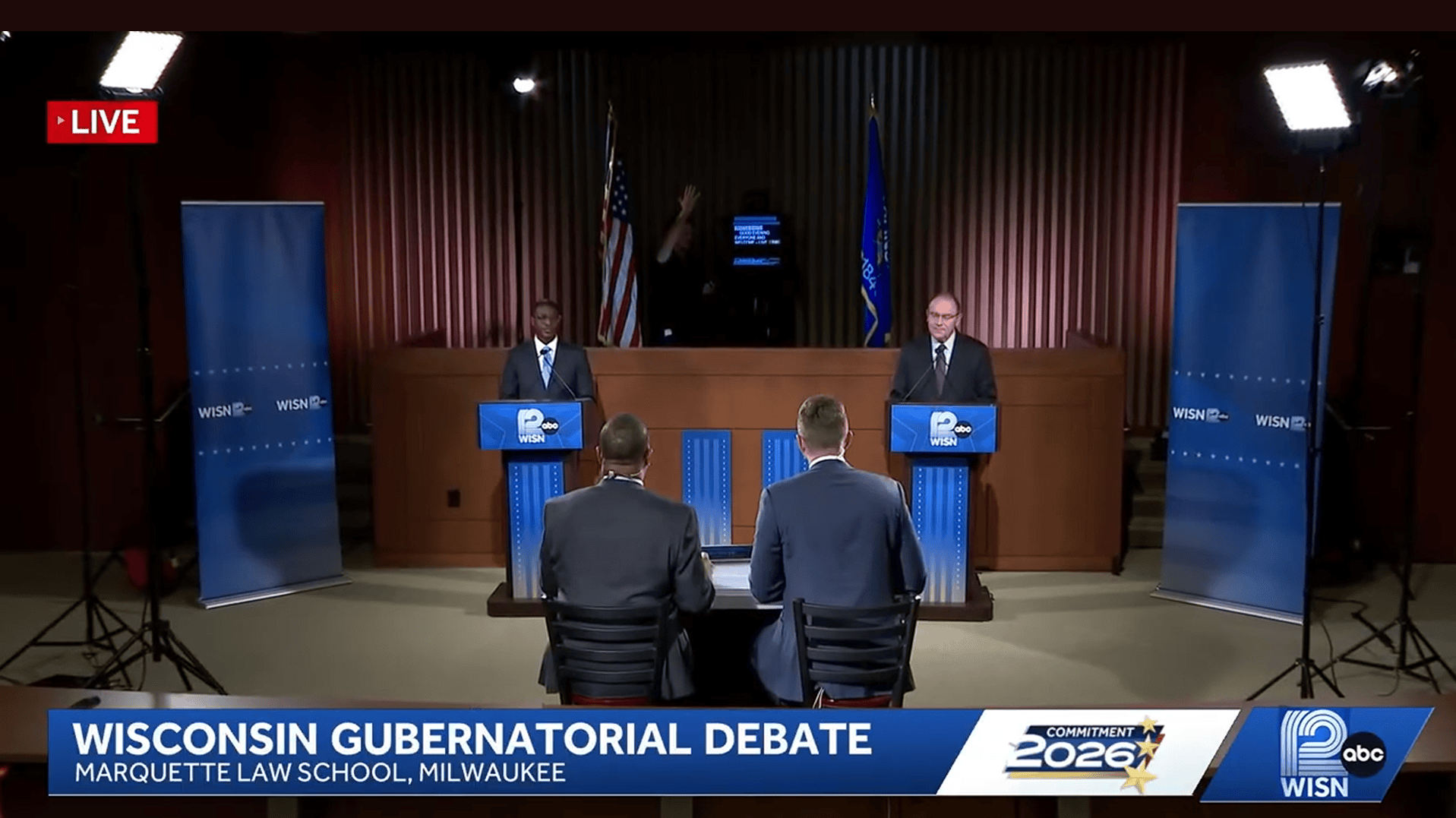
Republican U.S. Rep. Tom Tiffany prevailed in Wednesday’s sole debate against Democratic Milwaukee County Executive David Crowley as Crowley repeatedly failed to offer concrete answers and appeared to struggle with his delivery on key issues.
The hourlong event, hosted by WISN-TV at Marquette University Law School and moderated by Matt Smith and Gerron Jordan, covered taxes, school funding, abortion, transportation, election integrity, data centers, immigration enforcement and marijuana. With early in-person absentee voting underway and Election Day in less than two weeks, the debate offered the candidates their only direct comparison before voters.
And it was quite the comparison. Tiffany appeared confident and relaxed, while Crowley was agitated and relied heavily on obvious talking points while failing to offer specifics even when repeatedly pressed by the moderators.
On taxes and the state budget, Crowley did not answer whether he would create a new tax bracket for high earners or specify additional funding levels for schools. Instead, he spoke in general terms about working with lawmakers on a “fair” and “simpler” tax system and forming a commission to study school funding.
“We need to make sure that we have a fair tax system, a simpler tax system that allows people to get ahead,” Crowley said.
Tiffany, by contrast, outlined plans for income and property tax relief, including ending what he has called a “400-year” property tax increase enabled by the governor’s partial veto power, while arguing that recent spending growth and the state’s surplus would allow priorities such as education, transportation and health care to be funded without deep cuts.
Crowley similarly sidestepped a direct question on abortion. Asked if he would sign legislation expanding access with no limits, he did not answer yes or no, stating that such a measure was unlikely to reach his desk and that decisions belong between patients and doctors. He then launched into an anecdote that was largely unrelated to the question he had been asked and, when Smith pointed that out, Crowley responded: “No, no, let me finish my story.”
Tiffany said he would not sign a six-week ban, despite prior support for more restrictive measures in Congress, and pledged to maintain current Wisconsin law allowing abortions up to about 20 weeks.
On transportation funding, both candidates faced yes-or-no questions about new registration and title fees, tolling, and indexing the gas tax to inflation. Tiffany opposed all three. Crowley opposed indexing the gas tax but said he was open to user fees and tolling. Tiffany pointed to his experience on the Legislature’s Joint Finance Committee and said he would increase transportation funding through the budget process.
Crowley was noticeably nervous and seemed unprepared for the debate as he stumbled over his words throughout the hourlong event and steadfastly refused to offer any specifics no matter how many times he was asked.
Tiffany, by contrast, projected confidence and stayed focused on affordability–noting that Crowley had nearly doubled Milwaukee County’s sales tax. Crowley defended his record by saying the property tax rate had fallen each year of his tenure and that the largest property tax cuts in county history had been delivered while balancing the budget. Tiffany countered by pointing out that property taxes have risen every year Crowley was Milwaukee County Executive save for the year Crowley signed an ordinance raising the county’s sales tax from 0.5% to 0.9%.
Crowley’s campaign seemed to agree with the general consensus that he did not perform particularly well, as he did not come out to the spin room for a traditional post-debate press gaggle. Instead, the campaign sent out former Democratic Party of Wisconsin Chairman Ben Wikler.
WISN-TV said this was only the second time in its history of hosting gubernatorial debates that a candidate did not meet the media afterwards.
