



Southern Poverty Law Center’s (SPLC) educational arm Learning for Justice (LfJ), formerly Teaching Tolerance (TT), produced a unique set of Social Justice Standards based on Identity, Diversity, Justice, and Action domains. These standards frame education around the ideology of systemic injustice, power/privilege, and collective student action.
These are not neutral educational tools. Their lessons and documents appear throughout official Wisconsin Department of Public Instruction (DPI) education materials and are the backbone of Wisconsin Education Association Council (WEAC) Anti-Racist Toolkit website.
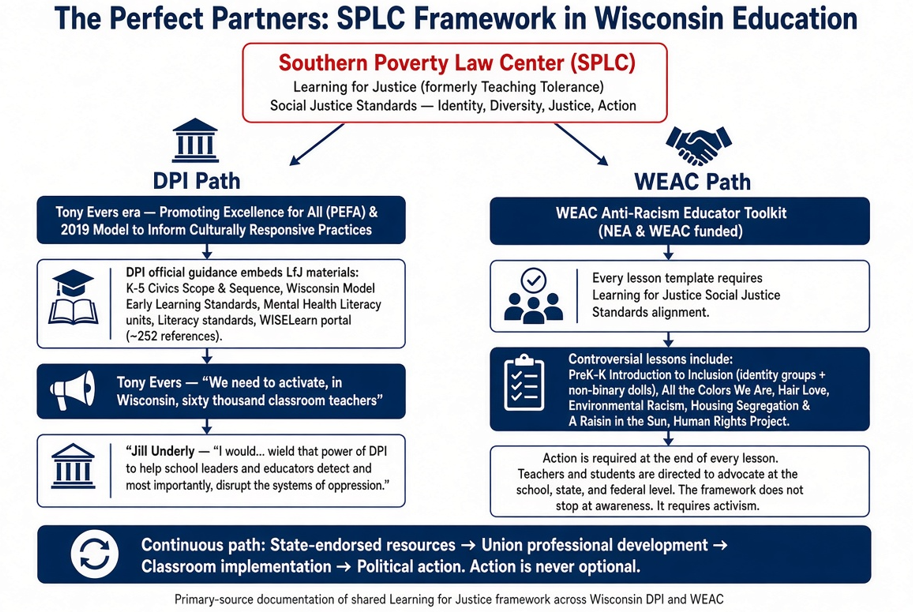
SPLC’s Learning for Justice framework is not on the perimeter of DPI or WEAC. DPI embedded SPLC materials as recommended state resources and early-learning/civics guidance. WEAC operationalized the identical Learning for Justice Standards into classroom lessons and union-driven action plans. Together they built the perfect partnership, until they didn’t.
Current State Superintendent Jill Underly has described the ideology in plain terms: the isms are “literally woven into everything in our schools,” and the role of DPI is to help educators “disrupt the systems of oppression.”
DPI and SPLC
Wisconsin Department of Public Instruction (DPI)
Site search results (April 2026): ~252 references total
– 118 for “Southern Poverty Law Center”
– 87 for “Teaching Tolerance”
– 47 for “Learning for Justice”
Then-State Superintendent Tony Evers launches Promoting Excellence for All (PEFA) as his top priority, a foundational equity (Diversity, Equity, and Inclusion) document that seeded what followed. The official 84-page task force report demands “color-conscious” strategies, “courageous conversations about race,” implicit-bias training, and race-based equity practices to close achievement gaps. PEFA Extended Learning Resources companion document, still hosted by DPI, explicitly lists SPLC’s Teaching Tolerance, now Learning for Justice, as a recommended equity resource for educators.
DPI, still under State Superintendent Tony Evers, develops and officially releases Wisconsin’s Model to Inform Culturally Responsive Practices (2019). This statewide equity (DEI) framework explicitly builds on PEFA as its foundational reference, citing the 2014 report multiple times for strategies on inclusive teaching, closing achievement gaps, and ensuring “every student is successful.”
The Model requires all Wisconsin educators to engage in ongoing implicit-bias self-reflection, “courageous conversations” on race and culture, and race-conscious teaching practices within culturally responsive multi-level systems of support. It became the required blueprint for teacher training, professional development, school policies, and classroom instruction across the state — directly institutionalizing the color-conscious equity approach (DEI).
DPI’s official “high-quality, standards-aligned” resource library WISELearn portal hosts multiple SPLC/Learning for Justice items. These resources present white privilege and systemic racism as ongoing and structural.
From “Racial Disparity in the Criminal Justice System”: “Racialized social control has adapted to race-neutral social and political norms in the form of mass incarceration. Criminalization stands in as a proxy for overt racism by limiting the rights and freedoms of a racially defined undercaste.” Big Idea / Essential Question: “How does mass incarceration function as a mechanism of racialized social control in the United States today?”
From Let’s Talk! guidance: “Learning how to communicate about such topics as white privilege, police violence, economic inequality and mass incarceration requires practice…”
From Teaching Hard History: “The first step is acknowledging your own position and privileges when addressing and discussing race…” During this training, teachers are instructed to model statements such as “As a white male who benefits from…” and notes that discussions “may include white guilt as well.”
DPI has gone even further embedding SPLC and Learning for Justice materials into official state documents. They appear in the following core guidance documents.
K–5 Social Studies/Civics Suggested Scope & Sequence, an official DPI PDF that lists five Learning for Justice resources as supporting materials, including for kindergarten with “Everyone’s a Helper”, second grade, and fifth grade with “Ten Myths About Immigration” explicitly credited to Learning for Justice through SPLC.
Wisconsin Model Early Learning Standards (WMELS) reference Teaching Tolerance publications. This material is used statewide from birth through grade 1.
Mental Health Literacy units (e.g., Grades 6–8) and Literacy in All Subjects standards cite Learning for Justice Social Justice Standards or Teaching Tolerance resources.
These materials remained listed after SPLC’s April 2026 federal indictment on fraud-related charges.
While DPI embedded the framework in official guidance, the state’s largest teachers union operationalized it.
WEAC and SPLC
WEAC, the state’s largest teachers union, has not been passive in its endorsement of SPLC materials. In June 2021, then-President Ron Martin issued an official statement defending the “Learning for Justice Curriculum of the Southern Poverty Law Center.” WEAC declared that educators “will not be bullied” by lawmakers restricting these materials and framed them as essential for teaching “systemic racial inequality.” WEAC’s teaching-resources page has continued to recommend SPLC/Learning for Justice materials for building “civil and inclusive school communities” and “teaching true history.”
WEAC hosts an Anti-Racist Educator Toolkit website that remains actively promoted on its website. The website was funded by the NEA and WEAC and is built directly on Learning for Justice Social Justice Standards.
One example is the lesson “Introduction to Inclusion (PreK–K),” designed for children ages 3–5. Its stated objectives include introducing the vocabulary words “equity” and “diversity.” The lesson is aligned to Wisconsin Academic Standards in Social and Emotional Development, Language Development and Communication, and Approaches to Learning. It is also aligned to SPLC Learning for Justice Standards, including:
- “I know and like who I am and can talk about my family and myself and name some of my group identities.”
- “I know some true stories about how people have been treated badly because of their group identities, and I don’t like it.”
Background guidance for the lesson states: “A common shortcoming of PreK/K curricula is to emphasize ‘color blindness,’ which excludes the explicit teaching and acknowledgement of non-white culture/racial groups and their experiences.” Materials listed for the lesson include “culturally inclusive manipulatives (e.g., dolls of all colors/non-binary…).” Assessments recommend pre- and post-testing on the targeted concepts and vocabulary, and note that “typically-developing peers also could be involved to help model and encourage the retention and repetition of learning concepts.”
Additional lessons available from WEAC include All the Colors We Are (PreK-4), Singing for Social Justice (MS), Hair Love (MS), Human Rights Project (HS), Environmental Racism (HS), Housing Segregation & “A Raisin in the Sun” (HS), Strategies for Multilingual Learners, and Addressing Hate Speech.
The toolkit applies the same Learning for Justice framework used in DPI guidance to children as young as three. Every lesson plan and template in the toolkit includes a required section aligning the lesson to SPLC Learning for Justice Social Justice Standards.
The WEAC Anti-Racist Educator Toolkit website also includes a resource list that recommends materials such as “Anti-racism resources for white people,” The 1619 Project, and “Math: Joy Buolamwini: How I’m fighting bias in algorithms.” These are not peripheral suggestions. They are presented as resources for educators’ personal growth and taking action.
Today
Today the apparatus is crystal clear.
DPI embeds SPLC Learning for Justice materials in core guidance — K–5 civics, early learning standards, mental-health literacy units, literacy standards, and the WISELearn portal. WEAC takes the identical standards and operationalizes them into classroom lessons, action-plan templates, and union-driven policy advocacy.
The result is a continuous path from state-endorsed resources to teacher training to classroom practice and political action. Action is never optional.
