


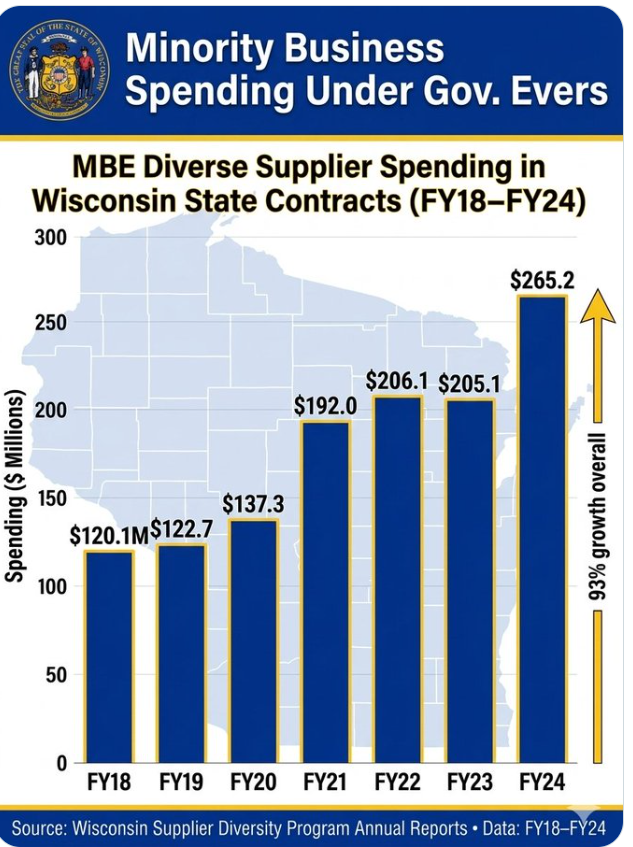
Minority business spending by Wisconsin state agencies has exploded under Democratic Gov. Tony Evers, reaching more than $265 million in the latest fiscal year, according to the state Supplier Diversity Program’s annual report.
The report indicates that spending with certified minority business enterprises (MBEs) rose from $120.1 million in fiscal 2018 to $265.2 million in fiscal 2024, representing a 93% increase. Annual totals increased steadily: $122.7 million in FY19, $137.3 million in FY20, $192 million in FY21, $206.1 million in FY22, $205.1 million in FY23, and $265.2 million in FY24.
Established in 1983, the state’s Supplier Diversity Program sets a 5% goal for purchases from minority- and disabled-veteran-owned businesses. Certified MBEs receive a 5% bid price preference on state contracts, enabling them to secure contracts if their bids are up to 5% higher than the lowest qualified offer. The program prioritizes non-white businesses in procurement decisions for goods, construction, architecture, and highway projects.
Attorney Dan Lennington of the Wisconsin Institute for Law & Liberty highlighted the surge in a post on X, formerly Twitter. “NEW: DEI Spending Exploding under @GovEvers,” Lennington wrote Friday. “Latest report reveals Evers Admin has boosted minority-business spending 93% to over $265M/year. The program prioritizes non-white businesses & gives them a 5% bid price preference on all state contracts.”
Conservatives argue that the race-based preferences waste taxpayer dollars and violate the colorblind principles of equal treatment. The program funnels public contracts to businesses based on owners’ race rather than merit or lowest cost, they say, echoing broader challenges to DEI initiatives nationwide.
Despite the program’s inclusion of disabled veteran-owned businesses (DVBs), 32 state agencies reported zero spending with them in the latest data. Critics say this underscores misplaced priorities: agencies aggressively pursue race-based goals for minority suppliers while sidelining service-disabled veterans who sacrificed for the country.
The spending surge comes as total state procurement exceeds $3 billion annually. In fiscal 2023, diverse suppliers claimed 6.09% of $3.37 billion in contracts, surpassing the 5% goal for the first time consistently under Evers. Several agencies directed more than 25% of their contracting dollars to diverse suppliers in prior years.
Wisconsin taxpayers foot the bill for these preferences through higher effective contract costs and the diversion of opportunities from non-minority businesses. Lennington and WILL have targeted the program in legal and policy efforts, calling it discriminatory and incompatible with equal protection under the law.
Evers administration officials have defended the initiative as a longstanding effort to expand opportunities for historically underrepresented firms. Yet the latest figures show minority spending accelerating far beyond earlier years, while no corresponding emphasis on veterans is evident across dozens of agencies.
Data from state agencies and University of Wisconsin System campuses indicate a clear policy shift. Since Evers took office in 2019, the program has delivered record funding to MBEs, while participation by disabled-veteran-owned businesses remains low across most agencies.
As debates over race-based government programs intensify, Wisconsin’s experience offers a case study in expanding DEI contracting. With spending now topping $265 million yearly and racial preferences baked into bidding rules, the state’s approach continues to draw scrutiny from those who favor merit-based, race-neutral procurement.
