


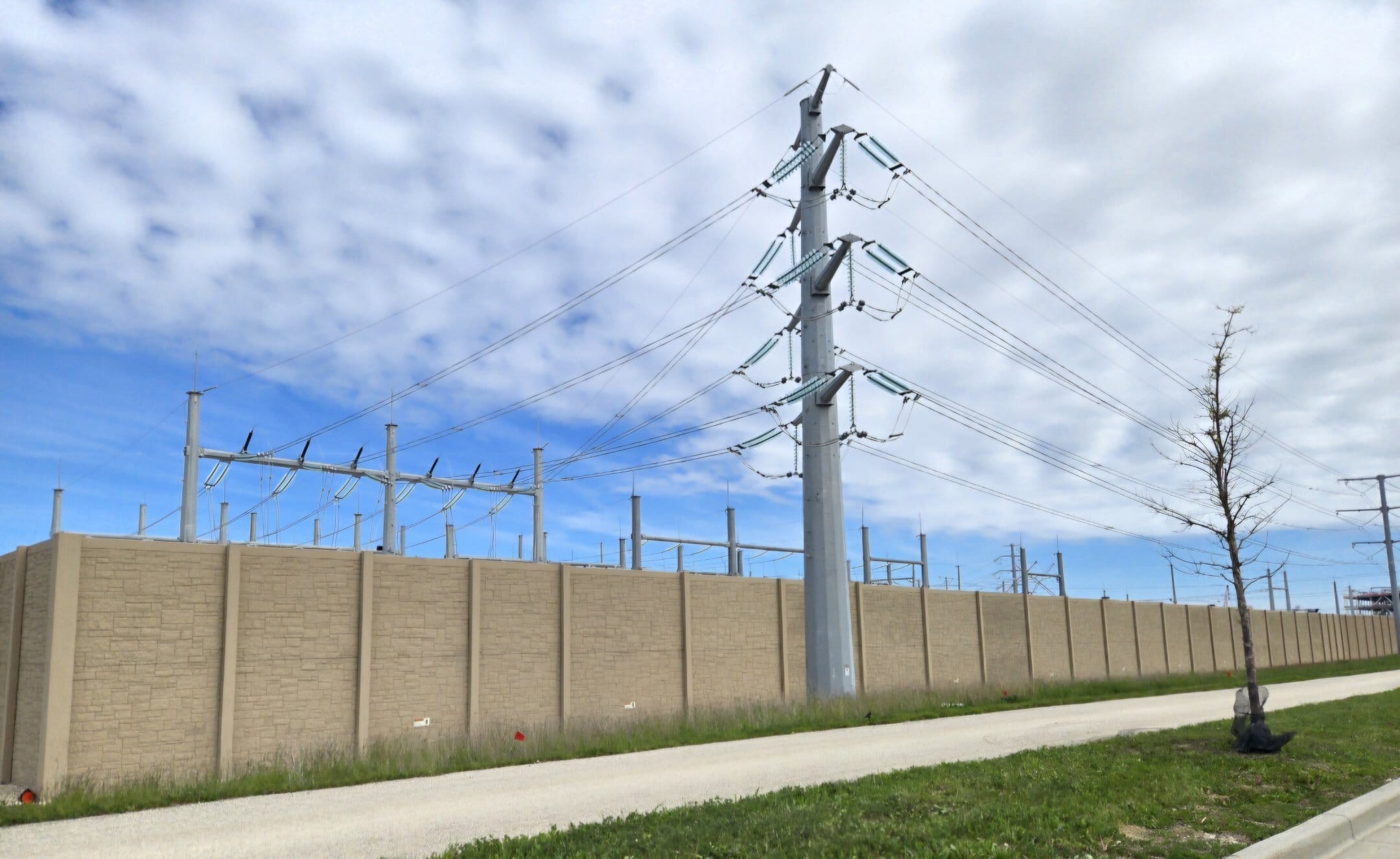
Wisconsin’s Public Service Commission on Thursday cleared a major regulatory hurdle for one of the state’s largest proposed power projects, unanimously granting a Certificate of Public Convenience and Necessity for a roughly 1,200-megawatt natural gas plant in Kenosha County. The facility is intended to help meet rapidly rising electricity demand driven by hyperscale data centers in southeastern Wisconsin.
The Red Oak Ridge Energy Center, proposed by Chicago-based developer Invenergy in the Town of Paris, would be a simple-cycle combustion turbine “peaker” plant capable of generating up to 1,186 megawatts using five gas turbines and hydrogen-cooled generators. We Energies plans to acquire the project for approximately $1.7 billion to $1.77 billion and bring it online by early 2030. When complete, it would rank as the second-largest of Wisconsin’s roughly 29 existing natural gas-fired plants by capacity.
Site Location: The proposed Kenosha County site is located on roughly 147 acres of farmland between 120th Avenue and 136th Avenue in the Town of Paris, right off Interstate 94, just south of County Highway E and north of the Kenosha Regional Airport.
Alternative Site: An alternative location has also been studied roughly five miles northwest of the primary site, as well as a secondary 58-acre option on 172nd Avenue
Regulatory Status: The Public Service Commission of Wisconsin (PSC) approved the project. Construction is set to begin in late 2027 or early 2028, with expected completion in 2030.
WALWORTH COUNTY — TOWN OF DARIEN
The same day, the commission approved a companion Invenergy project: the 324-megawatt Foundry Ridge Energy Center in the Town of Darien in Walworth County, targeted for completion in 2028. Combined, the two plants represent more than $2.2 billion in planned We Energies acquisitions and over 1.5 gigawatts of new capacity.
Site Location: Located at the Darien Solar Energy Center site near the corner of North Road and Creek Road, the Town of Darien, Walworth County, Wisconsin, a major 324-megawatt natural gas-fired “peaker” power plant requiring a permanent footprint of roughly 16 acres plus utility connections. This project is also developed by Invenergy and approved by state regulators
Alternative Site: Located about two miles east along Creek Road, with another candidate footprint evaluated along Foundry Road (south of I-43 and west of U.S. Highway 14).
Regulatory Status: The Public Service Commission of Wisconsin (PSC) approved the project, which is planned to be acquired by We Energies and is targeted for completion around 2028.
Local Infrastructure: The area also features regional utility and industrial properties, including Aldridge Electric on Foundry Road and the North Creek Substation.
Meeting AI Energy Demands
The plants are part of the response to explosive electricity demand growth across Wisconsin. A PSC analysis has indicated demand could rise more than 40 percent by 2032, largely from data centers. Key projects include Microsoft’s expanding campus in Mount Pleasant (on the former Foxconn site) and the roughly $15 billion Vantage Data Centers campus in Port Washington, developed for OpenAI and Oracle under the Stargate initiative. The Port Washington site alone is expected to support hundreds of megawatts.
We Energies is pursuing a multi-gigawatt portfolio of new natural gas capacity, including additional proposed plants in Calumet and Outagamie counties, while also investing billions in solar, wind, and battery storage.
Invenergy has developed substantial renewable energy projects in the state, and says the gas plants are practical resources needed to keep the grid reliable and support economic growth.
Proponents of the project highlight the construction jobs (up to 500 jobs at Red Oak Ridge and up to 150 at Foundry Ridge) and modest local tax revenue. However, only 8 permanent operations jobs are expected at the larger plant. Labor leaders have spoken in favor of the projects.
Local opposition
Public hearings in July drew strong opposition from residents in Kenosha County and nearby communities. Concerns were focused on air quality and health impacts (including asthma and other health hazards), noise, the conversion of farmland, and the industrialization of a largely rural area that already hosts other energy facilities. Critics argued the plants primarily serve data centers rather than local residential or commercial properties.
Environmental advocates, including Brittany Keyes of Healthy Climate Wisconsin, warned of significant health impacts, particularly for children, pregnant women and those with preexisting conditions. Opponents point to studies that suggest the combined emissions from the two plants could equal or exceed all commercial and institutional emissions in Kenosha and Walworth counties.
Commissioners approved the projects but voiced frustration with Wisconsin law governing “merchant” (non-utility) developers. Unlike regulated utilities, which must demonstrate public need before construction can start, merchant developers face a narrower review for a construction certificate. Public necessity, cost justification, and full ratepayer impacts are examined mainly in a separate proceeding once a utility company acquires the plant.
Under the current law, there are 2 different building paths for building power plants:
Regular utilities (like We Energies) must show the plant is needed by the public before they can even start building.
Merchant developers (like Invenergy) only need a limited construction permit. They don’t have to prove public need.
Chairperson Summer Strand described the process as a “two-step, piecemeal, often whack-a-mole approach” that complicates the process to determine if the projects will truly meet customer needs. Commissioner Kristy Nieto questioned whether existing law gives regulators the adequate tools needed to properly assess these projects. The commission noted it is limited in determining air pollution impacts once the Department of Natural Resources issues permits and described this problem as “ripe for legislative action.”
In other words, the companies building these plants didn’t have to prove Wisconsin actually needs them before getting permission to start construction. Regulators only get to fully examine the need, the cost, and the impact on electric bills later — when We Energies tries to buy the plants.
These are the first natural gas plants sought by a merchant developer under the current state process, which has more commonly been used for renewables. The projects still require DNR air permits and other approvals.
Project Plans : https://psc.wi.gov/Pages/CommissionActions/CasePages/RedOakRidge.aspx https://psc.wi.gov/Pages/CommissionActions/CasePages/FoundryRidgeEnergyCenter.aspx
