


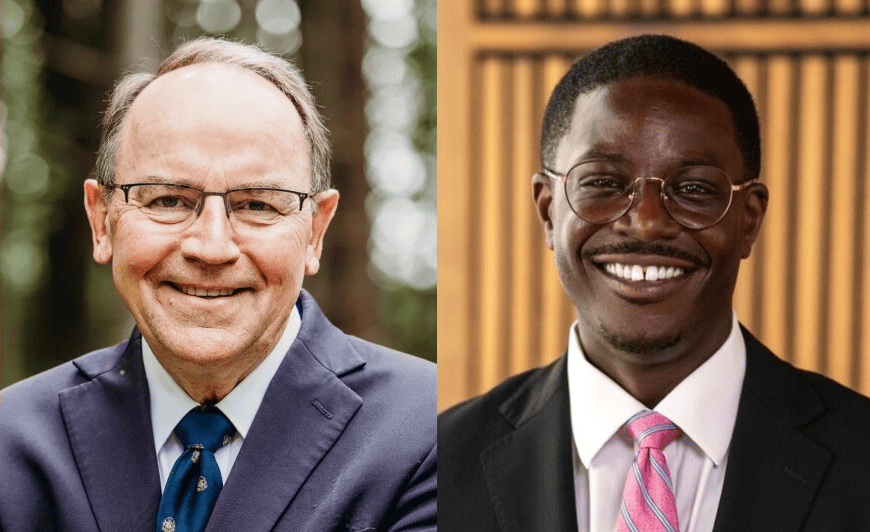
Winner: David Crowley — with an asterisk
Crowley is the polling winner on the likely-voter line, and that matters. After dropping out, re-entering, and surviving Hong by fewer than 4,000 votes, he is now the Democratic nominee in a 49-44 snapshot. Party consolidation seems to be on his side: 98% of likely Democratic voters back him. But enthusiasm is not on the Democratic side, as 55% of Republicans say they are very enthusiastic about voting, compared with only 49% of Democrats. Only 52% of voters who favored his primary opponent, Francesca Hong, are very enthusiastic about voting, which could translate into fewer volunteers and door-knockers. Hong voters may be willing to vote for Crowley but not do the work necessary to get him across the finish line.
Further drawbacks are just as real. Independents broke towards Crowley by a sizeable margin, but a large share remain uncommitted. Tiffany is better known. Crowley still has 38% of registered voters saying they have not heard enough about him, which means Tiffany’s attacks on him could define him and put Crowley on the defensive. 78% of voters say the downsides of data centers outweigh the positives, so Tiffany’s “Data Center David” message could do some real damage (more on that below). Furthermore, Crowley’s campaign, which just spent weeks explaining why Hong was unelectable, now has to sell a Milwaukee County executive whose record includes repeated property-tax increases and a nearly doubled sales tax.
A five-point likely-voter lead in August is not a coronation. It is an opening bid in a state that has spent a decade deciding statewide races by a point or two.
Winner: Eric Toney
Fond du Lac County District Attorney Eric Toney is not lighting up the favorability charts. Only 10% of registered voters view him favorably, 8% unfavorably, and 80% have not heard enough to say. Those are not great numbers.
They look a lot better when set next to the man he is running against.
Josh Kaul has been Wisconsin’s attorney general for eight years. Two terms. Statewide ballot twice. Constant press releases. After all of that, Marquette finds just 20% of voters have a favorable opinion of him. Sixteen percent view him unfavorably. And 61% still have no real idea who he is.
That is the story. A county prosecutor from Fond du Lac is being measured against a two-term incumbent who has failed to introduce himself to three in five voters. Incumbency is supposed to buy name ID. Kaul bought eight years of anonymity. Toney does not need to be a household name yet. He needs Kaul to keep being one. On that score, this poll is a win for the challenger.
Loser: Francesca Hong
This was supposed to be her moment.
Before Crowley’s shocking upset in the August 11 primary, public and internal polling showed Francesca Hong running away with the Democratic primary. But a series of ill-fated national TV appearances, followed by the unearthing of old tweets and controversial past statements, sent undecided Democrats overwhelmingly toward Crowley in the closing days of the campaign and helped deliver his unlikely victory.
For Hong and her supporters, the latest Marquette Poll may be the first of many post-primary “what if” moments.
Despite Hong’s loss, Marquette still surveyed voters on Hong as a candidate—and on several of the issues she championed throughout her campaign.
Hong herself emerged from the primary badly damaged, with her favorability rating underwater by a staggering 27 points after her campaign collapsed. Her policies, however, fared considerably better—adding salt to the wound for a candidate whose biggest knock from the Democratic establishment was electability.
78% of respondents supported requiring businesses to provide paid family leave for new mothers and fathers, a bill Hong introduced this session as a state representative. Another 59% favored creating a “millionaire tax,” including 71% of independents. Taxing the wealthy was another key pillar of Hong’s campaign.
But no issue defined Hong’s candidacy more than data centers—specifically her call for a one-year moratorium on new data center construction. To Hong’s credit, she was one of the first politicians to recognize data centers as a defining political issue, one that has continued to loom large in the general election between Tiffany and Crowley.
The latest Marquette Poll found 78% of voters believe the costs of data centers outweigh the benefits, giving data centers a staggering -57 net rating statewide. The opposition cuts across party lines: 96% of Democrats, 80% of independents, and 64% of Republicans said the costs outweigh the benefits.
Even more strikingly, more than two-thirds of voters support Hong’s signature proposal for a one-year moratorium on new data center construction—including 53% of Republicans and 67% of independents.
That overwhelming bipartisan support can’t make the primary result any easier for Hong loyalists to swallow. They are now being asked to rally behind David Crowley, who has called for making Wisconsin the “data center hub for the entire globe” and supports continuing taxpayer-funded incentives for data center developers—subsidies Tom Tiffany has pledged to end.
Perhaps that helps explain another number buried in the poll: just 52% of Hong supporters say they are “very enthusiastic” about voting for Crowley this November.
Loser: School Choice
In the wake of the COVID pandemic, support for Wisconsin’s school choice program surged. In the spring of 2022, 58% of voters surveyed by the Marquette Law School Poll supported allowing all students across Wisconsin to participate in the state’s school choice program. Three years later, support remained nearly as strong, with 57% backing the program in early 2025.
A little over a year later, that support has begun to erode as Democratic lawmakers and public school interest groups increasingly use the choice program as a political punching bag to scapegoat the financial and academic failures of traditional public schools.
In the August 2026 Marquette Law School Poll, just 51% of voters said they wanted Wisconsin’s voucher program to continue, while 48% supported ending it altogether.
Several Democratic candidates for governor, including Francesca Hong, Mandela Barnes, and WEAC-backed Kelda Roys, have expressed support for ending the state’s “voucher scheme.” David Crowley has taken a more measured approach, acknowledging the role choice schools currently play while opposing further expansion and calling for stronger regulations on the existing program.
But opposition is not confined to Democrats.
Roughly half of independents now support ending the voucher program, while just 68% of Republicans support keeping it. That Republican number should be setting off alarm bells throughout Wisconsin’s school choice movement.
There are two major reasons for that underwhelming level of Republican support.
Wisconsin is the birthplace of modern school choice, with the Milwaukee Parental Choice Program launching in 1990. Since then, three additional programs have emerged: the Racine Parental Choice Program, the statewide Wisconsin Parental Choice Program, and the Special Needs Scholarship Program.
Yet much of the state’s school choice footprint remains concentrated in southeastern Wisconsin, particularly Milwaukee and Racine. For Republican voters in rural Wisconsin, school choice can feel like a distant issue. There aren’t many alternatives when the next school is an hour away. Families in the Northwoods or other rural communities are also far removed from Milwaukee Public Schools’ failures and don’t encounter Milwaukee’s dismal academic outcomes daily.
But an even bigger problem for the school choice movement may be the growing wave of public school referendums, particularly in conservative and rural communities.
Democrats, their allies in the media, and the public school establishment have successfully portrayed voucher schools as the primary reason local districts must repeatedly return to taxpayers for more money. The zero-sum argument—that every dollar going to a choice school is a dollar being taken from a public school—has proven effective, even with some conservative voters.
Consider a rural community like Adams-Friendship, which recently joined several urban school districts in a lawsuit against the state legislature over the school funding formula. Voters may have few, if any, realistic school choice options nearby and therefore see little direct benefit from the program. What they do see are recurring school referendums and rising property tax bills. When those increases are blamed on school choice, the argument can resonate—even among voters who might otherwise support the principle of giving parents more control over their children’s education.
That is the growing political reality that Wisconsin’s pro-school-choice movement needs to confront. Simply relying on the traditional arguments for school choice may no longer be enough. Supporters will need to more aggressively counter claims that choice schools are responsible for public school financial problems while making the case for why the program matters to taxpayers and families well beyond Milwaukee.
Failing to do so risks further erosion of support for a program that has become a necessary lifeline for thousands of Wisconsin families seeking an alternative to failing public schools.
