


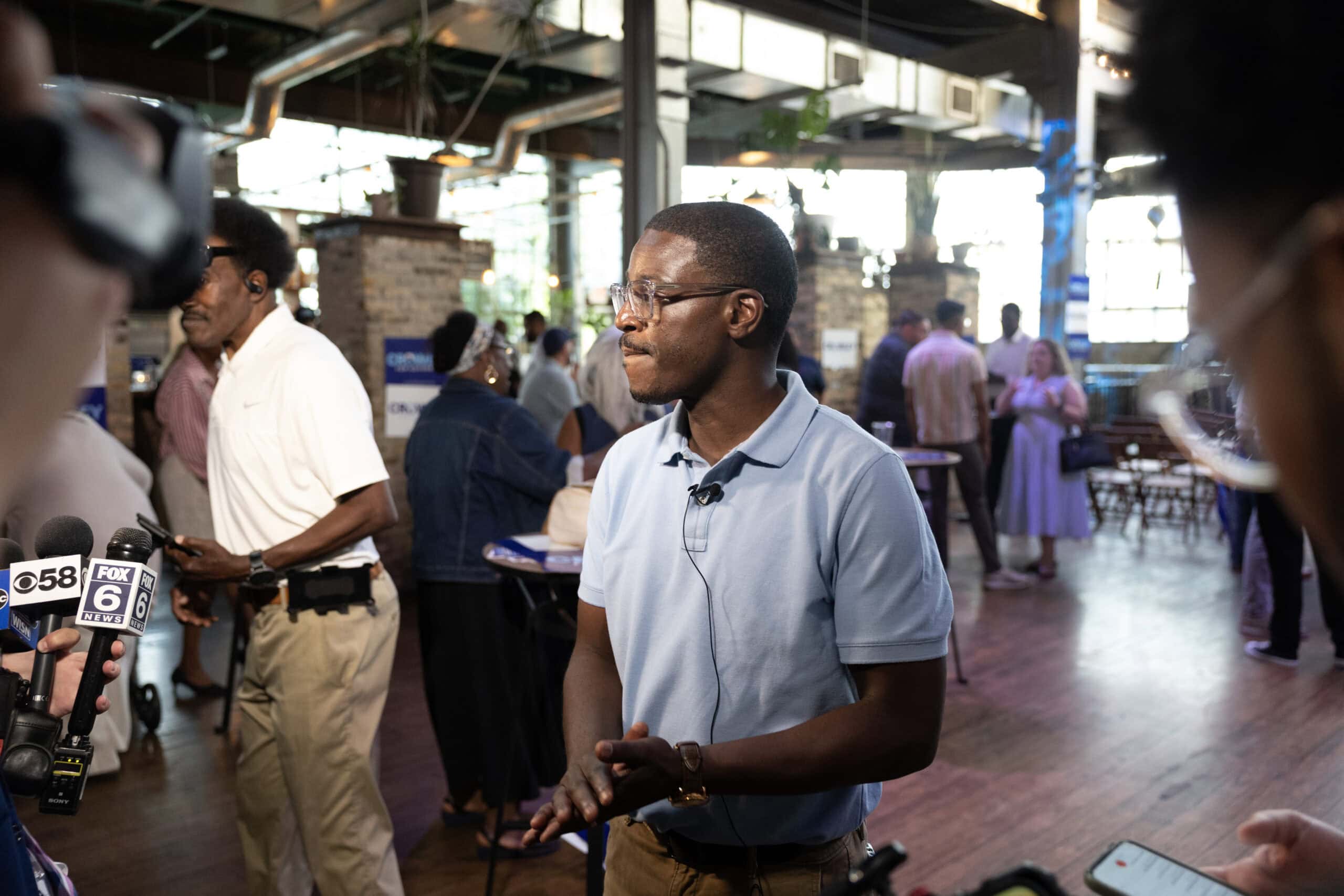
David Crowley has made a $20/hour minimum wage increase a centerpiece of his gubernatorial campaign. At a recent Marquette Law School event and in his “Badger Basics” platform, the Milwaukee County Executive has backed phasing out the longstanding minimum wage of $7.25 (unchanged since 2009) toward $15 immediately and $20 by 2030, while also calling for the repeal of Act 10 and right-to-work. The pitch is “affordability for workers.” The practical effect in 2026, especially for small businesses, contractors, and anyone whose job is routine or entry-level, is likely to be fewer hours, fewer hires, higher prices, and faster replacement by automation and machines.
Wisconsin’s economy is built on small businesses. According to Small Business Association (SBA) data, roughly 497,000 small businesses make up 99.4 percent of the state’s companies, and employ about 1.2 million people — nearly half the workforce. Construction alone supports well over 140,000 jobs, the great majority in small outfits that bid competitively on residential, commercial, and public work. Restaurants, retail, home services, landscaping, and subcontracting operate on thin margins where labor is often the largest cost. Jumping to $20/hour is not a modest adjustment. For many of these employers, this nearly triples the cost of the lowest legal wage.
What to expect — reduced hiring, especially of less experienced or seasonal workers, cut hours, higher prices passed to customers, off-book business arrangements, or worst case scenario, business closures. Rural and smaller market contractors are hit the hardest because they cannot absorb the added costs the same way larger companies sometimes can, and do not have the Cap-Ex to switch over to an automation business model to mitigate the problem.
The timing makes the policy more damaging. Artificial intelligence and automation are already substituting for human labor in precisely the occupations most sensitive to a high minimum wage — order-taking, inventory, basic construction support jobs, data entry, routine customer service, etc. Recent research from the National Bureau of Economic Research and others finds that minimum wage increases raise the probability that firms adopt robots and other automation technologies.
One study estimated that a 10% minimum wage increase simultaneously increased robot adoption by roughly 8% relative to the mean. California’s experience with a $20 fast food wage has produced higher menu prices, reduced employee hours, and accelerated deployment of kiosks, mobile ordering, and AI drive-thru systems. Wisconsin would be importing the same dynamic statewide, but without California’s coastal real estate taxes or density to buffer the financial effects.
The workers who lose out are disproportionately the young, the less skilled, and those seeking their first job — exactly the groups a higher statutory wage is supposed to help. When the price of unskilled or semi-skilled labor is set by politicians well above what many small employers can afford, those jobs disappear (or stop appearing in the first place).
The real minimum wage for the person who cannot find work remains zero. Meanwhile, larger businesses that can amortize automation investments gain a massive advantage. This decision will ultimately kill off small business. The gap will continue to widen for skilled “premium” workers who can operate, maintain, or complement the new AI tools.
Crowley’s overall labor agenda further compounds the problem. Repealing right-to-work and Act 10 would raise costs and reduce flexibility for public and private employers alike, while the same platform offers little emphasis on the supply side that actually raise wages over time via more apprenticeships, reduced occupational licensing barriers, better K-12 outcomes, and a tax and regulatory climate that lets small businesses expand rather than “survive” to keep their doors open.
Markets are the most reliable mechanism for determining pay scales based on output/productivity — NOT government, especially County Executives who are financially decimating Milwaukee.
Where productivity is low or tasks are easy to automate, a mandated $20 minimum wage does not create value, it only accelerates the substitution of capital for labor and prices the least experienced workers out of the economy altogether.
Wisconsin already has many workers earning well above $7.25 through experience, skill, and tight labor markets. A blanket $20 mandate is a blunt political instrument that helps robots, not Wisconsinites.
