



MILWAUKEE — Milwaukee County Executive David Crowley spent much of Wednesday night’s gubernatorial debate repeating a single charge: that Republican U.S. Rep. Tom Tiffany works for billionaires rather than Wisconsin residents. The claim surfaced in Crowley’s opening statement and returned ad nauseum. Crowley tied Tiffany to large contributions from Diane Hendricks of Beloit and Richard and Elizabeth Uihlein and said Tiffany would cut “billionaire taxes to 0 percent” and balance those breaks “on the backs of hardworking Wisconsin family members.”
First off, unlimited party contributions are permitted under Wisconsin law and have been used by both parties. Reid Hoffman, J.B. Pritzker, and Gwendolyn Sontheim Meyer name just a few of the ultra-rich donors to the Wisconsin Democrat Party. The double standard state Democrats push when Republicans happen to also have money is laughable.
The double standard state Democrats push when Republicans happen to also have money is laughable.
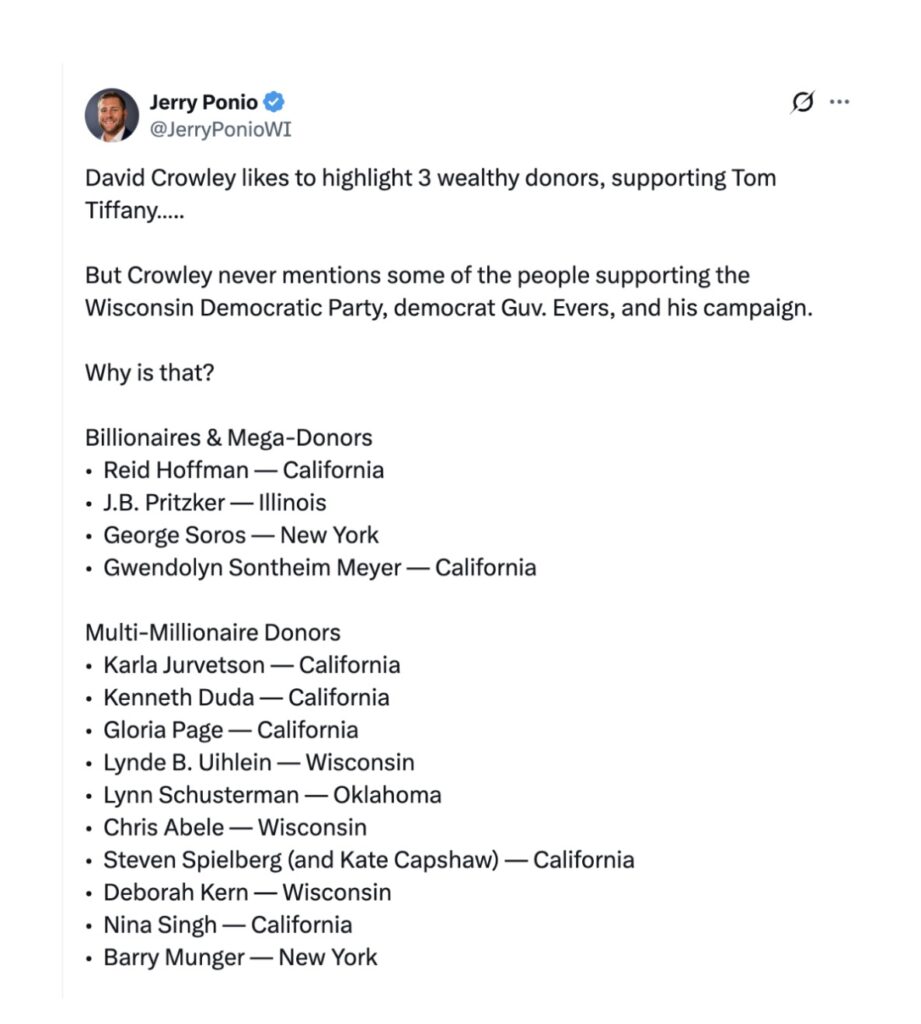
Further, Tiffany said he had never proposed zeroing out taxes on high earners and told moderators Crowley was “ranting constantly about billionaires” instead of explaining his own plans. Post-debate coverage from multiple outlets noted that Crowley stayed on the attack while offering few concrete figures when pressed on new tax brackets, additional school funding amounts or transportation revenue sources.
Tiffany’s agenda centers on middle-income relief. He’s called for a 10 percent income tax cut for families earning less than $150,000, the return of the state’s roughly $3 billion surplus through long-term tax reductions rather than new spending, the elimination of state taxes on tips and overtime, and an end to the multi-decade property tax increase created by Gov. Tony Evers’ partial veto of school funding.
As Milwaukee County executive, Crowley backed an 80 percent increase in the county sales tax and multiple property tax increases.
The “works for the billionaires” line is an incredibly tired framing used against Republican tax-relief proposals. It doesn’t address the distribution of Tiffany’s specific cuts, which are targeted at households below $150,000, or the fact that high earners already pay a disproportionate share of state income taxes. Returning a surplus returns prior over-collections rather than creating a new transfer. The alternative Crowley outlined keeps more revenue in government accounts.
Credit to moderators Matt Smith and Gerron Jordan who repeatedly sought numerical commitments from both candidates. Tiffany outlined the components of his affordability plan. Crowley more often answered with hollow attacks than his own policy specifics.
