


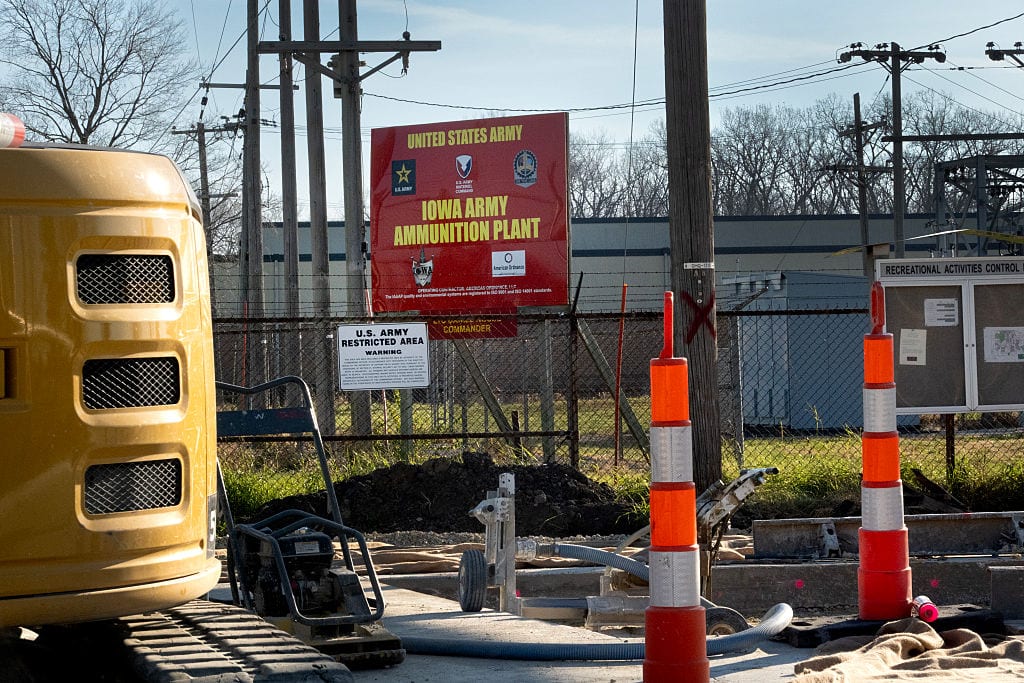
Nearly 10,000 pounds of unstable explosives are sitting inside an Iowa military installation. On Monday, the U.S. Army intends to blow them up.
Military officials say the material has become too dangerous to move. An accidental explosion could threaten soldiers, civilian workers, and nearby residents. But the proposed solution carries its own risk. The detonations are expected to send lead-containing particles into the atmosphere, potentially depositing toxic material beyond the installation.
For Wisconsin residents, the available scientific assessments offer reassurance. Significant impacts here appear unlikely. Yet the situation raises a question that deserves attention regardless of where the wind blows.
When the federal government exercises its authority to eliminate a danger, who protects the citizens who may bear the consequences of its solution?
The answer involves more than environmental safety. It concerns private property, individual rights, and the responsibilities that accompany government power.
An Explosive Problem With No Easy Solution
At the Iowa Army Ammunition Plant near Middletown, military officials are preparing to destroy approximately 9,500 pounds of deteriorating lead azide, a highly sensitive explosive compound used in detonators. The Army discovered the deteriorating material in March. According to federal officials, recrystallization has made it increasingly sensitive to friction, shock, and disturbance. Moving the containers could trigger an accidental explosion.
The operation involves 68 drums of explosives and two planned detonations at the storage site. Originally scheduled for Friday, November 20, the operation was postponed until Monday, November 23. Acting Army Secretary Adam Telle said the delay would place the operation before a forecast temperature drop that could further destabilize the explosives.
The Army maintains that it evaluated alternatives and determined that controlled detonation presents the lowest overall risk. That conclusion deserves serious consideration. An uncontrolled explosion could have devastating consequences. Military personnel and nearby communities should not be exposed to an avoidable catastrophe simply because the safest disposal method carries environmental concerns.
But recognizing the danger does not place the government’s response beyond scrutiny. The public deserves to understand why this approach was selected, what safeguards are in place, and what happens if those safeguards prove insufficient.
The Risk Beyond the Fence
Lead azide contains lead, a toxic heavy metal associated with neurological damage, developmental problems, and other serious health consequences. Children are particularly vulnerable to exposure. The Army acknowledges that the detonations will produce a dust plume containing lead particles.
Depending on atmospheric conditions, those particles may travel beyond the installation before settling on soil, buildings, vehicles, and other surfaces. That does not mean every location beneath a projected plume will experience dangerous contamination. Actual exposure depends on concentrations, weather, distance, and the effectiveness of protective measures.
The Environmental Protection Agency issued an emergency permit effective November 13, authorizing the operation under specific conditions. Those conditions require environmental monitoring before, during, and after the detonations, along with public notifications, reporting, and necessary cleanup.
The permit also addresses hazardous releases beyond the installation boundary and does not authorize injury to people or private property. These safeguards matter. But their effectiveness must ultimately be measured by environmental testing, not government assurances.
The Legal Challenge
The Iowa Environmental Council and the Sierra Club’s Iowa chapter have petitioned a federal appeals court to review the EPA’s authorization. The organizations contend that regulators did not adequately evaluate alternatives or establish sufficient protections for surrounding communities.
The Army disputes that characterization, maintaining that alternatives were considered and controlled detonation offers the safest practical solution. A legal challenge does not prove military officials acted recklessly. Likewise, an emergency permit does not establish that every potential consequence has been eliminated.
The relevant question is whether the government’s decision is supported by evidence that can withstand independent examination. An emergency may justify swift action. It should not become a substitute for explaining why that action is necessary.
What Wisconsin Residents Need to Know
For Wisconsin residents, the immediate concern is whether airborne lead particles could travel hundreds of miles from the Iowa installation.
Wisconsin Public Radio reported that the Wisconsin Department of Natural Resources did not anticipate impacts outside Iowa based on atmospheric projections reviewed for the originally scheduled operation. Brad Pierce, an air-quality researcher at the University of Wisconsin-Madison, similarly indicated that significant effects in Wisconsin were unlikely.
Those findings provide meaningful reassurance. There is no credible evidence at present that Milwaukee or other Wisconsin communities face an imminent public health emergency from the planned detonations.
However, atmospheric modeling depends on conditions at the time of an operation. Because the Army postponed the detonations until Monday, updated projections are essential to evaluating current conditions. The Army has outlined a schedule for updating its atmospheric maps as the operation approaches.
Wisconsin residents should have access to those findings, particularly if changing weather conditions materially affect the earlier assessment. There is a difference between reasonable vigilance and unnecessary alarm. The former demands accurate information. The latter assumes the worst before evidence supports it.

The Property Rights Question Washington Cannot Ignore
Perhaps the most important issue receiving comparatively little attention is what happens if federal activity causes measurable damage to private property.
Consider a homeowner living near the installation. Suppose environmental sampling after the detonations establishes that hazardous material from the operation has settled on that person’s land. Who pays for additional testing? Who determines whether remediation is necessary? What happens if government measurements and independent findings disagree? And what remedies are available if the homeowner suffers demonstrable property damage or financial loss?
These are fundamental questions about individual rights. The EPA permit establishes corrective-action requirements for certain hazardous releases. However, those requirements do not necessarily resolve every issue involving independent testing, disputed findings, or compensation for private losses.
Private citizens and businesses are expected to respect the property rights of their neighbors. When their activities cause contamination, they may face regulatory enforcement, cleanup obligations, or civil liability. Government agencies should also face meaningful accountability, even though legal remedies against the federal government can differ from those involving private parties.
A legitimate public purpose does not make an injured property owner whole. Nor should the government’s good intentions automatically settle questions of responsibility.
There is currently no evidence that this operation has contaminated Wisconsin property. The detonations have not yet occurred. But waiting until damage occurs to ask how citizens will be protected is hardly responsible government.
Property rights mean little if they can be disregarded whenever Washington determines that its objectives are more important.
Supporting the Military Without Surrendering Scrutiny
Americans can respect the armed forces while questioning a particular federal decision. The military has a legitimate responsibility to manage dangerous explosives and protect communities surrounding its installations. Its professionals possess expertise that deserves consideration, particularly when the alternatives may involve catastrophic risks.
But expertise does not eliminate accountability. A limited-government philosophy does not require opposing every government action. National defense is among the federal government’s most fundamental responsibilities. The question is whether that authority is exercised within appropriate limits and with proper regard for the rights of citizens.
This is not a demand for an impossible guarantee of zero risk. Every available option may carry consequences. It is a demand for a defensible decision, transparent safeguards, and responsibility for measurable harm.
What Washington Still Owes the Public
Before the detonations, federal officials should clearly address three issues.
First, they should explain which alternatives were evaluated and why those approaches were rejected. The Army says it conducted that review. Making its reasoning understandable would allow the public to assess its conclusions.
Second, environmental monitoring results should be released promptly and in plain language. Predictive models are valuable, but actual measurements are necessary to determine what happened.
Third, residents should understand how unexpected contamination would be handled, including notification, testing, corrective action, and procedures for pursuing claims involving proven damage.
These are practical expectations, not accusations against the military. They recognize that citizens living outside a federal installation have rights that deserve protection.
Power Without Accountability Is Not Public Safety
The Army may ultimately be correct that destroying these explosives in place is the safest available option. Wisconsin residents have reason to be reassured by the available scientific assessments rather than frightened by speculation.
But when government action creates risks for people who had no role in creating the original problem, those people deserve more than assurances that officials acted with good intentions. They deserve evidence, transparency, and meaningful accountability.
Americans should never have to choose between supporting their military and defending their constitutional principles. A government powerful enough to act in the name of public safety must also be accountable when its actions threaten the rights and property of the people it serves.
The burden of proof belongs to the government. The burden of its mistakes should never belong to the people.
