


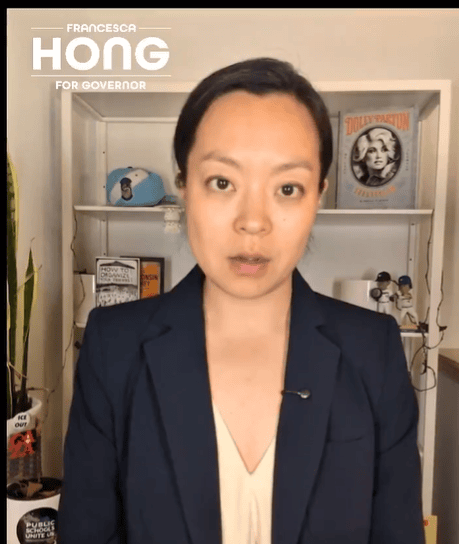
Francesca Hong is peddling the fantasy that the Green Bay Packers ownership is some sort of legitimate example of socialism. This is not just false; it is either a masterclass in economic illiteracy or a calculated effort to rebrand socialism as something as wholesome as a Lambeau Leap.
On April 23, 2026 — NFL Draft day — Hong posted: “Look no further than the Green Bay Packers, the only community-owned, publicly-owned team in pro sports. 539,000 shareholders. A board that answers to fans, not a boss. No billionaire owner. When people ask me what democratic socialism looks like, I point them to Green Bay.” She has repeated the comparison in interviews, saying that when people hear “socialism” they may be taken aback, but she “bring[s] it back to potholes and the Packers and public education.”
This comparison collapses the moment it encounters reality.
Green Bay Packers, Inc. is a Wisconsin nonprofit corporation. Roughly 539,000 private individuals own about 5.2 million shares. No one may hold more than 200,000. Those shares pay zero dividends. They carry no residual claim on profits or assets. They cannot be freely traded or sold for gain. Transfers are mostly limited to family. Voting rights are narrow — primarily electing the board and certain bylaw matters — plus the ability to attend the annual meeting and buy shareholder merchandise.
A board and professional management run the corporation. Government does not appoint directors, set ticket prices, allocate capital, or control operations. The structure was created in the 1920s when the franchise was near collapse; local residents bought restricted certificates to keep the team in Green Bay. The NFL later banned the model for every other franchise and grandfathered the Packers.
This is private, voluntary ownership by identifiable individuals. It is not ownership by ‘the public,’ the state, the city, or the faceless mass of taxpayers. It is not socialism, and it is certainly not state control of the means of production.
Socialism, in the real world, means collective or government ownership and control of productive assets, swapping out private ownership and market forces for political dictates. A novelty non-dividend, non-transferable stock certificate that exists largely for bragging rights and cannot be sold is not socialism; it is a souvenir. Credit unions and mutual insurance companies also have broad ownership and reinvest profits, but no serious person calls them socialist economies
The Packers thrive in a private league that uses revenue sharing and salary caps to keep the playing field level among private owners. Their worth is built on private media deals, private advertisers, and a private market for players. Strip away those capitalist institutions and a small-market nonprofit in a city of roughly 100,000 would face the same market pressures that eliminated most other early small-town professional teams in the early days of the NFL.
Hong is attempting to get voters to associate the warm, successful, small-town football team with her actual agenda: abolishing the police, massive tax increases on businesses, a state-owned bank, and public grocery stores. By wrapping those policies in the Packers logo, she tries to make radical ideas sound like common-sense Wisconsin tradition.
They are not. The Packers are a quirky historical outlier, kept alive by voluntary fans, nonprofit legal quirks, and the NFL’s private rules. They prove that a tightly defined, community-backed nonprofit can survive in a unique cultural pocket. They do not prove that socialism works, scales, or is anything but a bad idea.
