


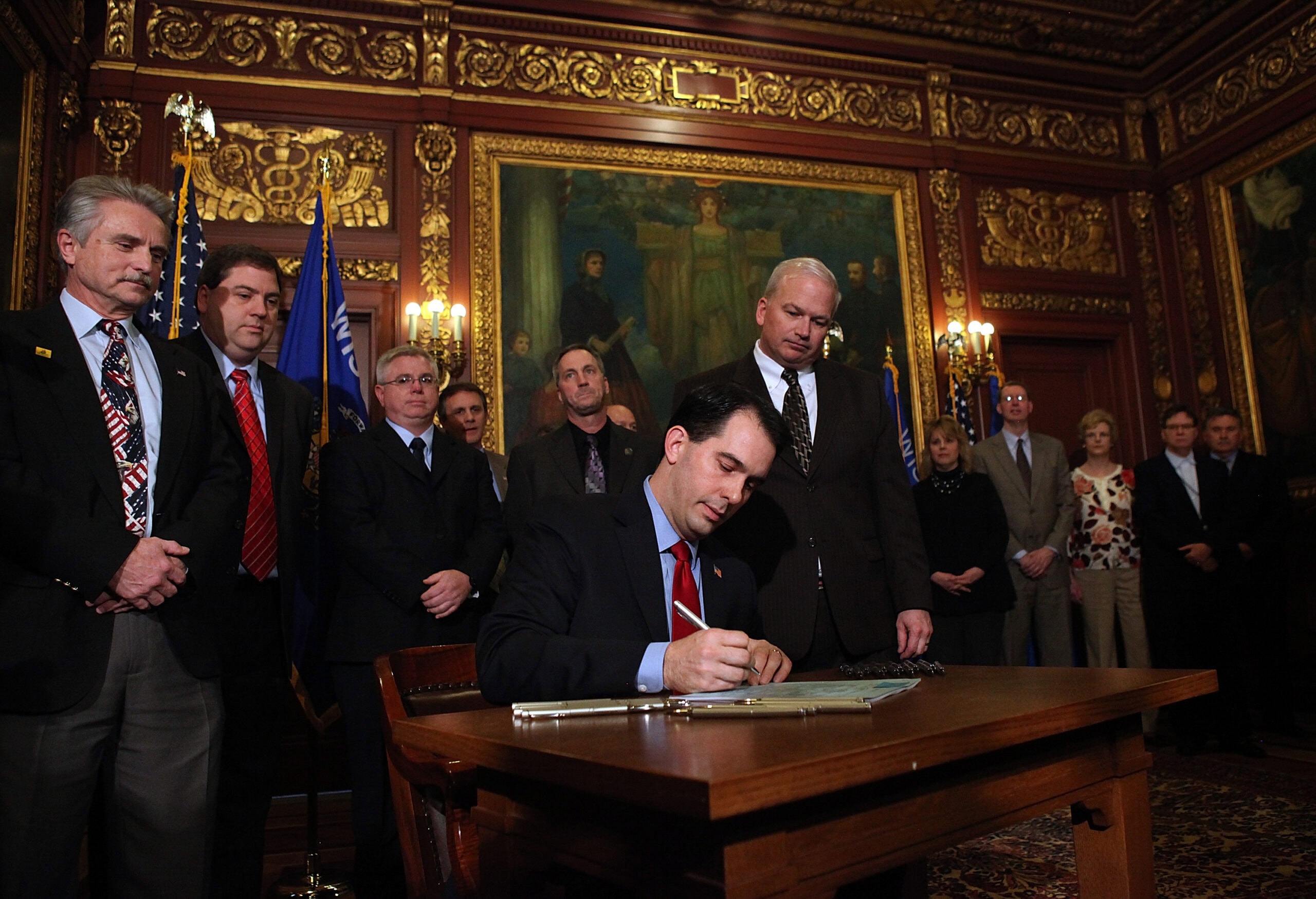
Fifteen years is long enough for a fiscal crisis to fade into folklore. It is not long enough to stop it from being real. Act 10, the law that reshaped collective bargaining for Wisconsin’s public employees in 2011, is fighting for its life again, and it will not survive on the assumption that everyone still remembers what it did.
Polling from the Marquette University Law Poll released on July 22nd points to a growing trend: voters do not remember all that Act 10 has done to protect our state finances. According to the poll, 46% of voters want to keep Act 10 as is.
Before we can defend Act 10, we must remember how we got there. Governor Scott Walker introduced the bill on Feb. 11, 2011, to close, according to the Legislative Fiscal Bureau, an immediate $137 million hole in the budget and head off a projected $3.6 billion shortfall over the next two-year cycle. The gap had been building for decades due to poor fiscal management from the Democrats in charge. Wisconsin’s cities, counties, and school districts had negotiated contracts with the public unions in which taxpayers covered nearly the entire cost of a public employee’s pension contribution and the bulk of health insurance premiums, while most employees paid little or nothing toward their own retirement.
To close this budget deficit, Act 10 required most public employees, teachers, county workers, and university staff to contribute half of their own pension payment and at least 12.6 percent of their health premium. It capped bargaining at base wages tied to inflation, ended automatic dues deduction, and required unions to win an annual recertification vote by a majority of everyone in the bargaining unit.
What followed was unlike anything Wisconsin had seen since the Vietnam War. Protesters filled the Capitol within days, sleeping on marble floors and chanting through the night. On Feb. 17, all fourteen Democratic state senators fled to Illinois, denying the chamber a quorum and triggering a three-week standoff that drew national coverage. By March 12, the crowd outside had grown to 100,000 people, among the largest protests in state history.
None of that drama changed the math behind the bill. A government funding its workforce’s pension and health plan almost entirely with someone else’s money eventually runs out of that money. Wisconsin was closer to that reckoning than most residents understood. Detroit’s bankruptcy and Illinois’s unfunded pension liability would spend the following decade proving what happens when that accounting is ignored too long. Act 10 forced Wisconsin to face its bills on its own schedule instead of waiting for a bankruptcy judge to set the terms.
The results are large enough that researchers still argue over exactly how large they are. The MacIver Institute, a free-market think tank, calculates cumulative savings of $35.6 billion through 2025, $13.8 billion in employee pension contributions collected since 2012, plus $21.8 billion in avoided health insurance cost growth. PolitiFact Wisconsin reviewed the figures in 2023 and found MacIver’s numbers consistent with independent estimates dating back to the law’s first year, when Walker’s claim of roughly $3 billion in savings by 2014 checked out as Mostly True.
The result? Wisconsin has one of the only fully funded pensions in the country. Local governments have the flexibility to fund their priorities, and school districts can keep the best and brightest teachers, despite union pressure. These are all wins for Wisconsin taxpayers and families.
Sadly, these savings and commonsense reforms are once again at risk.
In November 2023, a coalition of public-sector unions sued to overturn Act 10, shortly after a new liberal majority took the Wisconsin Supreme Court. Now, Democrat candidates for office promise to overturn Act 10 in nearly every forum and on most campaign websites.
The Wisconsin Institute for Law and Liberty modeled the impact using Department of Public Instruction payroll data, comparing inflation-adjusted 2009 compensation to actual 2024 figures district by district. The result: roughly $1.8 billion a year in new costs for school districts statewide, plus about $480 million a year for cities and counties, close to $2 billion annually combined. For the owner of a home near Wisconsin’s roughly $300,000 average value, that works out to about $624 more in property taxes a year just to cover one district’s share, with the ten hardest-hit districts facing far steeper increases.
That is the argument that must be made, not slogans recycled from 2011. Act 10 is not a relic of the past. It is why Wisconsin’s pension system is solvent while other states dig out of holes of their own making, and why a school board can build a budget on numbers it controls rather than numbers a union sets at the table.
None of that survives on autopilot. It survives only if the taxpayers who benefit from these reforms understand what is truly at stake.
