


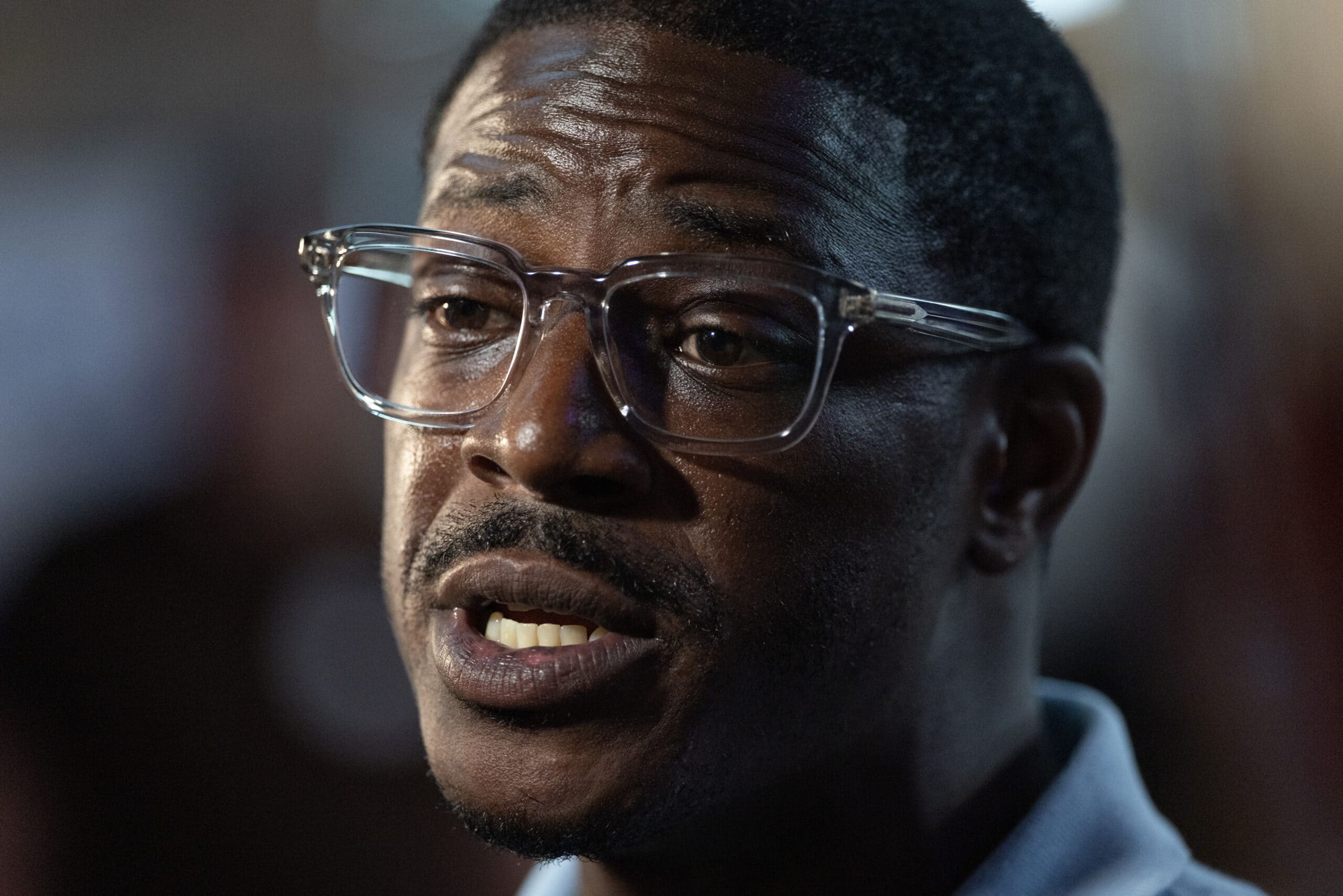
For months, Wisconsin Democrats had told themselves that David Crowley was the safe choice; following a chaotic primary which included a campaign suspension, a last-minute revival, and a half-point victory over a democratic socialist, David Crowley is now seen as the mature figure in the room – moderate enough to win over the suburbs and experienced enough to govern the state.
He isn’t. He’s a dud.
In 2016, he won a seat in the Milwaukee Assembly, with no Republican candidate appearing on the ballot, and received 99 percent of the vote against write-ins. He won the same seat again in 2018 in the same way. He was elected Milwaukee County executive in a nonpartisan spring election. Throughout his career, he has never had to convince the people of Waukesha, the Fox Valley or the Northwoods that his style of Milwaukee County government should be represented at the governor’s office. He has also never had to face a Republican opponent who had money, a ground game and a point of contrast.
A campaign that already needed a rescue
Crowley wasn’t the party’s first choice. He started the campaign, his support level remained in single figures, and on July 8 he suspended his bid and instead backed Lt. Gov. Sara Rodriguez. Ten days later, Rodriguez’s campaign collapsed amid doubts about her finances. Crowley then reentered the race with the support of Gov. Tony Evers, who was presented as the viable option compared to state Rep. Francesca Hong. Three weeks before the primary, a poll conducted by Marquette Law School still showed Hong at 38% and Crowley at 7%. On August 11, he won by around 3,760 votes, 39.8% to 39.3%, thanks to Evers, and the establishment rushed in late.
The Journal Sentinel and national outlets immediately framed the result as proof Crowley can win statewide. A post-primary Marquette survey of likely voters gave him a 49-44 edge over Republican U.S. Rep. Tom Tiffany; among registered voters, the race was tied at 44. It is a snapshot taken before most of Wisconsin had heard Crowley talk for 30 seconds unscripted.
The State Fair dodge told you everything.
A genuine general-election stress test did not come until the final night of the Wisconsin State Fair.
Videos displayed groups of teenagers and young adults punching, kicking and chasing people around the grounds in West Allis; an officer was hit, and a security guard was hurt. Seven people were arrested, and some families fled. Tiffany’s reaction was straightforward: “This is Milwaukee County under David Crowley. Crime. Chaos.”
Crowley’s response was a classic left-wing dodge and a messaging strategy spin pulled straight from Reddit comments:
“Let’s be very clear,” he said. “State Fair is actually controlled by the state of Wisconsin, which is controlled by the Republican-controlled Legislature.”
The Board, which governs Wisconsin State Fair Park, has 13 members. The governor — Democrat Tony Evers — appoints seven of them and names the chair. Four legislators sit on the board, split evenly, plus two agency secretaries. Daily operations sit with the park’s CEO and the staff, not with the Assembly Republicans in Madison. The fairgrounds are located in Milwaukee County, and it was the local police, the State Fair Park Police, and the county’s forces who got involved in the situation.
The Heartland Post described it as “blatant obfuscation.” It’s the same tactic that the Milwaukee Democrats employ each time violence comes to light: they deny any responsibility, blame Madison, fabricate a Republican control that in fact doesn’t exist, and hope that the footage will disappear.
People who vote outside the I-94 area don’t need a flowchart from the park board; they just want to know whether the man asking for the entire state can tell the truth about the county he already governs.
The record he wants you to forget
Crowley runs on the basis of having ‘balanced the budget’ and bringing about ‘the largest property tax cut in the history of Milwaukee County’. The detailed provisions, however, are worse.
In 2023, he played a role in securing passage of Act 12, the agreement that imposed a 0.4 percent sales tax on Milwaukee County to cover its pension liabilities and ensure the Brewers remained in the area. Property taxes saw the highest year-to-year rise. The county now faces a projected shortfall of $50.8 million when the 2027 budget is drawn up—after a series of ‘firsts’, the introduction of new taxes and overall cut targets. The windfall from the sales tax did not remedy the fundamental problem; it only provided a temporary solution and a talking point.
The Crowley method consists of increasing taxes, announcing a victory, ignoring the next shortfall onto someone else, and then campaigning throughout the state as the mature figure in the room.
Public safety is also an important consideration. In 2026, Milwaukee’s figure for homicides finally started to fall after several years of high levels of killing, which went against the national trend in 2025. That is something to be glad about. It does not, however, serve as a justification for supporting the county executive who allowed the situation to worsen, who underfunded the sheriff’s office in previous budgets, and who, in response to a brawl at the State Fair, simply told Wisconsin about which party “controls” a board that is itself dominated by his own governor.
Crowley is asking 72 counties to import the governing culture of the one county that already produces the state’s worst crime headlines and the most creative excuses.
Tiffany has already outmaneuvered him on the race’s hottest issue. Data centers are unpopular with Wisconsin voters. Tiffany defined Crowley first, flooding the airwaves with a “Data Center David Crowley” ad built on Crowley’s own line that the state should become an “AI and data hub not only for the entire country, but for the entire globe.” Tiffany’s demand is simple: end the sales-tax exemption Evers signed, which the Legislative Fiscal Bureau says will cost more than $2 billion; ban secret NDAs; no rate hikes on families; no converting productive farmland. Crowley will not repeal the subsidy. He wants a “more rigorous review,” union labor, and a requirement that new centers run on 100 percent wind, solar, and batteries, a plan Tiffany says would chew up about 100,000 acres just to power the Mount Pleasant and Port Washington projects. Crowley has spent the opening weeks answering the nickname instead of setting the terms. That is what an untested candidate looks like when a Republican finally puts him on offense.
Why the Harris comparison sticks
Kamala Harris did not lose in 2024 because she lacked credentials. She lost because voters finally saw the candidate behind the résumé — cautious, scripted, allergic to taking ownership, and unprepared for a fight that she had never had to win on her own.
Crowley is showing flaws: he has held safe Democratic seats and a nonpartisan local office, had a primary in which he came very close to losing after having quit, and his message, even after just two weeks, has already settled on blaming the Legislature.
Crowley’s record is now the campaign. He has never beaten a Republican. He suspended his gubernatorial bid, reentered only after Sara Rodriguez collapsed, and Tony Evers endorsed him, then won the primary by half a point. His first statewide test produced a false claim that the Republican Legislature controls State Fair Park, a board appointed by a Democratic governor in the majority. Milwaukee County still faces a multimillion-dollar budget hole after the sales-tax increase he championed, but the first few weeks on the general election stage indicate he is not as electable as the party thinks.
