


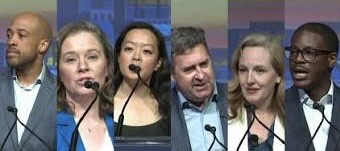
Six Democratic gubernatorial candidates met Tuesday at the Black Business Hub on Madison’s South Side for a forum hosted by Blacks for Political and Social Action of Dane County. Although the event was intended to address racial disparities in pollution, education, health care, and criminal justice, the discussion shifted to the demographic composition of each candidate’s staff.
Moderators asked pointed questions about whether they employ Black staff members. Francesca Hong identified two Black women on her campaign staff and one in her legislative office. David Crowley highlighted several Black officials in his cabinet and county leadership. Kelda Roys noted that her Senate chief of staff is Latina. Sara Rodriguez and Mandela Barnes did not provide similar confirmations.
This exchange demonstrated the extent to which DEI expectations influence campaign operations. Candidates advocating for race-conscious policies in state contracting, hiring, grants, and government programs were expected to show similar practices within their own teams.
Rodriguez’s office has made this priority clear. Job postings for her Madison staff state that the Office of the Lieutenant Governor “strives to recruit and retain high-quality staff committed to increasing the diversity of the organization.” Hong has sponsored legislation to provide grants for hiring school mental health professionals “who are members of a racial minority group” and has introduced other bills focused on minority health and inclusion. She cited the passage of “a bipartisan bill on race and inclusion and diversity” as a significant achievement.
Crowley’s record goes further than forum answers. Shortly after taking office, he announced that Milwaukee County would pursue racial equity to become the healthiest county in Wisconsin. He directed that the 2021 budget be developed “with a racial equity lens so that we can make intentional decisions about where we invest.” County departments were required to analyze their budgets accordingly. Milwaukee County now has an Office of Equity and requires agencies to use an equity budget tool that addresses workforce inclusivity, people-focused design, and improved equity practices. All agencies must consider this framework in their spending decisions.
Barnes, whose public brand rests on racial equity rhetoric, was notably quiet. As lieutenant governor, he chaired the Black and Latino Caucus, served on the Governor’s Health Equity Council, and focused on “sustainability and equity” while expressing a commitment to ensuring he would “not be the last” Black statewide official. When asked about Black staff in his current operation, he did not provide a specific response.
The remainder of the forum continued in a similar manner. Candidates proposed various government interventions framed through an equity lens, including expanded DEI preferences in state contracting, efforts to reduce prison populations, additional health initiatives, and programs addressing race-focused maternal mortality. Barnes highlighted his climate task force and his “11 by 15” prison-reduction campaign. Other candidates advocated for marijuana legalization, changes to juvenile sentencing, and increased support for “diverse” providers and contractors.
The forum reflected the left’s laser focus on identity in political discourse. Candidates are now expected to demonstrate their commitment to diversity within their own teams as well as addressing broader systemic disparities. Barnes’ decision not to provide details about his staff was notable, given his history of advocating for equity audits in other institutions.
Wisconsin voters now have greater insight into the Democratic candidates: those advocating for expanded government DEI programs are also expected to meet similar diversity standards within their own teams. The forum focused on staff demographics rather than introducing new policy proposals.
