


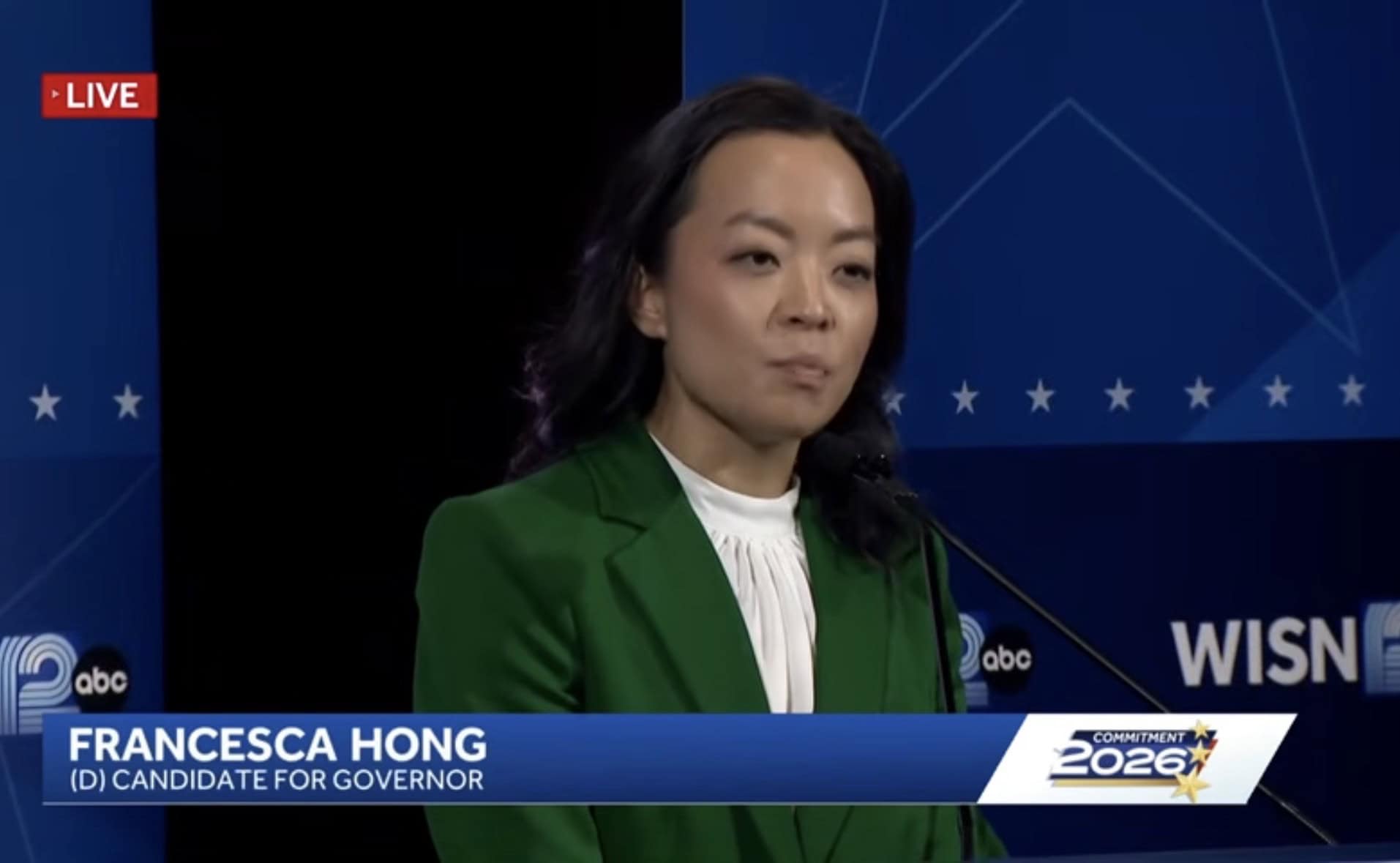
Francesca Hong may have lost the Democratic primary for governor, but she certainly isn’t acting like someone preparing to disappear from Wisconsin politics.
Three months after coming within fewer than 4,000 votes of winning the Democratic nomination, the Madison democratic socialist remains a prominent figure in Wisconsin’s rapidly changing political landscape.
Following her primary defeat, Hong launched her eight-stop “We Make Better Possible” tour across Wisconsin, continuing to organize alongside former campaign manager Becky Cooper.
And while Hong initially appeared reluctant to embrace the man who defeated her, she ultimately emerged as a team player, traveling thousands of miles to campaign for David Crowley and encouraging her supporters to help Democrats secure a governing trifecta.
That reconciliation could prove politically valuable.
Hong’s surprisingly strong gubernatorial campaign exposed a significant ideological divide within the Democratic Party, with Gov. Tony Evers and other prominent Democrats ultimately coalescing around Crowley as Hong threatened to capture the nomination.
Hong hasn’t forgotten that intervention. In a post-primary interview with Vox, she expressed disappointment with Evers’s endorsement, arguing that the governor had put his thumb on the scale and dismissed the hundreds of thousands of voters energized by her campaign.
But her willingness to help elect Crowley has also given her an opportunity to build goodwill with mainstream Democrats who were hesitant to embrace her candidacy.
More recently, Hong has emerged as something of a mediator between the incoming Crowley administration and the Democratic Party’s increasingly vocal socialist left who remains skeptical of how Crowley will govern.
When Crowley appeared to backtrack on his commitment to Medicaid expansion, Hong quickly came to his defense, acknowledging his budgetary concerns while simultaneously arguing that Wisconsin’s surplus could cover the costs of expansion.
For now, Hong finds herself in a delicate political balancing act. As the de facto conscience of the party’s progressive wing, Hong is uniquely positioned to keep socialist activists from turning against Crowley before he even takes office. At the same time, that influence gives her a powerful platform to hold the incoming governor accountable to his campaign promises and pressure his administration to move further to the left.
And with Democrats preparing to control the governor’s office and both chambers of the Legislature, Hong will have no shortage of opportunities to exercise that influence. It also gives her an opportunity to leverage her newfound political clout into another run for higher office.
At just 38 years old, Hong has plenty of time to chart the next chapter of her political career. But politics is also about seizing the moment, and with her political stock still riding high following a surprisingly strong gubernatorial campaign, Hong may not want to wait too long.
The question, then, may be less about whether Hong will seek higher office again and more about which office she has her sights set on.
What’s Next for Francesca Hong?
There has been plenty of speculation about what office Hong might seek next.
One possibility was Madison mayor, particularly after incumbent Satya Rhodes-Conway announced she would not seek another term in 2027. Hong, however, has unequivocally ruled out entering the race.
The more popular theory has been that Hong will eventually challenge longtime Rep. Mark Pocan in Wisconsin’s deep-blue 2nd Congressional District.
Such a campaign would fit a national trend of democratic socialist candidates challenging longtime Democratic incumbents in safe blue districts, particularly when activists believe those incumbents have become too comfortable with the party establishment.
But Hong’s gubernatorial campaign demonstrated that her political appeal extends considerably further than Madison.
Hong carried Dane County with roughly 44% of the vote compared with Crowley’s 37%, but she also ran nearly even with Crowley in Milwaukee County while winning Brown, Outagamie, Winnebago, Eau Claire and La Crosse counties.
Statewide, she captured nearly 40% of the Democratic primary vote despite beginning the campaign as a relatively unknown Madison legislator.
Her strong showing beyond Madison, coupled with her newfound statewide name recognition and established grassroots infrastructure, gives her a foundation for a potential U.S. Senate campaign in 2028.
And Hong hasn’t exactly closed the door on that possibility.
During a recent interview with Isthmus, Hong said she has no immediate plans to seek another office and is still processing her gubernatorial defeat. But while she emphatically ruled out running for Madison mayor, she was noticeably less definitive when asked about a potential Senate campaign.
A Crowded Field of Familiar Democrats
Republican Sen. Ron Johnson’s seat will be on the ballot in 2028, and the three-term incumbent has yet to announce whether he intends to seek another term.
Recent reporting indicates Johnson has begun preliminary conversations with longtime campaign advisers about the possibility of running for a fourth term, although he has emphasized that no decision has been made.
On the Republican side, Congressman Bryan Steil was widely viewed as a potential successor should Johnson retire. However, his unexpected defeat to Democrat Mitchell Berman in November has complicated that scenario. Businessman and 2024 Senate nominee Eric Hovde has indicated he could make a third Senate run, while Congressman Tony Wied and Franklin businessman Scott Mayer have also expressed interest.
Democrats, meanwhile, have no shortage of familiar names who could enter the race.
Former Democratic Party of Wisconsin Chairman Ben Wikler is widely discussed as a potential candidate and has raised his public profile with a statewide and national book tour, featuring stops in every major Wisconsin media market as well as liberal donor hubs like San Francisco, Los Angeles and Washington, D.C.
Wikler would enter the race with a formidable fundraising network, national connections and extensive knowledge of Wisconsin’s Democratic political infrastructure. He would also face an important question: Can his success as a political operative behind the scenes translate into success as a candidate on the ballot?

Wikler has never run for public office, and his close association with the Democratic establishment could present challenges among the party’s increasingly vocal socialist wing.
While Wikler played a central role in rebuilding Wisconsin’s Democratic Party and helping Democrats regain control of state government, he also represents the institutional wing of the party that Hong and her supporters have frequently criticized.
A longtime political insider with deep ties to wealthy donors and national Democratic leadership, Wikler represents a more traditional approach to Democratic politics built around coalition-building, fundraising and incremental gains.
The contrast between Wikler and Hong would be stark.
Attorney General Josh Kaul and incoming Lt. Gov. Sarah Godlewski are two other familiar statewide Democrats who could plausibly enter the race.
Kaul, fresh off winning a third term as attorney general, would bring established statewide name recognition, three successful general election campaigns and the ability to run for Senate without surrendering his current office.
Godlewski’s circumstances have changed even more dramatically. After serving as Secretary of State, she was elected Lieutenant Governor alongside Crowley, giving her a considerably higher-profile position and a more prominent platform within the Democratic Party.
But a Senate campaign would require Godlewski to turn around almost immediately after winning statewide office and launch another campaign. It would be her fourth statewide run since 2018, potentially inviting questions about her political ambitions and motivations.
Both Kaul and Godlewski have demonstrated their ability to win statewide general elections. Neither, however, has demonstrated the same kind of dedicated ideological following that Hong cultivated during her gubernatorial campaign.
Kaul has never faced a Democratic primary opponent, while Godlewski’s most significant attempt to build a statewide primary coalition came during the 2022 Senate race, when she struggled to gain traction, polling at just 9% before dropping out and endorsing Mandela Barnes.
Wikler, Kaul and Godlewski have different political backgrounds and strengths, but all three are closely associated with the Democratic Party’s mainstream establishment. They would likely compete for many of the same donors, activists and primary voters.
Hong would enter that field from an entirely different direction.
Hong Would Enter As The Favorite
Hong would enter the Senate race with something she lacked when first entered the governor’s race: momentum.
She would no longer enter a statewide primary as an obscure Madison legislator hoping to catch fire. Her political brand is established, she has developed a statewide donor network and grassroots infrastructure, and she has an opportunity over the next two years to broaden the coalition she assembled in 2026.
And while Wikler, Kaul and Godlewski may be the more conventional Democratic candidates on paper, Hong’s nearly 40% showing in the gubernatorial primary gives her a distinctive starting point. If that coalition remains intact, Hong would begin a Senate campaign with an established base of support while her potential rivals compete for much of the remaining electorate.
While some of Hong’s supporters could certainly defect to other candidates, her political floor appears remarkably high. She has cultivated an intensely loyal following, and barring another progressive challenger competing for the same ideological base, it’s difficult to envision a significant portion of that coalition abandoning her in 2028.
And there is little reason to assume that 40% represents her political ceiling.
Hong would have another two years to build on the momentum of her gubernatorial campaign, expand her fundraising network and introduce herself to voters who may have overlooked her the first time around.
Much will depend on whether the socialist movement’s recent political momentum continues into 2028.
With prominent progressives like Alexandria Ocasio-Cortez and Ro Khanna both discussed as potential presidential candidates, the next Democratic presidential primary could provide a national platform for the same ideological movement that powered Hong’s gubernatorial campaign.
The direction of the Crowley administration could also shape the political environment.
If Crowley successfully unites the party’s competing factions and delivers on the progressive priorities that helped Democrats win their trifecta, some of the urgency behind Hong’s insurgent movement could fade. If ideological tensions persist, however, the divide exposed during the gubernatorial primary could become an even more important feature of the next statewide Democratic primary.
If Crowley delivers on the progressive priorities that helped Democrats win their trifecta, Hong could claim some of the credit for championing those reforms while making the case for taking that agenda to Washington. If Crowley falls short of her expectations, however, it could just as easily strengthen her argument against the party’s more corporatist establishment and reinforce her case for why Democrats need a democratic socialist representing them in the U.S. Senate.
A similar ideological struggle is already playing out in Washington, where the progressive wing of the new Democratic Senate majority has rallied behind Chris Van Hollen for majority leader over the more establishment-backed Chuck Schumer. That divide could provide Hong with another opportunity to frame a potential Senate campaign as part of a broader movement to reshape the Democratic Party from within.
Hong has no shortage of options before her, and plenty could change between now and 2028.
She could take the potentially safer route of challenging Mark Pocan in Wisconsin’s deep-blue 2nd Congressional District. She could forgo another campaign altogether, maintaining her position as a prominent organizer and influential voice within the Democratic Party’s progressive wing.
Or she could set her sights on something bigger.
And if Hong decides to make a run for the U.S. Senate, she could find herself in an unfamiliar position: no longer the insurgent underdog, but the candidate her Democratic rivals would have to beat.
