


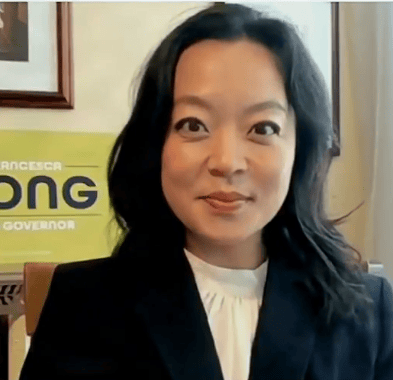
Francesca Hong delivers her lines in a soft, deliberate monotone that her fans have branded as ‘quiet gravity.’ To the rest of us, it’s less gravitas and more the grown-up equivalent of the sing-song babble that saturates toddler YouTube. Calm, circular, and rhetoric-loaded with feelings, dignity, community, and the ever-present ‘systems of care,’ but when it comes to actual answers, she’s running a deficit. It’s Kamala Harris’ word salad meets Ms. Rachel’s baby talk—a cocktail of empty platitudes and emotional fluff.
In a governor’s race, that style isn’t a virtue; it’s a liability masquerading as authenticity. Two recent national interviews put this charade on full display.
Hong, the Madison democratic socialist seeking the Democratic nomination, rarely delivers sharp, specific plans when the questions get hard. Pressed on her earlier support for defunding and ultimately abolishing police, she pirouettes into talk of ‘systems of care,’ prison staff mental health, and utopian dreams of a world without law enforcement. The words circle the same abstract points — connection, lived experience, collective dignity — without landing on mechanisms, timelines, or trade-offs. It is the political equivalent of telling a frustrated child, “I hear your big feelings.” The language soothes, but it never solves. Like a high school student who failed to prepare for a class presentation, she thinks voters are too stupid to realize if she talks for a long time in a soft tone, they’ll never notice she’s not saying anything of substance.
That pattern was unmistakable in her interviews with Fox News’ Dana Perino and CNN’s Dana Bash.
Perino confronted Hong with her own past posts: in 2020 she wrote that she supported “defunding the police as a first step towards abolishing the police.” In 2021 she went further: “Police exist to uphold white supremacy. Defund then abolish. Reform can’t be an option.” When asked why voters should not simply take her at her word, Hong offered a soft, meandering reply. “I believe people can evolve,” she said. She added that “the governor cannot defund the police, and I won’t defund the police,” before pivoting immediately to her preferred economic framing: “As a Democratic Socialist, what that means is I want to put working class people first.” The hard question about abolishing police was never directly answered. It was validated, reframed, and gently set aside.
CNN’s Dana Bash received the same treatment. When Bash asked whether Hong’s views on defunding the police had actually evolved, Hong launched into a lengthy, feelings-heavy response about a recent police shooting in her Madison district, the pain of mothers who lose children to police violence, the need to change “systems,” the high suicide rates among prison staff, the dignity of incarcerated people, mental health resources, and the opioid epidemic. Bash finally interjected: “Okay. I didn’t hear a yes or a no there. But let’s move on.”
This is campaign therapy-speak. It validates, reframes, and reframes again. It prioritizes emotional resonance over clarity. Supporters hear empathy and authenticity from a former chef and bartender who still identifies as a renter and service worker. Skeptics hear an inauthentic, poorly rehearsed performance: soft packaging designed to make radical socialist priorities, a $20 minimum wage, expansive government programs, police abolition, public grocery stores, and government-run healthcare all disguised as gentle common sense. The delivery is grating precisely because it never quite commits. It keeps the conversation in the safe space of feelings and aspirations while the policy substance remains fuzzy.
The cultural parallel is hard to miss. Children’s YouTube star Ms. Rachel (Rachel Griffin Accurso) built a massive following with an exaggeratedly cheerful tone, parentese, and constant emotional validation aimed at toddlers. That same soft aesthetic has not stayed confined to the playroom. Accurso has directed real money and platform support toward far-left progressive and democratic-socialist candidates, including contributions to Michigan Senate hopeful Abdul El-Sayed and candidates in the orbit of New York City Mayor Zohran Mamdani. The toddler whisperer is comfortable lending her gentle brand to hard-left, socialist and antisemitic politics. The pattern is the same: a soothing, child-oriented presentation wrapped around agendas that are anything but moderate.
Hong’s campaign leans into joy, community, and personal storytelling. She talks about rebuilding connection and meeting people where they are. That can sound refreshing in a cynical political culture, but it’s pure evasion when voters want real answers on crime, taxes, energy, and the limits of government. Does she still support her past stances on abolishing the police, not criminalizing groping, supporting a hookers bill of rights, or canceling Thanksgiving are still positions she holds. Soft voices and circular language do not magically make radical ideas more practical. They make them harder to pin down.
Wisconsin is not an experimental lab for wrapping socialism in therapy-speak. Voters have a right to clear answers rather than validating loops. Hong’s quiet style may charm progressive primary voters who already share her worldview. For conservatives, independents, and Democrats who still value substance over soft packaging, the gentle sell is wearing thin.
The question heading into the August primary is simple: Does the calm delivery signal thoughtful leadership, or does it simply leave the hard questions unanswered while the radical agenda sits underneath, carefully wrapped in the language of feelings and care? When even national anchors cannot get a straight yes-or-no answer on abolishing the police, Hong proves she’s clearly in over her head, and it will be tougher once she wins the nomination.
