


As of October 27, Wisconsin Elections Commission data shows 641,771 absentee ballot applications statewide, down 1.3 percent from the same point in 2022. Ballots returned sit at 513,602, up 2.1 percent from four years ago.
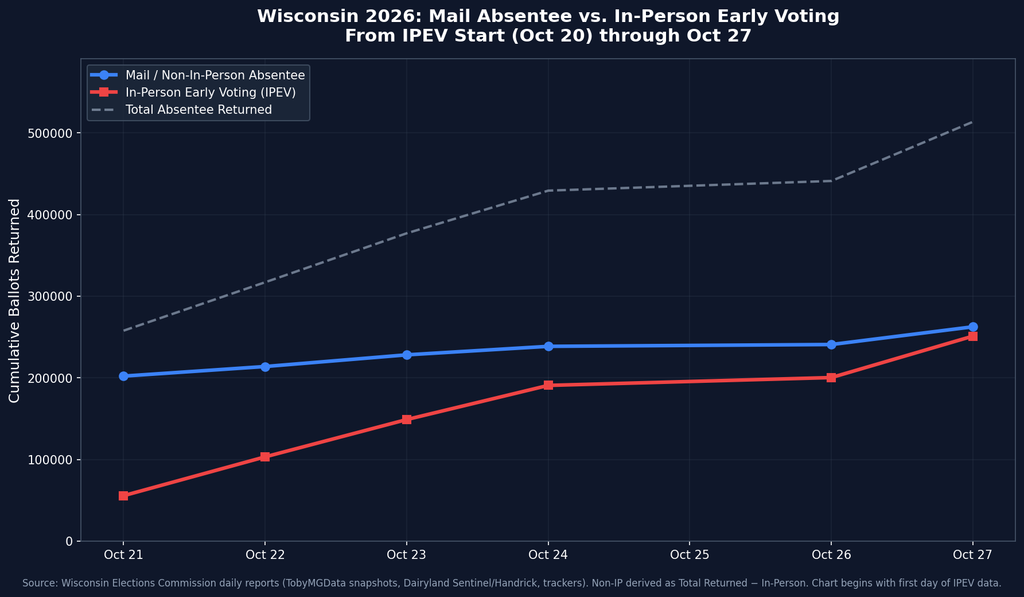
The initial absentee mail returns lagged heavily, but the gap closed quickly once in-person absentee voting opened on October 20. First-day in-person numbers jumped roughly 65 percent over 2022. With a week until the election, in-person absentee voting (IPEV) already exceeds the 2022 early in-person total. Mail returns remain behind the 2022 pace, down in the mid-20 percent range earlier in the cycle before the in-person surge began closing the overall gap.
Total applications are still down overall, which include IPEV and mail, if only by a hair. With early voting continuing through November 1 and Election Day on November 3, it is difficult to see the final early total failing to match or exceed 2022. The remaining days will tell, but the trajectory points upward on the strength of people walking into clerk’s offices rather than waiting on the mail.
Wisconsin is not a party-registration state. We do not know the partisan makeup of these ballots with any precision. Anyone claiming a clear edge from the early numbers is guessing, although perahps an educated one. Stronger relative performance shows up in places that have leaned Republican—Washington County, Waukesha County, parts of the WOW region, and several congressional districts outside the deep-blue cores. Madison and Milwaukee city applications and returns still lag 2022 by noticeable margins.
Some voters who started using mail ballots during COVID will keep doing so. At the same time, a portion of the mail drop appears to be simple cannibalization: people who previously requested a ballot by mail are now choosing to vote in person instead. Distrust of the postal system and ongoing national arguments about mail voting have accelerated that shift for some.
Democrats have long treated mailed absentee ballots as a core organizational tool. Campaigns and outside groups with more money identify low-propensity or sporadic voters, get them to request a ballot, then chase that ballot until it is returned. Door-knockers, phone banks, and text programs exist largely to convert those requests into counted votes. In-person early voting requires a different kind of effort. A voter must show up during set hours. That is easier for high-propensity voters and harder for the marginal ones Democrats have historically harvested through mail chasing.
The open question is whether Democrats have successfully converted most of those former mail requestees into reliable early in-person voters. Some conversion is clearly happening without a doubt. The in-person surge is real and statewide. Whether it fully replaces the volume and composition of the old mail program is another matter. Mail remains the method that has allowed Democrats to expand the electorate beyond people who reliably show up on their own. If, on the final day of early voting, mail returns are still meaningfully behind 2022 while total early volume is merely even or slightly ahead, that would be a legitimate concern for anyone counting on the old absentee machine to deliver the same margin. It would not mean Democrats are out of the race. It would mean they are banking more heavily on people who choose to vote in person early and on Election Day itself.
