


Baseball is America’s oldest love story.
It’s a love affair that has endured through wars and depressions, and through generations of triumph and tragedy. For nearly two centuries, the game has been a constant in American life, bringing people together and connecting generations through a shared experience and a pure love for America’s pastime.
Baseball, in many ways, is a lot like life. It’s unpredictable and imperfect. It can be painfully cruel and impossibly beautiful, sometimes within the span of a single inning. There are good days and bad days, winning streaks and losing streaks, moments of extraordinary triumph followed by stretches of seemingly endless disappointment.
And nowhere is that enduring, yet sometimes irrational, love affair quite as strong as it is in Milwaukee.
Milwaukee has never been a city particularly interested in doing things the way everybody else does, and the Milwaukee Brewers have never been a team particularly interested in being like everybody else. Perhaps that’s what makes them such a perfect match for one another.
For generations, the calendar in Wisconsin has revolved around football season, with the Brewers serving as little more than a summertime distraction to fill the long, lazy nights between the final whistle of the Packers season in January and the first kickoff in September. But for others, they were something much more.
They were the soundtrack of summer, the reward at the end of a long day’s work, a familiar voice on the radio during the drive home, a cold beer on the back porch, or an afternoon spent in the bleachers with family and friends. It was 162 games of something to look forward to.
And unlike the Packers, whose history is steeped in championships and legends, the Brewers offered something different. Something a little less glamorous, a little less celebrated, and a little more familiar.
They offered us a reflection of ourselves.
A small-market team in a working-class city, accustomed to being overlooked, underestimated, and counted out. A franchise without the seemingly bottomless pockets of New York or Los Angeles, finding a way to compete with the giants of the game through years of hard work, determination, and an almost stubborn refusal to accept what everybody else thinks they should be.
In other words, Milwaukee.
This is a city that has never needed the rest of the world to tell us what we are worth. Our pride isn’t manufactured for television cameras or carefully packaged for tourists. It’s found in our neighborhoods, our corner taverns, our church festivals, our factory floors, and the generations of families who have built their lives here. It’s a city that works hard, laughs loudly, celebrates the little things, and doesn’t particularly care whether anyone on either coast is paying attention.
Milwaukee doesn’t need to be flashy. It just needs to be Milwaukee. And the Brewers, perhaps more than any other institution in this city, understand exactly what that means.
In an era when professional sports franchises spend billions constructing gleaming stadiums surrounded by luxury apartments, upscale restaurants, and elaborate entertainment districts, the Brewers offer something decidedly different: a baseball stadium surrounded by 160 acres of concrete–a sea of asphalt stretching toward the horizon and disappearing beneath a familiar haze of charcoal smoke.
To an outsider, it might seem like an architectural afterthought. A missed opportunity to build something bigger, brighter, more glamorous or more lucrative. But to Brewers fans, it’s paradise.
Because in Milwaukee, baseball isn’t just a game–it’s a reason to come together. The excitement doesn’t start with the first pitch, but rather hours earlier with the smell of bratwurst sizzling over hot coals, the hiss of a beer can cracking open, the familiar thud of beanbags landing on homemade wooden boards, and the sound of laughter carrying between rows of cars as somebody fires up the grill.
It’s families gathered around folding tables, old college buddies reuniting for their annual ballgame, and generations of fans who have been tailgating in the same parking lots for as long as they can (and sometimes can’t) remember. Lifelong friendships are celebrated while new ones are forged over a plate of brats and a cooler full of beer; where the only thing separating a complete stranger from a new friend is a shared love of the blue and gold.
Rain or shine, win or lose, it’s ordinary people enjoying the simple pleasure of being together. For all the money that has transformed professional sports into a multibillion-dollar industry, Brewers baseball has remained an experience meant to be shared. A place where families can still make memories without spending a fortune, and the joy of baseball isn’t reserved exclusively for those who can afford the best seats in the house.
Because the magic of baseball has never depended on how close you sit to home plate. It’s the anticipation as a pitcher begins his windup, the split second of silence before a bat meets a ball, and the sudden roar of forty thousand voices rising together as a white speck disappears into the summer sky.
And it’s a ballpark where the traditions are every bit as wonderfully peculiar as the city that created them. Where five oversized sausages race around the warning track in a delightfully absurd celebration of Milwaukee’s rich history, and where the familiar polka strains of “Roll Out the Barrel” turn the seventh-inning stretch into something uniquely ours.
That’s the beauty of the Brewers. They don’t try to hide the city’s idiosyncrasies; they embrace them. The German and Polish roots, the neighborhood taverns, the tailgate culture, the Friday fish fries, the summer festivals, and the distinctly Midwestern ability to find extraordinary happiness in life’s most ordinary pleasures.
And that is why, throughout all the ups and downs, this city has embraced them back. The Brewers have spent much of their existence fighting the same uphill battles that many Wisconsinites know all too well. They don’t have the biggest payroll. They have to live within their means. They’re under-appreciated. And sometimes they just have to worry about about keeping a roof over their heads.
Yet somehow, they keep finding a way to compete when everyone else has counted them out. Through smart decisions, hard work, and an undaunted stubbornness that seems to define both the team and its hometown, the Brewers have made a habit of defying expectations.
In a world where it sometimes feels like the deck is stacked against the little guy, there’s something deeply satisfying about watching a team of overlooked ballplayers take the field against baseball’s richest franchises and refusing to back down. Every now and then, the little guy wins. Not because he has the deepest pockets or the brightest spotlight, but because he worked harder, believed in himself, and refused to quit when everyone else told him he should.
There’s something unmistakably Wisconsin about that. A quiet confidence that doesn’t announce itself with grand declarations, but reveals itself through the simple act of showing up, day after day, and getting the job done.
After decades of heartbreaks and seasons that ended just short of something special, the Brewers have shown that a small-market team from a working-class Midwestern city can stand shoulder to shoulder with the giants of the game. That the overlooked can become undeniable, and greatness can be found where you least expect it.
But the real love story of Milwaukee baseball has never been about payrolls, pennants, or postseason appearances. It’s about something far more personal.
It’s about growing up with Bob Uecker’s unmistakable voice drifting through your grandparents’ living room on a warm summer evening, or getting to the game hours early with your dad hoping to snag a ball during warmups.
It’s the soundtrack to a lazy Sunday afternoon, the sweet release after a hard day’s work, and the comforting familiarity of knowing that, no matter what else is happening in the world, there’s probably a baseball game on tonight. And for a couple of hours, you can escape.
From the first pitch to the final out, baseball becomes intertwined with our own stories. We measure the passage of time not simply in years, but in seasons: the summer we graduated, the year we got married, the first game we took our children to, or the last game we watched with someone we loved.
Players come and go. Stadiums change names. Familiar voices eventually fade. But the game, like life, moves on.
And in moments like this, how can you not be romantic about baseball?
Like any great love story, it isn’t always easy. There are moments of pure joy and moments of comfort and familiarity, but there are also disagreements, disappointments, and a few leaks that need patching.
There are people we wish had stayed, moments we wish we could forget, and days when we wonder why we keep putting ourselves through it. But every spring, we fall in love all over again. And this October, we’re reminded of exactly why.
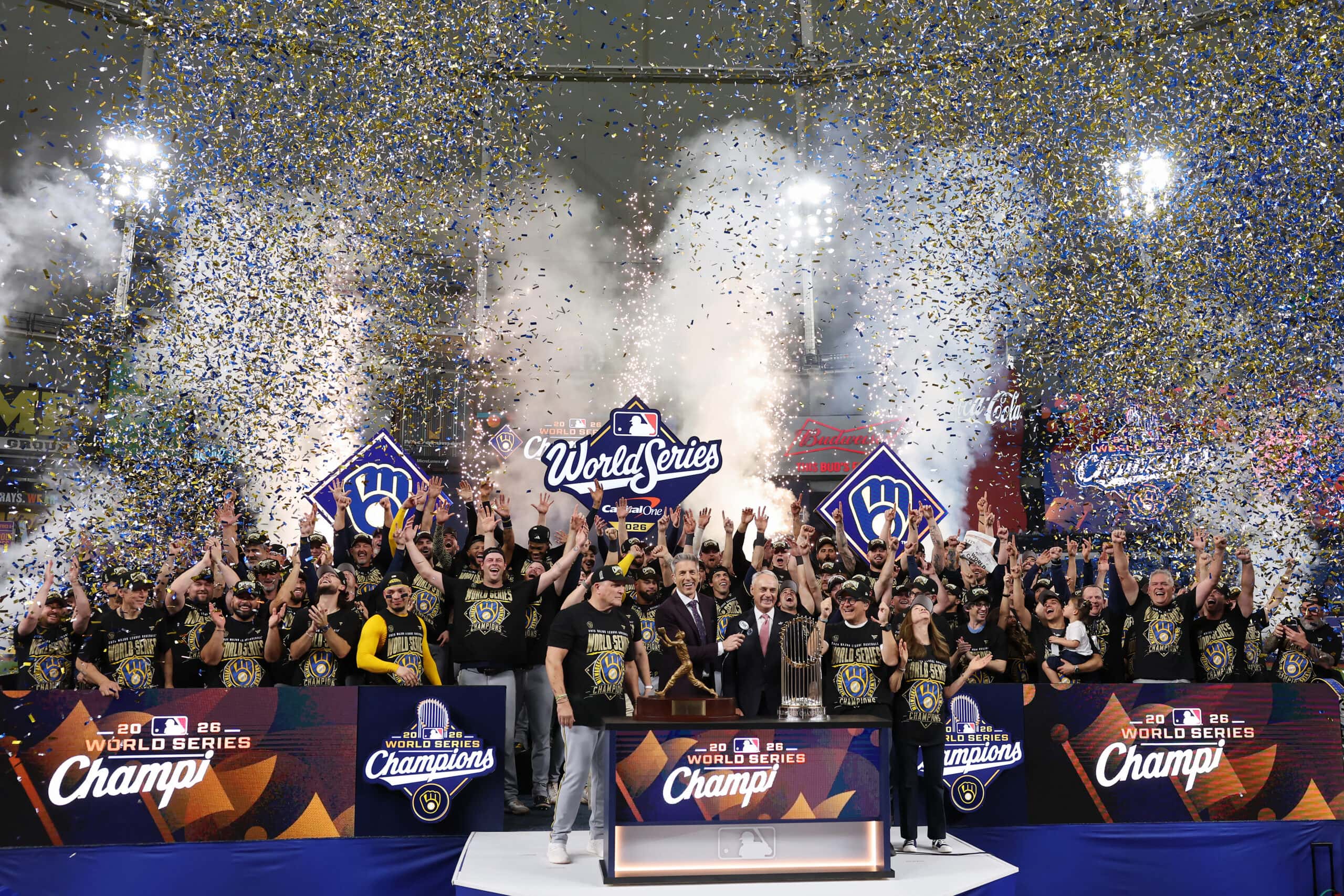
Because the Milwaukee Brewers are much more than a baseball team. They’re part of the story of the city they call home–a history of unlikely heroes, unforgettable characters, and memories that have become part of Milwaukee’s collective identity.
A city where records have been broken, where the Brave are remembered, where Kids grow up right before our eyes, and where dreams are Ignited. A place where reaching the bottom of the barrel is a reason to celebrate, where a man named Bud proudly proclaimed it Miller Time in Milwaukee, and where being told to “Get up! Get up! Get outta here!” only made forty thousand people want to stay a little longer.
A city where 26 men can come together as one and give an entire community a reason to believe in the impossible.
It’s a history that belongs not just to the players who wore the uniform, but to the generations of fans who filled the stands, listened on the radio, and passed their love of the game down to their kids and grandkids.
And perhaps that’s what makes the Brewers so special. In a world that often seems to have forgotten the value of ordinary people and simple pleasures, Milwaukee has never lost sight of either. We don’t need the biggest stadium, the brightest lights, or the richest roster to appreciate what we have. We have our traditions, our memories, our families and friends, a ballpark that feels like home, and a team that reminds us of who we are.
Through every winning streak, every heartbreaking loss, and every harsh Wisconsin winter spent waiting for spring, there’s something that has kept this city coming back year after year.
Hope.
It’s the same stubborn hope that built this city, that keeps it going through good times and bad, and that brings generations of families back to the ballpark every year.
Because in so many ways, the story of the Milwaukee Brewers has always been the story of Milwaukee itself: a little unconventional, often underestimated, sometimes imperfect, but never willing to compromise who they are.
