


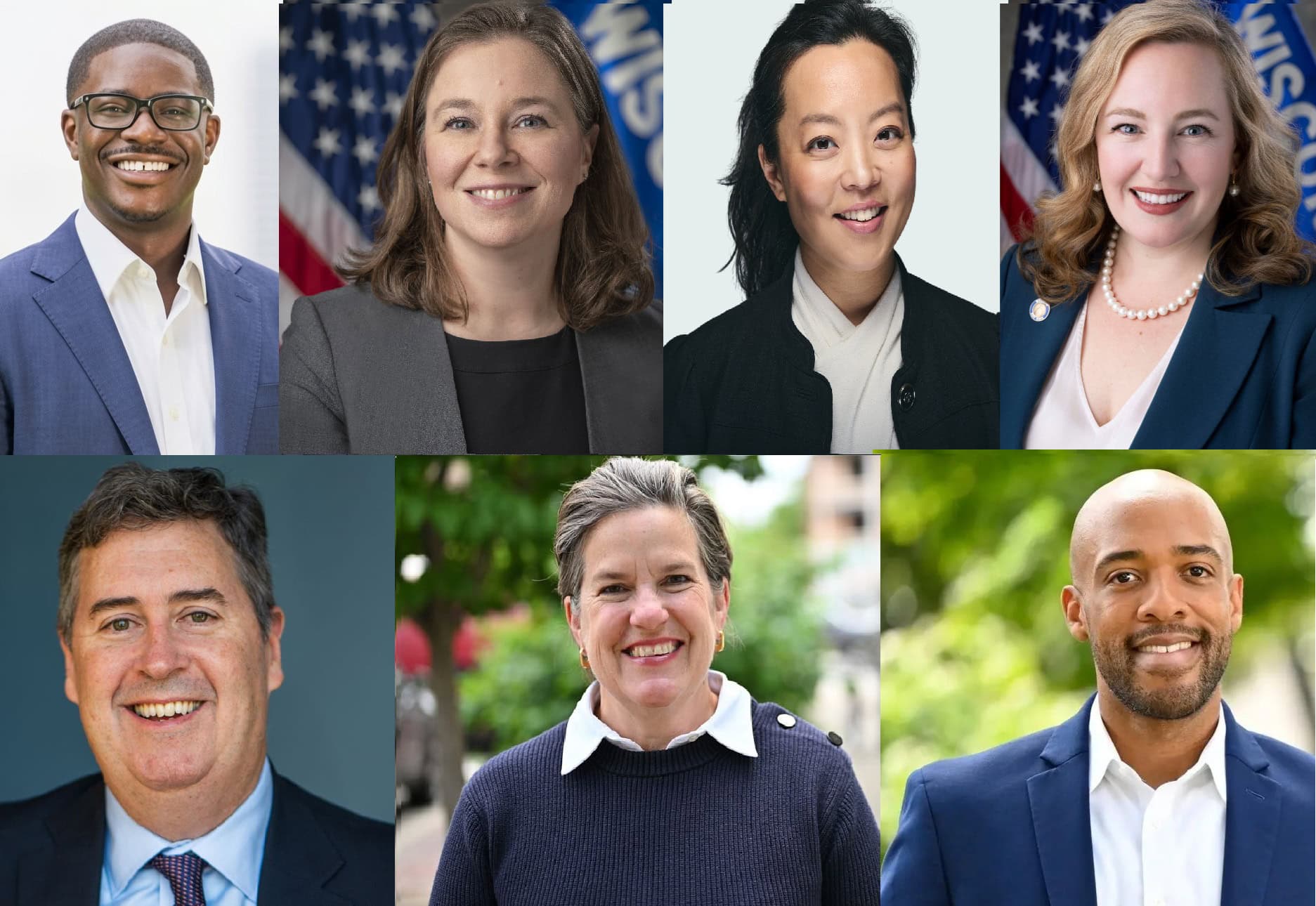
The Wisconsin Democratic convention is over. The August primary is fast approaching. Absentee ballots will be hitting mailboxes in a matter of weeks. Millions of dollars in TV ads are about to hit the airwaves.
And yet, the Democrat primary for governor remains surprisingly unsettled.
Seven candidates are still competing for the nomination, but after months of campaigning, no one has managed to emerge as the clear favorite. Instead, the primary is beginning to fracture into several competing factions, leaving the field wide open as campaigns enter what may be the most important stretch of the race.
No candidate has managed to seize full control of the race, but the field is beginning to sort itself into two distinct camps: contenders with a realistic path to the nomination, and survivors still searching for one.
If there is one candidate who has exceeded expectations, it is state Rep. Francesca Hong.
When Hong entered the race, many political observers viewed her as a long-shot candidate appealing primarily to Madison-area activists. Instead, she has spent much of the campaign leading public polling, building a sizable volunteer network, and becoming the focal point of the entire contest. The question surrounding Hong is no longer whether she can gain attention. It is whether she can withstand it.
As Hong’s profile has risen, so has scrutiny of her past statements and political record. For the first time, opponents have begun treating her as the frontrunner rather than a long shot. Whether Democratic voters view those attacks as disqualifying or merely the cost of success may determine the outcome of the primary.
At the same time, establishment Democrats appear to be searching for a candidate capable of stopping her.
That search increasingly points toward Lt. Gov. Sara Rodriguez. Rodriguez’s victory in the Democratic convention straw poll provided the strongest indication yet that party insiders, donors, and activists are beginning to coalesce around her campaign. The challenge is proving that convention support translates into support from rank-and-file primary voters.
Rodriguez’s rise also reflects a broader reality of the race: many Democrats remain unconvinced that any single candidate has locked down a winning coalition.
That uncertainty may be most evident in the campaign of former Lt. Gov. Mandela Barnes.
Barnes entered the race with the highest name recognition, an established fundraising network, and the experience of running a competitive statewide campaign. Yet months later, he still appears caught between the progressive movement that once fueled his political rise and the more moderate image he is attempting to project today.
His disappointing sixth place showing at the state convention reinforced concerns that Barnes has yet to clearly define his place in a crowded field. He remains a serious contender, but increasingly looks like a candidate searching for a coalition rather than leading one.
And then there is State Sen. Kelda Roys, who is attempting to prove that reports of her political demise were a bit premature.
After spending much of the spring struggling to gain traction, Roys has quietly assembled the ingredients of a potential comeback. A major union endorsement from WEAC, a stronger-than-expected convention performance, and a significant television investment have given her campaign new life. Whether that momentum becomes a genuine resurgence remains to be seen, but Roys once again looks relevant in a race where relevance is a commodity.
Further down the field, the challenges become more severe.
Milwaukee County Executive David Crowley continues to search for a breakthrough despite entering the race with considerable expectations. Meanwhile, former Wisconsin Economic Development Corporation CEO Missy Hughes and Greater Milwaukee Committee President Joel Brennan have struggled to gain meaningful traction while attempting to occupy a more moderate, pragmatic, and business-oriented lane.
Their challenges highlight a broader reality that extends well beyond Wisconsin. Across the country, Democratic primaries have increasingly become battlegrounds between an energized progressive wing and a more traditional party establishment. Candidates running on competence, economic development, and managerial experience have often struggled to generate the enthusiasm that fuels modern primary campaigns, while insurgent candidates promising more sweeping ideological change continue to gain traction.
Wisconsin’s race is increasingly reflecting that same divide.
On one side is a progressive movement that has rallied around Hong and her brand of economic populism and activist politics. On the other is an establishment wing searching for a candidate capable of uniting the party and winning a general election. The tension between those two factions has become one of the defining stories of the primary and will continue to play out long-past the August 11th primary date.
That dynamic has also created a natural sorting process within the field.
A handful of candidates—Hong, Rodriguez, Barnes, and perhaps Roys—can still credibly argue they have a path to the nomination. The details of those paths differ dramatically, but each remains within striking distance of becoming the Democratic nominee.
For others, the clock is ticking.
Crowley, Hughes, and Brennan increasingly find themselves searching for a breakthrough that has yet to materialize. As television spending ramps up and voters begin paying closer attention, candidates stuck in the low single digits will face growing pressure to explain not only how they plan to win, but why they remain in the race at all.
The coming weeks may finally provide some clarity.
Advertising will increase. Outside groups will become more active. Scrutiny will intensify. And voters will begin making decisions.
More than any individual candidate, the race is becoming a contest between competing visions for the Democratic Party. The candidates may differ, but the underlying question is the same: will Democratic voters reward insurgent energy and ideological activism, or gravitate toward a more traditional, establishment-backed path?
Until that question is answered, Wisconsin’s Democratic primary will remain one of the most fluid—and most fascinating—races in the country.
