


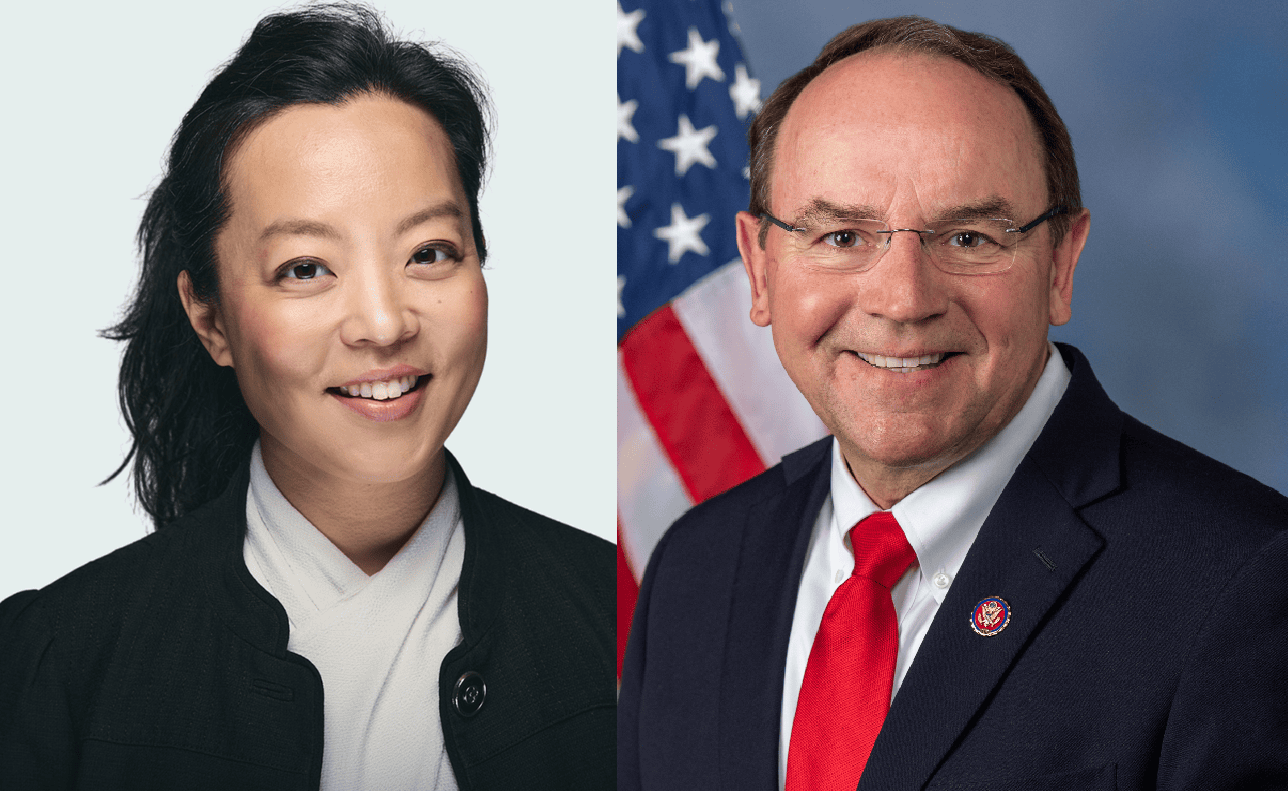
An internal memo from the campaign of U.S. Rep. Tom Tiffany obtained by the Milwaukee Journal Sentinel is offering a blunt warning to Republicans: Democratic state Rep. Francesca Hong is not just a contender for governor—but she may be a far more serious threat in November than people think.
The memo, authored by campaign advisers Clinton Soffer and Chris Hansen, argues that Hong has “solidified her position as a frontrunner” in the Democratic primary and is rapidly emerging as the most formidable opponent Republicans could face in a general election.
Citing recent polling, including Marquette Law School surveys, the memo notes that Hong has consistently led a crowded Democratic field, with higher support among voters who have already made up their minds. That advantage, the memo argues, is only growing as her name recognition increases through grassroots organizing and media attention.
Hong, who initially branded herself as the “wildcard” in this packed Democratic primary has quickly emerged as an unlikely frontrunner–running what has so far been a grassroots driven campaign that has allowed Hong’s natural creativity and personality to garner earned media in a way that none of her fellow primary challengers have thus far been able to match.
Her strategy, along with her more populist messaging focused on kitchen table issues and working class voters, has created a broad coalition that the Tiffany camp acknowledges makes her a serious threat in November.
Described as “the most progressive candidate in the race,” Hong is drawing strong support from younger, urban, and highly engaged Democratic voters—groups that tend to turn out at higher rates when energized.
That enthusiasm, the memo warns, translates into a tangible advantage on the ground: volunteers, small-dollar fundraising, and organized door-knocking operations that could outpace more traditional Democratic campaigns.
The campaign also highlights the broader electoral environment. In a midterm-style election, turnout dynamics often determine outcomes—and Hong’s ability to mobilize the Democratic base in vote-rich areas like Dane County and the Milwaukee media market could prove decisive.
A “Mamdani-Type” Threat Emerging in Wisconsin
The Tiffany team explicitly frames Hong as a “Mamdani-like threat”—a reference to the kind of insurgent, left-wing candidate who can consolidate ideological voters, dominate grassroots organizing, and turn what might otherwise be a conventional election into a turnout-driven fight.
That comparison is telling.
Like New York’s Zohran Mamdani, Hong is unapologetically ideological, comfortable with the “democratic socialist” label, and focused heavily on economic populism—targeting corporate subsidies, cost-of-living pressures, and what she frames as systemic inequities.
The memo’s concern is that this combination is not just energizing the Democratic base—it’s creating overlap with traditionally Republican populist messaging on issues like affordability and economic frustration.
In a lot of ways, Hong is becoming the Democrat Socialist equivalent of President Trump–an outsider type of candidate whose unorthodox and blunt type of messaging bucks traditional establishment norms, but appeals to voters who feel like they have been left behind by the establishment of their party. In 2016, Democrats made the mistake of underestimating Trump’s widespread appeal. Tiffany’s camp warns Republicans of making the same mistake ten years later.
Hong’s Messaging Creates Challenges For Republicans, But Also Offers Plenty of Opportunities
While questions continue to linger about whether or not a Democratic Socialist could win statewide in a traditional 50/50 state in America’s Heartland, polling suggests that Hong is no longer the fringe of the Democrat Party–but rather, she is emerging as the leader of it.
The Tiffany memo acknowledges that Hong’s focus on “kitchen-table” issues—childcare, taxes, and cost of living—has tested well with voters beyond the Democratic base, including independents and some working-class constituencies.
That presents a messaging challenge. Traditional attacks centered solely on ideology may not be enough if voters perceive her proposals as directly addressing economic concerns.
At the same time, Hong’s record and online rhetoric poses a number of opportunities for Tiffany and his allies to exploit in a general election.
One issue that Tiffany’s team has already fought to tag Hong with has been her vote against bipartisan legislation that would criminalize adults who sexually groom children, with Hong arguing that the terminology would harm members of the LGBTQ community. Hong was just one of six Democrats in the entire legislature to vote against this effort, which Governor Evers signed into law.
Hong’s previous rhetoric calling for “defunding the police” and abolishing ICE could also come back to haunt her, as we saw with Mandela Barnes’s unsuccessful Senate race just four years ago–with Senator Ron Johnson making those positions the focal point of his election as he successfully painted Barnes as a radical whose values were vastly out of touch with Wisconsin.
Even Hong’s Democrat rivals in the primary are beginning to raise concerns about her electability, with Lt. Governor Sara Rodriguez recently telling a group of College Democrats that she “worries” about Hong’s ability to win the general.
Insiders have also pointed to polling that shows Hong as the weakest head-to-head opponent for Tiffany in November as cause for concern. With what is expected to be a favorable environment for Democrats this November and with Democrats eyeing a potential trifecta in Wisconsin, Democrat insiders are worried that a Hong candidacy could cost them a golden opportunity this fall.
Those quiet concerns about Hong’s electability are only expected to grow louder as she continues to gain momentum.
Still, the message from the Tiffany memo is clear: underestimate Hong at your own peril.
“Treat Hong as a very probable nominee,” the memo advises, warning that her combination of grassroots energy, economic messaging, and turnout potential makes her uniquely positioned to turn the 2026 race into a base-driven contest.
For Republicans, that means preparing now for a candidate who may not fit the traditional mold—and who, if the memo is correct, could reshape the dynamics of this fall’s gubernatorial election.
