


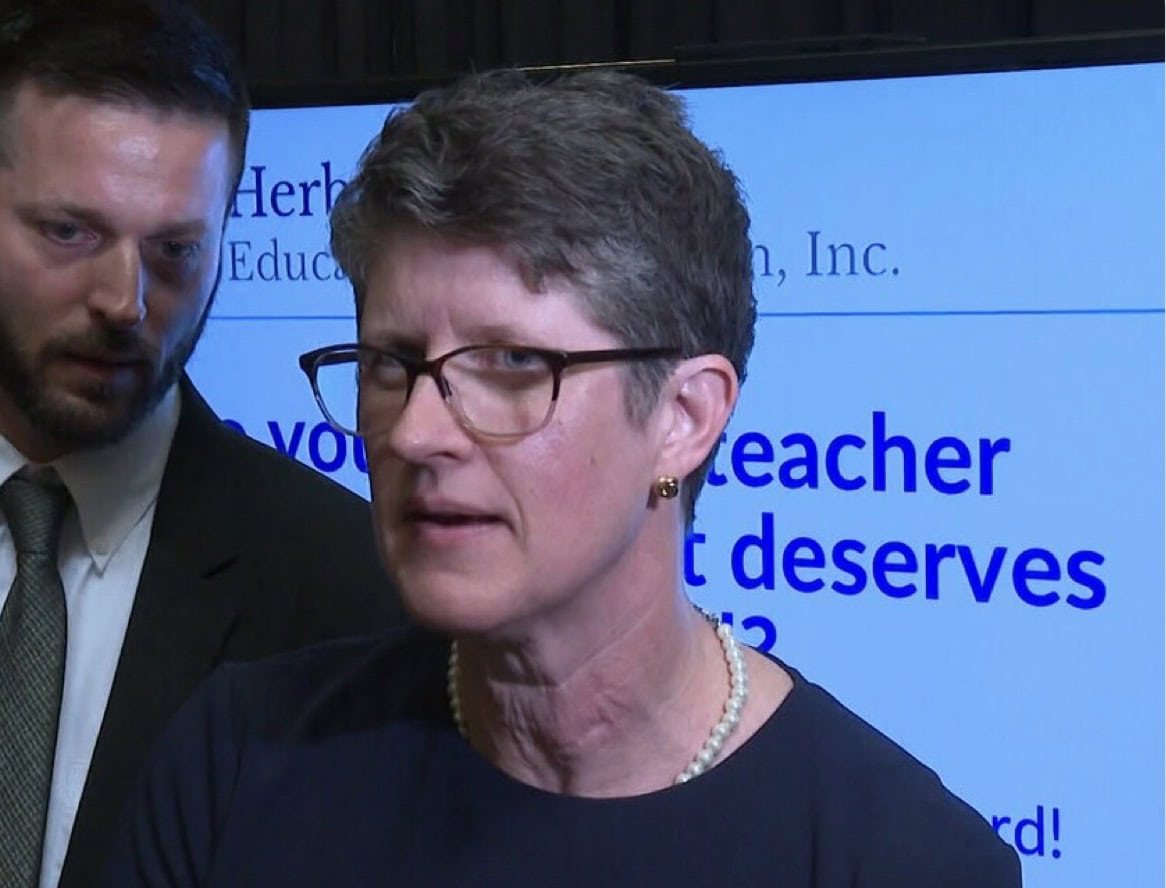
State Superintendent Jill Underly used her sixth State of Education Address on Thursday to tell Wisconsinites the problem with public schools is that they don’t have enough money.
Speaking in the Capitol Rotunda, Underly blamed “decades of below-inflation funding,” attacked school choice as a diversion of public dollars into “unaccountable, private systems,” and urged voters to elect leaders who are “pro-public school, pro-child and pro-Wisconsin.” What she did not do is explain why near-record spending has produced weak achievement, why report cards look better than national tests, or why districts keep adding adults while they lose children.
Furthermore, school choice lets parents leave a school that isn’t working and take the state aid with them, so the money follows the student instead of protecting a ZIP code. Families use it because those options often deliver stronger reading gains at a lower public cost.
The money is already there
The Wisconsin Institute for Law & Liberty reports district revenue at about $18,746 per student for 2024-25, up in raw dollars and close to the inflation-adjusted peak from before Act 10. Wisconsin Manufacturers & Commerce puts current funding near $18,592 per student, roughly double the 2000 level and more than 50 percent higher than one year of UW-Madison tuition.
WILL’s Will Flanders has made the obvious point: if this is “underfunding,” critics should say what number would finally be enough. Of course, Underly didn’t.
Plus, enrollment is falling. DPI data show tens of thousands fewer public-school students than a decade ago. The Wisconsin Policy Forum found a 9.2 percent enrollment drop since 2011 even as overall staffing rose 7 percent. Classroom teachers barely moved. Paraprofessionals jumped nearly 31 percent. Other licensed staff, including district personnel, principals, counselors and support roles, rose nearly 16 percent.
The Institute for Reforming Government’s review of DPI staffing reports is even more stark: Wisconsin public schools now employ about 113,000 staff for fewer than 792,000 students, about one adult for every seven children, while educating the fewest public-school students since 1991. From 2010 to 2025, national data cited by IRG show Wisconsin added fewer than 1,000 teachers and more than 11,000 non-teachers while losing more than 65,000 students.
WMC’s briefing before the speech put the staffing mismatch this way: over two decades, enrollment fell about 7 percent, administrative staffing rose 40 percent, non-teaching staff rose 28 percent, and teacher positions fell 2 percent.
Referendums follow that math. When districts keep the staff and lose the pupils, the per-child cost spikes and the ballot questions multiply. Underly treated those votes as proof the state is starving schools. They are also proof local systems refuse to shrink to the students they actually have.
Then come the results
WMC notes that nearly two-thirds of Wisconsin students are below grade level in math and about seven in ten are below grade level in reading, even as DPI report cards rate 94 percent of schools as meeting or exceeding expectations. WILL has documented that DPI lowered report-card cut scores and relabeled Forward Exam categories, which made state scores look healthier while NAEP results stayed poor. Wisconsin still lags its 2019 peers and ranks near the bottom of states with available data on post-2022 recovery in reading and math.
That is the record Underly skipped. She said schools, teachers and students are not the problem. The problem, in her telling, is everyone who will not write a larger check.
AFP-Wisconsin called the speech what it was
Americans for Prosperity-Wisconsin answered the address the same day under the headline that Underly’s speech “follows failed results.” The group’s point was not that public schools do not matter. It was that another lecture about funding is a substitute for accountability.
AFP-WI State Director Megan Novak
Wisconsin families don’t need another speech. They need results. Instead of raising the bar, Jill Underly’s DPI lowered it and now parents can’t track whether their child or their school is actually improving. That is not the transparency parents need to make the best decision for their children.
AFP-WI also flagged racial achievement gaps and stalled reading gains, the issues Act 20 was supposed to force into the open. Underly mentioned gaps, then returned to the formula. She did not own DPI’s decision to make it easier to achieve a passing grade.
The release fits AFP-WI’s long-running “fund students, not systems” argument. If the dollars followed the child, districts that lose enrollment would have to compete. If report cards told the truth, parents could see which schools are failing. Underly’s speech ran the opposite direction: protect the system, squeeze the taxpayer, treat family options as a raid on public schools.
Choice and independent charter schools receive thousands less per pupil than traditional districts and still post stronger gains in multiple WILL analyses. That fact is inconvenient if the only allowed answer is a bigger appropriation.
A different roadmap already exists
A day before the speech, WILL released a new report entitled, The Wisconsin Education Comeback. The Wisconsin Education Comeback details 26 recommendations built around opportunity, parental authority, transparency and funding what works.
Kyle Koenen, WILL’s director of policy, notes the contrast:
Wisconsinites are tired of being told that more funding is the only answer to improving education. We should be focused on reforms that actually raise student achievement. States like Mississippi and Louisiana have shown that better outcomes do not require higher spending. Wisconsin needs to be more willing to challenge the status quo, give families more options, and hold schools accountable for results. The Wisconsin Education Comeback gives policymakers a roadmap for doing that.
Mississippi’s reading gains came from phonics, screening, and refusing to socially promote children who cannot read, not from matching Wisconsin’s central-office headcount. Louisiana moved in the same direction. Wisconsin passed Act 20 and then watched DPI soften the gauges parents use to judge whether it is working.
The choice Underly actually offered
Underly closed with a civic sermon about America’s 250th anniversary and a warning that democracy itself is at risk if lawmakers do not “invest.” Wisconsin already invests. It spends near historic sums per child. It employs a record number of adults for a shrinking student body. It tells families most schools “meet expectations” while most students still cannot do grade-level work.
Underly may have asked the state to invest, but taxpayers already have. What they haven’t received is schools that shrink to fit the kids they serve and scores that accurately reflect how those kids are doing.
