


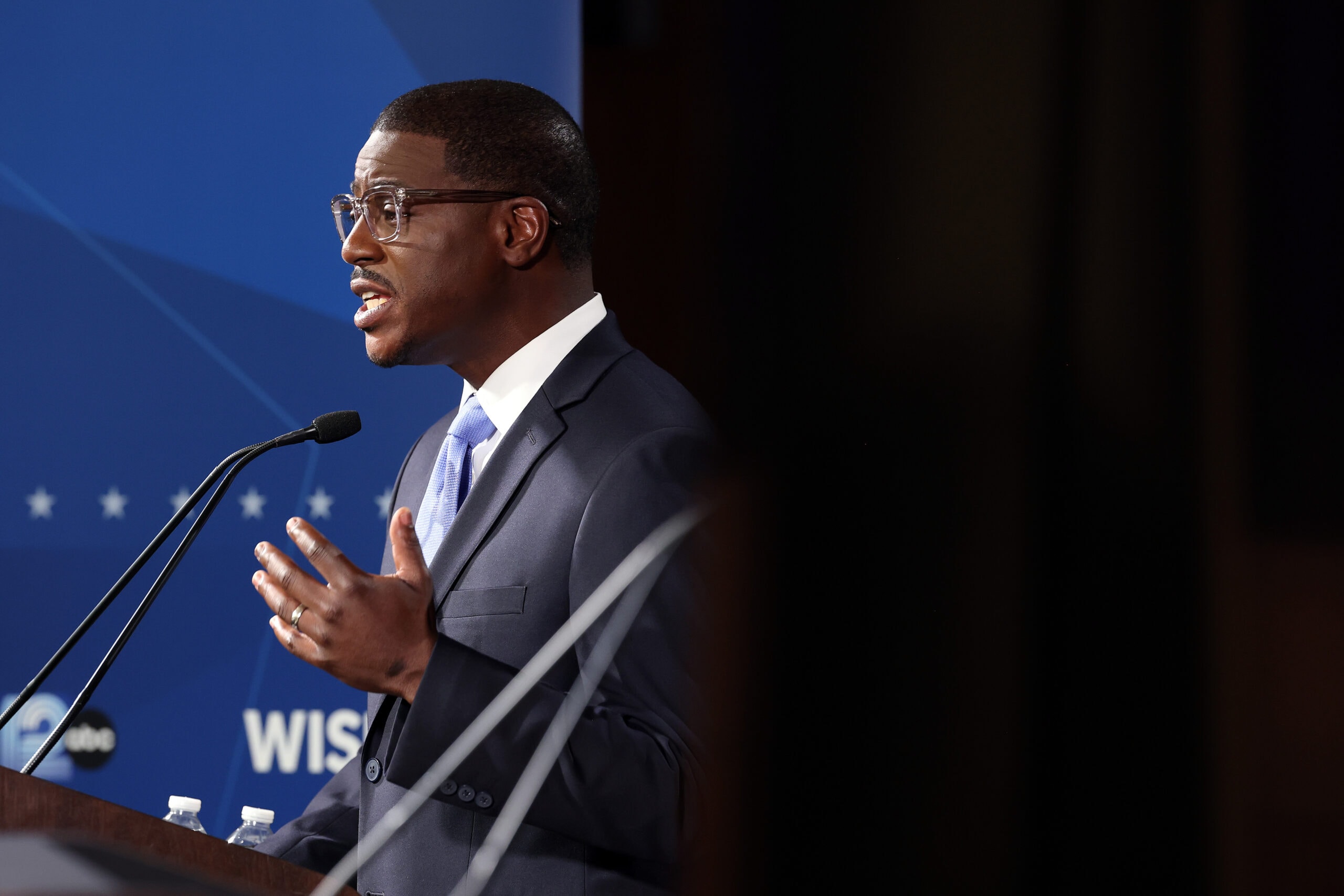
Democrats got their trifecta Tuesday. David Crowley beat Tom Tiffany 54.1 percent to 45.9 percent, Democrats flipped the state Senate 18-15 and the Assembly 53-46, and for the first time since 2010 one party controls the governor’s office and both houses of the Legislature.
That answers who won. It doesn’t answer who’s in charge. Crowley is the face of the party now, but he got there as the establishment candidate, the same wing the socialist left spent all summer calling “corporate Democrats.” The people who called him that didn’t go away. Many of them are about to be in the majority.
The Corporate Democrat and the Socialist Caucus
Crowley didn’t win the nomination so much as get carried to it. He dropped out in July, returned with Tony Evers’ endorsement, and beat Francesca Hong by about 3,200 votes, 315,413 to 311,740, after trailing her by double digits in every public poll. Over a third of Democrat primary voters told pollsters the Evers endorsement was the reason.
The left saw that for what it was. Two days after the primary, Wisconsin’s DSA chapters put out a statement bragging that Hong gave “corporate Democrats and their wealthy donors a literal run for their money” and demanding Crowley adopt her platform. The Wisconsin Electoral Socialists sent him an open letter asking for a data center moratorium and a new top tax bracket.
Hong endorsed him and hit the road, but she told WISN that Crowley still had to show her supporters “that he shares our values.” State Rep. Ryan Clancy, part of the Legislature’s four-member Socialist Caucus, put it more plainly: “We need Crowley to throw us a bone.”
That’s the setup for January. Crowley will be signing the bills and budget, but he needs a 53-seat Assembly and an 18-seat Senate to give him anything to sign. Leadership in both chambers and the activists who built those majorities will decide what lands on his desk. Then there’s the money.
Who Was Really Running the Evers Office
If you want to know how a Democrat governor gets pulled left, look at the past eight years.
Maggie Gau ran Evers’ 2018 campaign and became his chief of staff right after. She called herself his “closest adviser” and came to the job out of the office of Madison Rep. Chris Taylor, one of the most liberal members of the Assembly.
Evers sold himself as a mild former school superintendent. Even in his first year, people around the Capitol accused him of letting his staff push him to be more partisan. Gau called that “total BS,” and Evers said he was “just not pushable.” Then in 2020 his staff secretly recorded a call with Republican legislative leaders, and Evers said he didn’t know it was happening. That is a funny way to be unpushable.
My read is simple. Evers was never the one driving. Mandela Barnes even admitted this on a recent podcast. He said he had to step in to save Evers at press conferences. Tony was the friendly face out front, happiest when losing a pickleball game with Kathy or thanking “our pickleball crew” on Thanksgiving, while the people he hired wrote the budgets and picked the fights. Look at what came out of that office: a 100 percent carbon-free by 2050 executive order, Medicaid expansion in every budget, and one veto fight after another. That is not the agenda of a sleepy superintendent. It is the agenda of the progressive staff.
Crowley inherits that machine, and the same professional class of Madison staffers will fill his office. If they could push the most cautious governor in the country left, imagine what they’ll do with a Democrat Legislature.
Evers had Gau. Crowley already has the Secretary of State. JoCasta Zamarripa hasn’t been sworn in yet, and she has already handed him his first assignment. Last month she said her “number one priority is to see the governor sign driver’s licenses for undocumented Wisconsinites into law,” and she hoped that governor would be Crowley, a bill she has carried since her days in the Assembly. Crowley answered “yes” at a candidate forum when asked if he supports driver’s licenses for illegal immigrants, so it won’t take much of a push.
A Trifecta With No Brakes
For eight years, Republicans in the Legislature were the only thing standing between Wisconsin and the full Evers wish list. Starting in January, that check is gone. Nothing has to be negotiated. Nothing has to survive a veto.
The list is already public. Every Democrat who ran for governor this year backed a full repeal of Act 10. Hong promised to repeal right-to-work and bring back prevailing wage. Sen. Kelda Roys vowed to end the statewide voucher program starting in the 2027-28 school year. Add in expanding BadgerCare, writing abortion into the state constitution, legalizing marijuana, raising the minimum wage and spending down the surplus. Senate Majority Leader-to-be Dianne Hesselbein says Democrats want to know “on day one” what they’re doing.
Crowley says he won’t sign a bill cutting Milwaukee vouchers. He’s never had to say no to his own majority before. The socialists already told him what they want, and they told him he owes them.
Here’s the part Democrats haven’t thought through. With no Republican hand on the brakes, every bill Democrats pass in 2027 is theirs alone, and so is every result voters feel in 2028. If property taxes rise when Act 10 goes away, that’s on them. If school choice families in Milwaukee lose their spots, that’s on them. If the surplus disappears and the next budget has a hole in it, nobody gets to blame Robin Vos. Democrats will have to go back to the same swing voters who elected Crowley as the safe choice and explain why they got Francesca Hong’s platform.
The Open Seats Are Lining Up
The socialist left also has something it hasn’t had in years: open doors.
Start with Milwaukee County. Crowley must resign as county executive before he’s sworn in as governor in January. County Board Chair Marcelia Nicholson-Bovell becomes acting county executive, appoints an interim, and faces a special election that could be on the February and April ballots. She says she’s running. Chris Larson ran for Milwaukee County executive twice, losing to Crowley in 2020 by just 1,039 votes. Marquette’s analysts found that Hong and Larson won almost the same parts of Milwaukee County against Crowley. Larson says he isn’t planning a third run for county executive, but with the position opening up, he may rethink his position.
Then there’s Congress. Rep. Gwen Moore, 75, won again Tuesday, but a democratic socialist challenger, with no campaign infrastructure, took 28 percent against her in August. The rumor is this is her last term. In Madison, Rep. Mark Pocan has held elected office since 1999, and there’s similar talk that he could step aside in 2028. Neither has said so. But if either seat opens, it’s the most valuable real estate the socialist left could ask for.
More seats will likely open up too. Crowley will need to fill his cabinet and administration with people he trusts to carry out his agenda, and safe legislative seats are a place to find those people. Socialists could also win more special elections to fill those seats.
Hong gave up her Assembly seat to run for governor, so she’s out of office in January. She leaves with more than 311,000 primary votes, a statewide list and national attention. A Madison congressional seat or the open Mayor’s office would fit her like a glove. So would a 2028 Senate primary against an establishment pick.
So Who Runs It?
Crowley has the title. The establishment has the governor’s office and the donors. But the socialist left has the energy, a caucus inside the majority, a list of demands Crowley already heard and agreed to in the primary, and a stack of open seats coming in 2027 and 2028.
If the last eight years taught us anything, it’s that the person at the Governor’s desk isn’t always the one running the place. Republicans should spend the next two years making sure voters know exactly who passed what, and who has to answer for it.
