


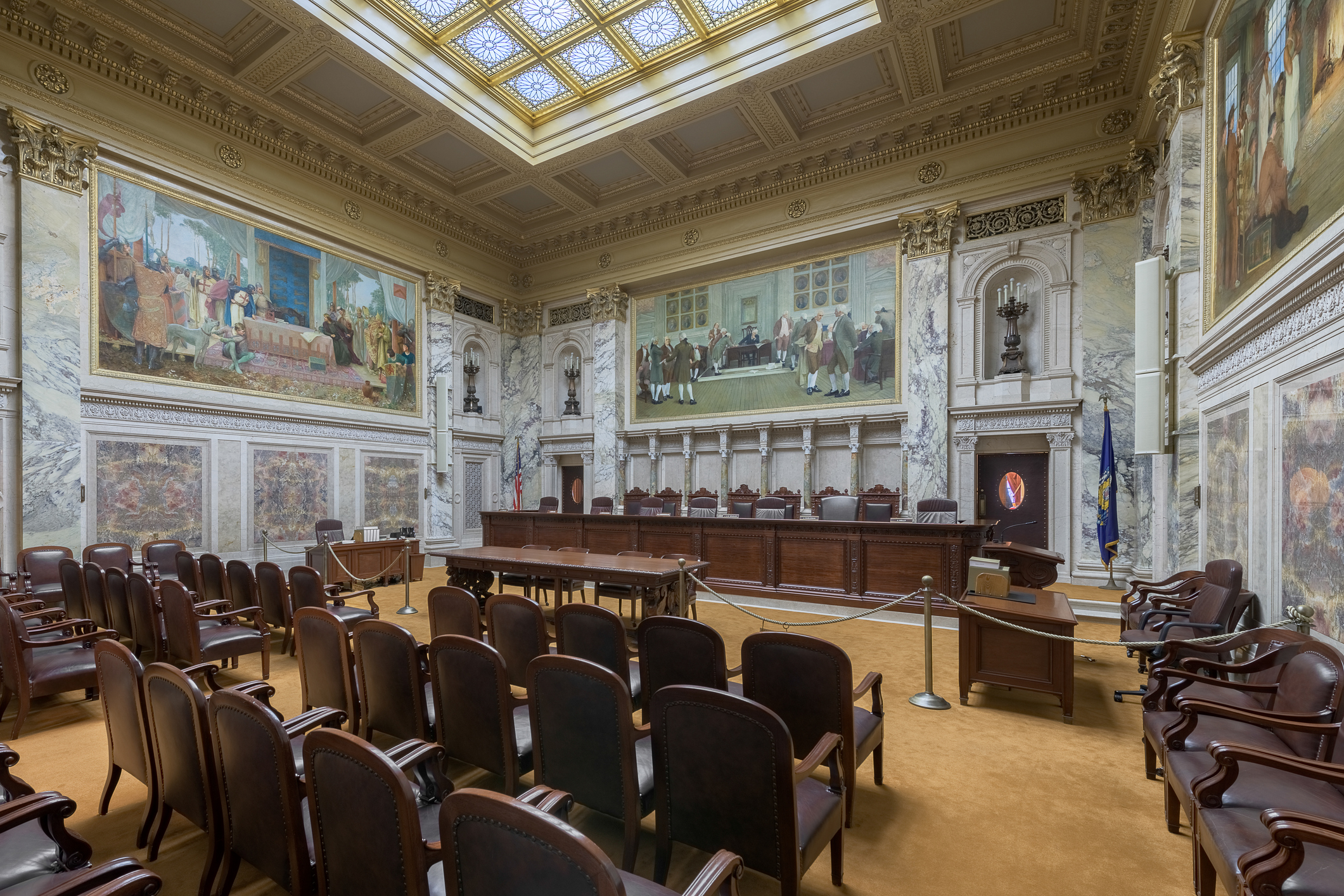
When the Wisconsin Supreme Court hears arguments in the latest challenges to the state’s congressional maps, much of the attention will inevitably focus on the politics. Set against the backdrop of the national scramble from red states and blue states to re-draw their congressional maps ahead of the 2026 midterms, Wisconsin’s ongoing legal battle over the maps will set the stage for the national redistricting fight headed into the 2028 presidential election.
Much of the conversation around the latest court challenge to the Evers-drawn congressional maps will center around the following questions: Which districts could change? Which party stands to benefit? And could a new map alter the balance of Wisconsin’s congressional delegation?
Those are understandable questions. But they risk overshadowing a much more consequential one at the heart of these cases: Can a lower court overrule the Wisconsin Supreme Court?
On its face, the answer would seem obvious. Wisconsin has a judicial hierarchy for a reason. Circuit courts sit at the bottom, the Court of Appeals sits above them, and the Wisconsin Supreme Court sits at the top. The Supreme Court reviews decisions made by lower courts. Lower courts do not sit in judgment of decisions made by the Supreme Court.
Yet that seemingly basic principle has become the central problem in the latest redistricting litigation.
The current congressional districts were proposed by Democratic Gov. Tony Evers and adopted by the Wisconsin Supreme Court in 2022. When two new lawsuits were subsequently filed by liberal organizations seeking to overturn those maps, the Supreme Court relied on a little-used state statute to appoint two separate three-judge panels composed of left-leaning circuit court judges to hear the challenges.
Think about what those judges were being asked to do. A collection of circuit court judges — each individually subordinate to the Wisconsin Supreme Court — was being asked to determine whether a final judgment of the Wisconsin Supreme Court was unconstitutional and potentially replace the congressional districts the Supreme Court itself had ordered into effect.
Conservative justices Annette Ziegler and Rebecca Bradley immediately recognized the problem.
Ziegler warned that the court was effectively surrendering part of its constitutional authority to lower courts. Bradley focused on an even more basic principle: “The Wisconsin Constitution is superior to the Wisconsin Statutes.” In her view, the Legislature cannot accomplish through an ordinary statute what the state Constitution does not permit — giving lower courts authority to review a final judgment of the state’s highest court.
Those concerns are easy to dismiss as partisan objections in the politically charged world of Wisconsin redistricting. They shouldn’t be.
Altering the long held institutional foundation of how our judicial system is structured would completely erode justice itself.
Take congressional maps out of the equation entirely and reverse the politics.
Imagine a future Wisconsin Supreme Court with a conservative majority issues a final ruling on a hot button political question–say the participation of biological boys in girls sports. Liberal activists strongly disagree with the result and bring a new lawsuit forward in Dane County. Circuit court judges are then asked to decide that the Supreme Court got the constitutional question wrong and effectively overturn its judgment. Given the politics of Dane County, it isn’t hard to imagine how that could play out.
A liberal Supreme Court issues a controversial ruling. Conservative plaintiffs find sympathetic circuit court judges somewhere else in Wisconsin, ask them to reconsider the same constitutional question, and those judges decide the Supreme Court got it wrong and strike down its ruling. Would the people cheering this half-baked legal theory today be celebrating that outcome? Probably not.
Altering the long held institutional foundation of how our judicial system is structured would completely erode justice itself.
The structure of our court system cannot depend on who happens to control the Supreme Court or whether you like the outcome of a particular case. If circuit court judges can simply revisit constitutional questions already decided by the Wisconsin Supreme Court and reach the opposite conclusion, then what exactly makes it the “Supreme” Court?
Wisconsin has an appellate hierarchy for a reason. Courts inevitably disagree. Judges interpret constitutional provisions differently. Political control of courts changes. But there must ultimately be a final judicial authority, and under Wisconsin’s Constitution that institution is the Wisconsin Supreme Court.
The strangest part of the current redistricting fight is that the three-judge panels themselves eventually demonstrated the problem.
Both panels dismissed the challenges. They did not determine that Evers’ congressional maps were perfectly fair or that the challengers had no legitimate objections to them. Instead, the circuit judges confronted the reality of their own position in Wisconsin’s judicial hierarchy. The Wisconsin Supreme Court had already spoken, and as lower-court judges, they were bound by Supreme Court precedent.
Consider the circle Wisconsin’s judiciary has now traveled.
The Wisconsin Supreme Court adopted Evers’ congressional maps. New plaintiffs challenged that result. The Supreme Court appointed lower-court judges to hear those challenges. The lower-court judges concluded they lacked the authority to provide the requested relief because they could not overrule the Supreme Court. The challengers then appealed those decisions back to the very Supreme Court whose original judgment they are attempting to undo.
You couldn’t invent a better illustration of the constitutional concern if you tried, to the point where one has to consider whether or not the potential collapse of our judicial hierarchy was the intended outcome from the start.
The liberal Supreme Court is now tasked with addressing the question at hand, and the answer could matter well beyond the boundaries of Wisconsin’s eight congressional districts.
The danger in cases like this is allowing an immediate political objective to obscure the precedent being established along the way. Wisconsin’s Supreme Court will not always have the same ideological composition. Neither will its circuit courts. A procedural mechanism that seems useful when it produces one political outcome can look considerably different when control of the judiciary changes hands.
Ziegler and Bradley’s warnings ultimately boil down to a remarkably simple question: Who gets the final word?
Article VII of the Wisconsin Constitution gives the Supreme Court “superintending and administrative authority over all courts.” The constitutional structure places circuit courts beneath it. However unusual or politically contentious a Supreme Court decision may be, allowing inferior courts to exercise something resembling appellate authority over the state’s highest court risks turning that structure on its head.
The justices can debate whether the statutes governing three-judge redistricting panels can be interpreted in a way that avoids that constitutional problem. They can debate whether these particular plaintiffs are entitled to relief. And they can debate whether Wisconsin’s congressional maps comply with every provision of the state Constitution.
But the institutional question should transcend all of those disputes. Today the issue is Tony Evers’ congressional maps. Tomorrow it could be something entirely different.
Wisconsin should be extremely careful about establishing a principle under which the answer to a Supreme Court decision someone dislikes is to find a way for lower-court judges to reconsider it. Because eventually the political composition of the courts will change, the parties will switch places, and everyone will have to live under the same precedent.
This fight may have begun with eight congressional districts. Its most lasting consequence could be determining something far more fundamental about Wisconsin’s judiciary: whether a decision of the Wisconsin Supreme Court is actually supreme.
