


David Crowley pitches himself as a job creator. But his rhetoric is sharply at odds with his record.
Milwaukee County lost nearly 18,000 private sector jobs since he took over as county executive.
And as governor his policies would chill job creation in Wisconsin.
To date the media has given David Crowley’s record on jobs a good leaving alone. But campaign promises should be measured against actual results.
First the numbers. Then his policies.
Job numbers tell a different story
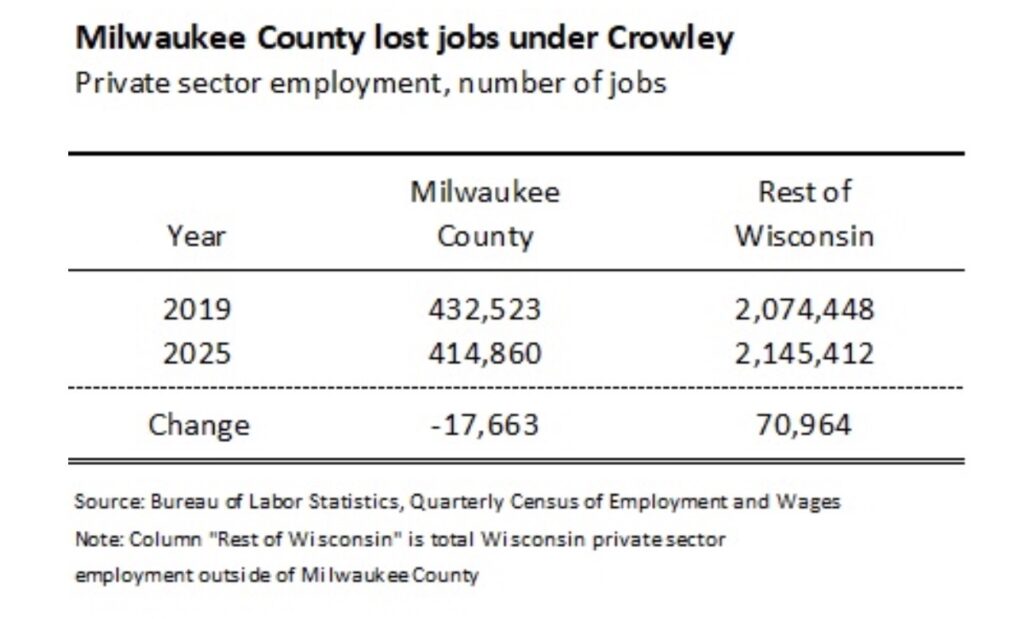
The table below contains private sector employment in Milwaukee County in 2019 and 2025. The figures are monthly averages over the year as reported by the U.S. Bureau of Labor Statistics.
David Crowley became county executive in May 2000. For that reason, I use 2019, the year before he took office, as my baseline.
In 2019, Milwaukee County had over 432,000 private sector jobs. By 2025, private sector employment in Milwaukee County had shrunk to less than 415,000.
During Crowley’s tenure as county executive, Milwaukee County had a net loss of almost 18,000 private sector jobs.
When candidate Crowley is confronted with the failures and shortcomings of his administration, he often attempts to shift blame to the Republican legislature or Donald Trump.
Candidate Crowley prefers to blame the Republican legislature or President Trump when he is confronted with his failures. The problem with that explanation is that the rest of Wisconsin gained jobs while his Milwaukee County lost jobs.
The problem with blame shifting on jobs is that the rest of Wisconsin gained jobs at the same time Milwaukee County lost them.
In the six years since 2019, Milwaukee County lost nearly 18,000 jobs while the rest of Wisconsin gained 71,000.
Try as he may, David Crowley can’t lay Milwaukee County job losses on Republicans in the legislature … or Donald Trump … or COVID. Republican policies and those of Donald Trump apply statewide. The COVID virus doesn’t adhere to county boundaries. Rather, it’s David Crowley and his fellow Democrats that have been in control of Milwaukee County throughout.
County executives are responsible for business development
Wisconsin county executives have significant responsibilities for and influence over economic development. David Crowley himself states on the Milwaukee County website that business development is one of his priorities.
Business location decisions are driven by practical considerations: Are government finances sound and tax regimes stable? Can the transportation system get employees from home to work and back? And, most importantly, is there a semblance of civic and social order?
David Crowley’s Milwaukee County falls short in every one of these areas.
Milwaukee County has major fiscal challenges. Local businesses are rightly concerned about the county’s large, looming deficits, the direction of tax policy, and the quality of county services. The 2024 increase in county and city sales tax rates put Milwaukee retailers at a competitive disadvantage versus competitors in adjacent counties. What will be the consequences of future rounds of tax increases?
The county executive has primary responsibility for overseeing the management and finances of the Milwaukee County Transit System. MCTS finances are a mess. Business groups warn that further reductions in service will make it even more difficult for their employees to get to work.
And there is a sense of growing social disorder in Milwaukee County. The melee at the close of the Wisconsin State Fair which candidate Crowley cynically tried to blame on Republicans, the rise in street takeovers, and high rates of violent and property crime being just a few examples.
Further declines in private sector employment could send Milwaukee County into a doom loop. Fewer private sector jobs and less wealth creation mean higher tax rates and poorer services. Higher taxes and poorer services chase employers away. And so on.
Taking bad policies statewide
Despite massive private sector job losses during his tenure as county executive, candidate Crowley says he’ll bring more jobs to the state.
Promises aside, here are four Crowley policies that are certain to kill job growth in Wisconsin:
1. Minimum wage: Crowley wants to raise Wisconsin’s minimum wage to $15 an hour, the highest in the Midwest, and to $20 by 2030. But raising the minimum wage reduces employment. It’s what economists call the “law of demand,”when costs go up, demand goes down. The law of demand works for jobs too. When the cost of labor goes up, hiring goes down. Hardest hit will be younger and less experienced workers.
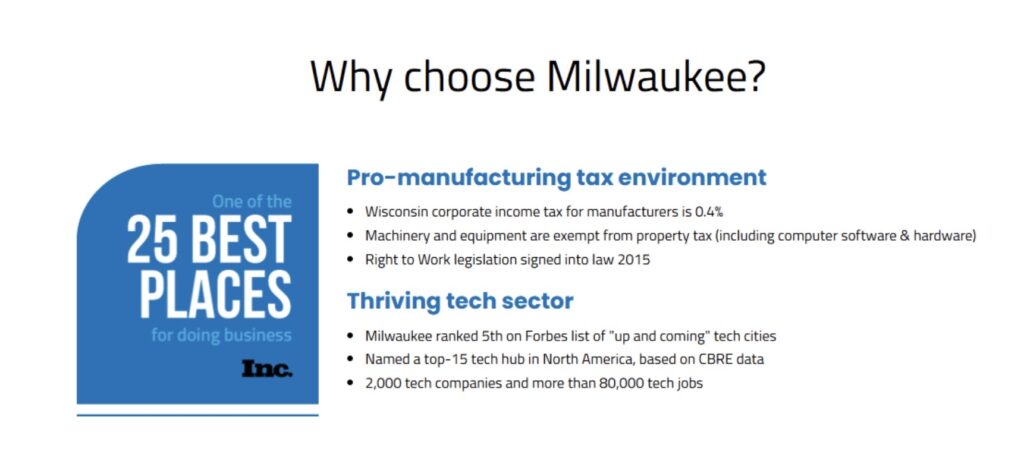
2. Right-to-work: Crowley wants to repeal Wisconsin’s 2015 right-to-work law. Right-to-work provides a check on union excesses by giving workers the right to opt out if they wish. Employers, particularly in the manufacturing sector, prefer to invest in right-to-work states. In fact, Wisconsin’s right-to-work law is cited by the Metro Milwaukee Chamber of Commerce as a top reason for manufacturing firms to locate in Southeast Wisconsin. Repeal of right-to-work would make it harder to attract companies to Wisconsin.
3. Higher taxes: Its clear from even a cursory review of Crowley’s website that he intends to spend big. But the money has to come from somewhere. Candidate Crowley’s promises to spend big are also promises to tax big. Wisconsin’s income tax rates are already among the highest in the nation. Taxes discourage work and investment. Still higher taxes will drive businesses and Wisconsin’s most innovative and entrepreneurial residents out of state.
4. Favoritism: One area of growth in Wisconsin is data center construction. However, David Crowley plans to exclude non-union contractors from data center construction work. This is clearly a payoff to his union supporters and financial backers. But it leaves the 80 percent of Wisconsin construction workers that are not union members out in the cold. Businesses want to compete on a level playing field. Basic fairness would allow anyone, Crowley supporter or not, the opportunity to bid and work on data center projects.
