


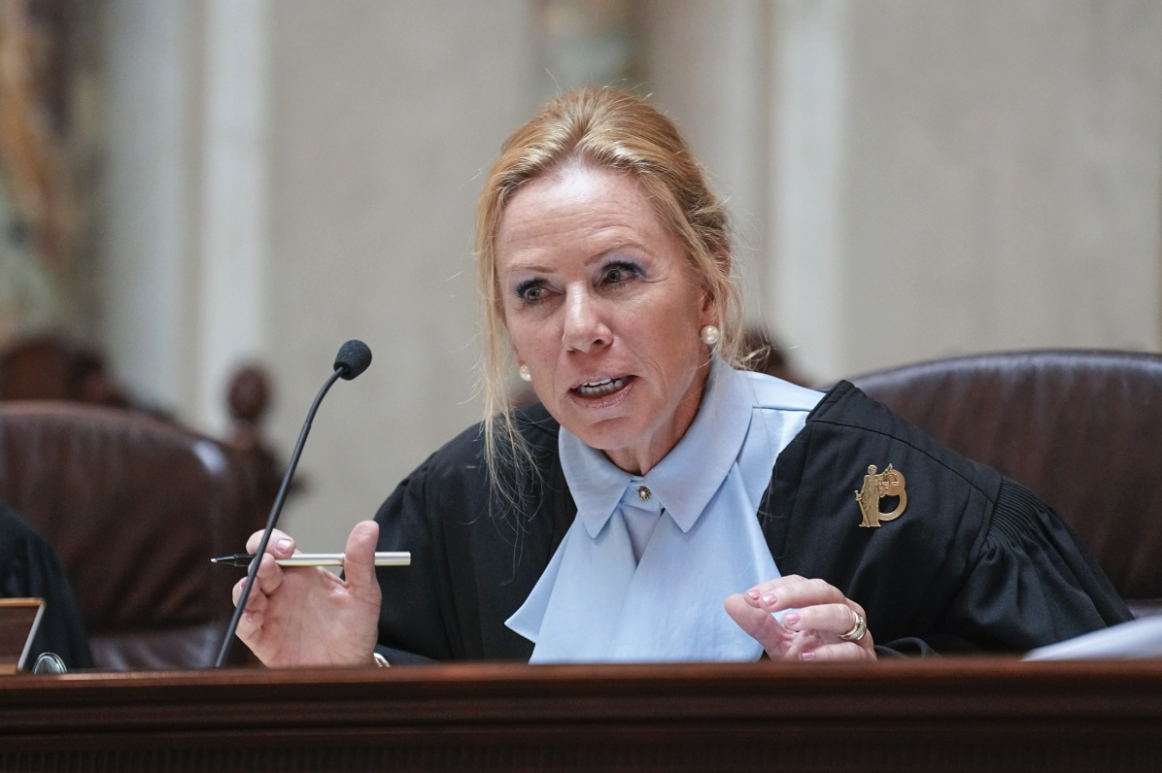
Ziegler has been on the court since 2007 but announced Monday that she will not seek re-election.
Over one year away from the 2027 April elections and with the 2026 Supreme Court election still on the horizon, Justice Annette Ziegler has announced she will not seek reelection in 2027. JR Ross of WisPolitics first reported the news.

Ziegler has been a member of the Wisconsin Supreme Court since 2007. She is known as one of the court’s conservative members and also served as Chief Justice.
Ziegler graduated from Hope College in Michigan in 1986 with degrees in psychology and business administration. She earned her law degree from Marquette University Law School in 1989, where she served as a staff editor of the Marquette Law Review. Over the years, she has received several honors, including the Dean’s Award, Marquette Law School Alumna of the Year in 2019, and the Distinguished Alumni Award from Hope College in 2014.
In 1997, Republican Governor Tommy Thompson appointed Ziegler to the Washington County Circuit Court, Branch 2, following the death of Judge James Schwalbach. She was the first woman to serve as a judge in Washington County. Ziegler was elected unopposed to a full term in 1998 and again in 2004.
While serving on the circuit court, Ziegler was the deputy chief judge of the Third Judicial District and the presiding judge of Washington County for six years. She also took part in the District II Court of Appeals Judicial Exchange Program in 1999. In 2007, she was elected to the Wisconsin Supreme Court, replacing Justice Jon P. Wilcox. She won the nonpartisan election against Linda M. Clifford with 58.61% of the vote and took office on August 1, 2007. Ziegler was reelected without opposition in 2017. This was the first unopposed Supreme Court election since 2006.
Ziegler was chosen by her colleagues as chief justice on April 14, 2021, with her term starting May 1, 2021, after Patience D. Roggensack. She served as chief justice until April 30, 2025, when Ann Walsh Bradley took over.
Ziegler has played a role in several major cases that show how the court has changed over time. In 2015, when conservatives held the majority, she joined a 5-1 decision to stop a John Doe investigation into Governor Scott Walker and conservative groups, ruling these activities were legal and did not require donor disclosure. More recently, with the court now having a 4-3 liberal majority, she dissented in Clarke v. Wisconsin Elections Commission, where she criticized the liberal justices for what she saw as judicial activism and ignoring legal procedures.
For what will likely be the fourth time in five years, conservatives face a tough challenge to keep a seat on the Supreme Court, as the liberal bloc now holds the majority, having won open seats previously held by conservatives in 2023 and 2025 and poised to win another seat next month. Conservative’s chances in recent elections have been hampered by changes in the candidate quality, national trends, and costly races.
