


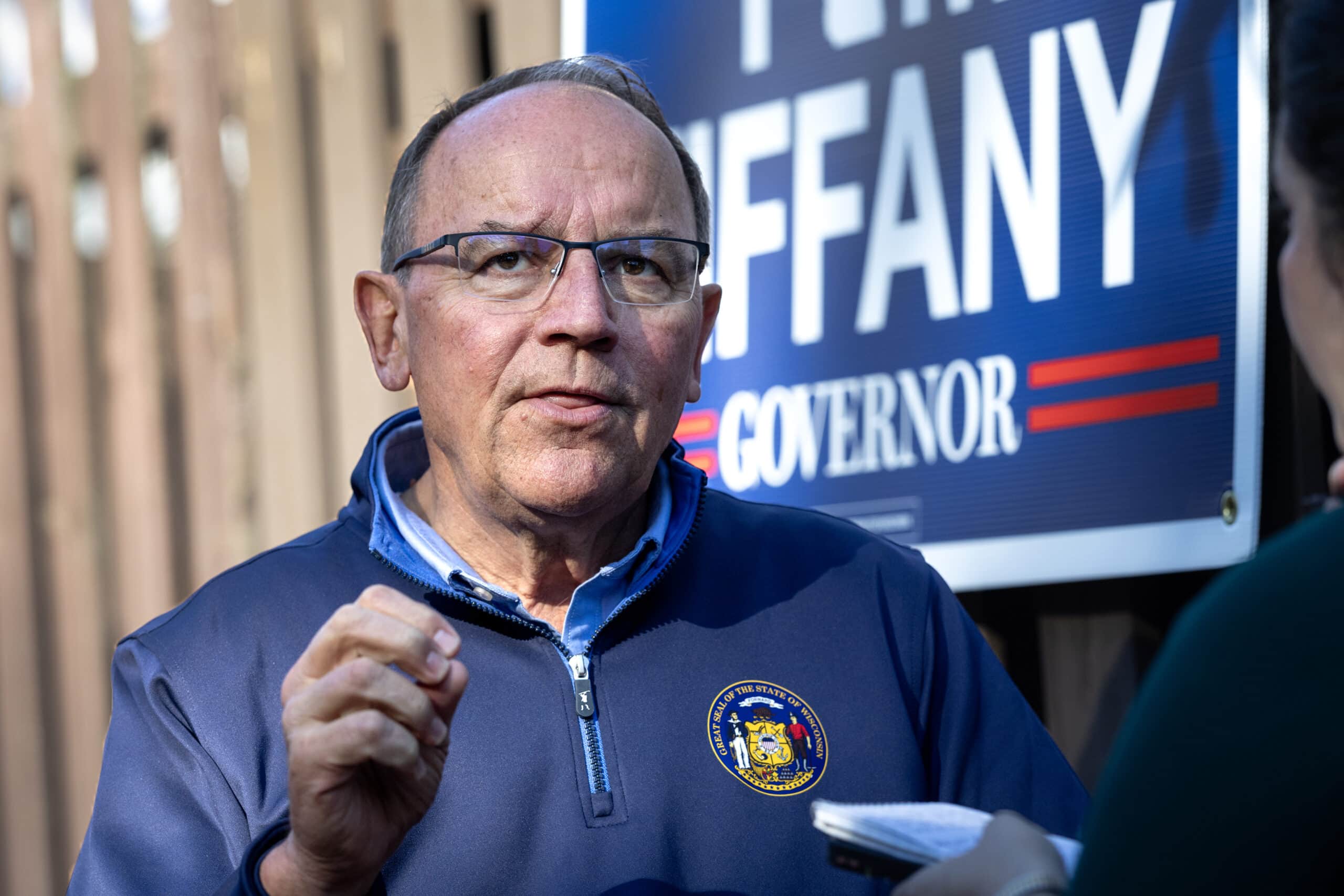
Republican gubernatorial candidate Tom Tiffany announced his education platform, the Parents and Teachers Bill of Rights, last week during campaign stops in the Green Bay area and Franklin.
The proposal focuses on parental rights, classroom safety, teacher authority, school transparency, and student well-being. Tiffany described it as a plan to increase accountability in Wisconsin schools.
“Every child deserves a safe classroom. Every teacher deserves the authority to maintain order, and every parent deserves to know what is happening in their child’s school,” Tiffany said. “That is the foundation of my Parents and Teachers’ Bill of Rights.”
The platform has three main components:
Parents Bill of Rights includes honest A-F school report cards to give parents a clear view of school performance, curriculum transparency so parents can review instructional materials, parental notification and consent requirements before a school changes a student’s name or pronouns or provides medical services, notifications about school safety issues such as violence or threats, and twice-yearly updates on a child’s academic proficiency and classroom behavior.
Teachers Bill of Rights would give educators clear authority to remove students whose violent or disruptive behavior threatens classroom safety or interferes with instruction. It would require behavior intervention plans before such students return to class, protect teachers from retaliation for enforcing rules or reporting unsafe conditions, and impose greater accountability on school districts and administrators.
Common Sense for Kids would prohibit biological males from participating in girls’ sports or using girls’ locker rooms and bathrooms in schools. It would also ban gender transition procedures for minors and prohibit taxpayer-funded menstrual products in boys’ bathrooms.
Tiffany has tied the plan to concerns raised in specific school districts. He referenced the New Richmond School District, which faces a federal lawsuit and a U.S. Department of Education Title IX investigation over policies allowing transgender students to use bathrooms according to their gender identity. He also cited reports from Winneconne High School involving families who said school officials used different names and pronouns for students without parental knowledge or against parents’ wishes.
Tiffany criticized the state’s current school report card system, which rated 94 percent of public school districts as meeting or exceeding expectations for the 2024-25 school year. However, Tiffany noted only 31 percent of Wisconsin fourth graders are proficient in reading (according to federal data) and said parents deserve clearer information about school performance.
The announcement came after the debate with Democratic opponent David Crowley in which education was a major topic. Similar parental rights legislation has passed the Republican-led Legislature in past sessions but was vetoed by Democratic Gov. Tony Evers.
Tiffany’s education positions include raising academic standards, strengthening reading instruction, supporting higher minimum salaries for teachers, and expanding career and technical education while increasing transparency and parental involvement.
Tiffany also supports Wisconsin’s school choice programs and has said families should have access to high-quality options whether public, charter, private, or homeschool. As a state legislator, he voted to create and expand the programs, including the Racine and statewide parental choice programs and the Special Needs Scholarship Program.
Wisconsin’s four parental choice programs—the Milwaukee Parental Choice Program, Racine Parental Choice Program, statewide Wisconsin Parental Choice Program, and Special Needs Scholarship Program—enrolled a record 63,000+ students in 2026-27, representing roughly 7–8 percent of the state’s K-12 students. Milwaukee accounts for the largest share (about 30,000 students), followed by the statewide program (about 25,000), Racine (about 4,000), and the special needs program (about 3,900). Parents rely heavily on these four programs to provide essential educational options for alternatives to traditional public schools, and record enrollment proves it is crucial to keep these programs firmly in place.
Early voting is underway ahead of the November 3 election. Register to vote or find out where to vote here: https://myvote.wi.gov/en-us/
