


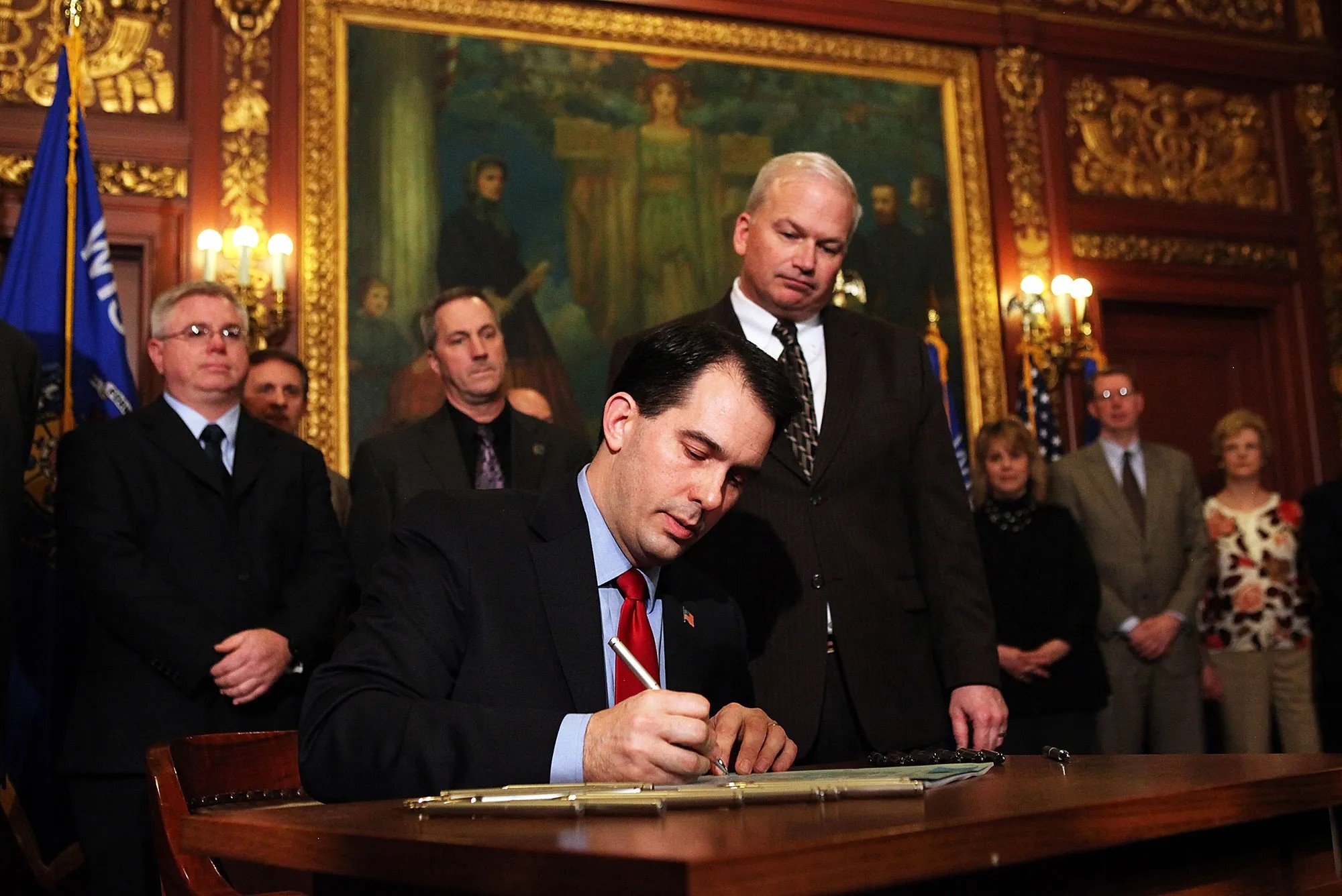
Fifteen years ago today, March 11, 2011, Governor Scott Walker signed Act 10 into law. This landmark conservative reform curbed out-of-control public union bargaining, required fair employee contributions to pensions and health benefits, and empowered local governments to manage budgets efficiently. Amid massive union-led protests, Republican lawmakers facing the possibility of recalls, and Democratic lawmakers fleeing to Illinois, Act 10 stood as a testament to principled governance over special-interest pandering and to the strong convictions of Republican state senators. By 2026, the verdict is clear: This law has been wildly successful, delivering massive taxpayer savings, balanced budgets, and a model for fiscal conservatism that other states envy. Liberals’ doomsday predictions of crumbling schools and a mass exodus of workers? Proven false. Instead, Act 10 has strengthened Wisconsin’s economy while promoting accountability and restraint.
At its heart, Act 10 curbed collective bargaining excesses by requiring public employees to contribute 50% toward their pensions and 12.6% toward their health insurance premiums. This aligned the public sector with private-sector norms, where workers do not get a free ride on taxpayers’ dime. This was not anti-worker; it was pro-taxpayer, preventing unsustainable benefit spirals that plagued states like Illinois. The proof is clear: According to the MacIver Institute’s analysis, Act 10 has saved $35.6 billion since 2012, with $13.8 billion from pension reforms that fully funded the system and $21.8 billion from health insurance changes.
These are not pie-in-the-sky numbers; they come from real data across Milwaukee, counties, and schools, showing how districts avoided tax hikes or cuts by seeking competitive benefits. The story does not end with past wins. Act 10’s ongoing value is most clear when considering the risk of repeal, as detailed in a new analysis from the Wisconsin Institute for Law & Liberty (WILL). Their report uses Department of Public Instruction data to estimate that repealing Act 10 would impose $1.788 billion in new annual expenses on school districts, as employee contributions disappear and costs return to pre-2011 levels. That is an average of over $22,000 more per full-time employee in some districts, potentially raising property taxes by $624 yearly for a $300,000 home.
WILL’s methodology—adjusting 2009 costs for inflation and comparing to today’s learner figures—highlights how Act 10 has kept spending in check, especially in districts that leveraged its flexibility. Repeal wouldn’t just erase these gains; it would empower unions to negotiate wasteful deals, shift burdens onto state aid, or force referendums, all while ignoring revenue limits that cap unchecked growth. But now, Democrat politicians, progressive judges, and the teachers’ unions are fighting to overturn Act 10, a decision that would be disastrous for taxpayers and upend years of fiscal responsibility.
The average property owner in the City of Waukesha would see their property taxes go up an additional $1,152 if Act 10 were repealed. In the Village, the average homeowner could see their tax bill increase by up to $1,765.These liberal efforts to repeal Act 10 have intensified through the courts, with unions filing a lawsuit in 2023 arguing the law’s unconstitutionality, leading to a December 2024 Dane County ruling striking down key parts of the law—though the ruling was stayed pending a Supreme Court appeal.
With the court’s growing liberal majority potentially deciding the fate of Act 10, and Democrats pushing related bills to undo other Walker-era union curbs, such as right-to-work, this assault risks billions in new costs statewide. Such a reversal would betray fiscal restraint, forcing tax hikes or cuts that hit families hard—proving once again why conservatives must vigilantly defend this cornerstone reform. Act 10’s triumph lies in its defense of limited government against entrenched union power. It turned Wisconsin from a high-tax, bureaucratic haven into a surplus-generating powerhouse, funding tax rebates, infrastructure, and education without the massive deficits that characterized the tenure of former Democratic governor Jim Doyle. And with federal efforts like the Department of Government Efficiency’s belt-tightening nationwide, repealing Act 10 would be a step backward into fiscal foolishness.
As WILL and Maciver warn, this isn’t abstract—it’s billions in real costs that hit families and communities hardest in places like Beloit and rural Plum City. In 15 years, Act 10 has saved fortunes, stabilized finances, and proven that conservative reforms work. It’s a legacy worth defending against any threat of repeal from the left. Wisconsinites, take note: Fiscal stability requires vigilance.
