



Conservatives are on a long losing streak in Supreme Court elections, but as Eric Brooks writes, two promising young conservatives who won last week offer a path forward.
Last week’s 20-point Supreme Court blowout was the exclamation point in a growing string of statewide spring defeats. From the moment Maria Lazar hit “send” on her four-minute campaign launch video, it was clear what kind of race she intended to run—and just as clear it wouldn’t be a winning one.
In that video, Lazar promised to be different. Instead, she doubled down on the same tired, uninspiring platitudes that have defined four of the last five losing conservative-backed candidates. She decried partisan politics and delivered a long-winded lecture on the rule of law and the role of the courts—the same script voters have already rejected time and again. Notably, she never once used the word “conservative.”
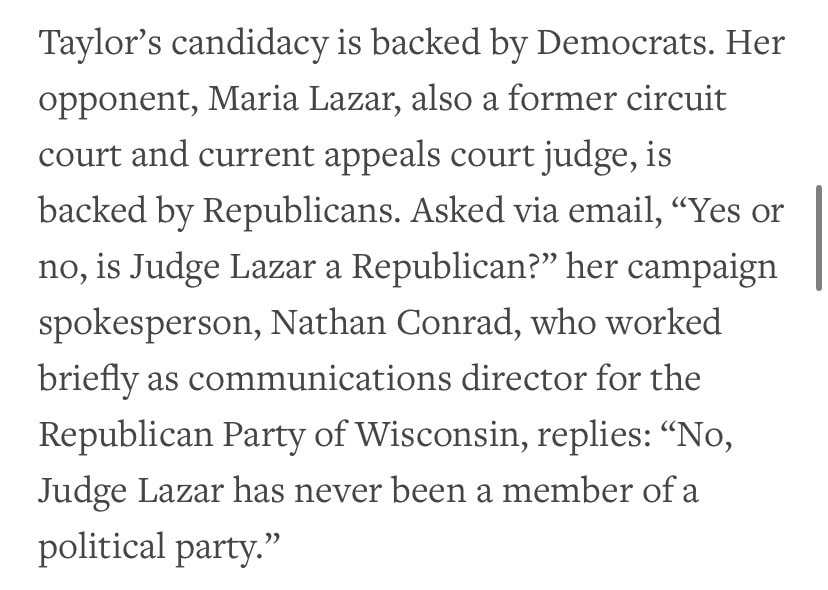
At first glance, that omission may have seemed accidental. In hindsight, it was anything but. Throughout the campaign, Lazar consistently avoided labeling herself a Republican or a conservative, even going so far as to correct reporters who did. The result was predictable.
(photo credit: The Isthmus)
While liberals fully understand that judicial races are partisan in practice—despite their nonpartisan labels—conservative candidates continue to run campaigns that feel designed to impress the legal community rather than mobilize Republican voters. And when candidates fail to appeal to their base, their base doesn’t show up.
But while Lazar ran away from conservative values, two other candidates were explicitly running on them.
Grant Scaife and Anthony LoCoco both ran campaigns rooted in clear, unapologetic conservatism. They spoke directly to voters about the issues that matter most, without crossing ethical lines—but getting close enough that voters understood exactly where they stood.
Future conservative judicial candidates—whether for circuit court, Court of Appeals, or Supreme Court—would be wise to study and replicate that approach.
Scaife Successfully Ousts Evers Appointee in Washington County
Washington County is one of the reddest counties in Wisconsin. Yet, until now, its circuit court bench has been composed entirely of liberal appointees from Governor Evers. That changes this August, when prosecutor Grant Scaife is sworn in as Branch 2 Circuit Court Judge.
An assistant district attorney under Republican DA Barry Braatz, Scaife launched his campaign in July 2025 against Evers appointee Gordon Leech. From day one, there was no ambiguity about where he stood. The word “Conservative” was prominently displayed on his campaign logo and website—and more importantly, it was reflected in his campaign.

Scaife backed up that branding with a strong list of endorsements from across the political, judicial, and law enforcement spectrum, including former Governor Scott Walker, Washington County Executive Josh Schoemann, and respected conservative jurists like Justices Bradley and Ziegler.
He also drew a sharp contrast with his opponent, framing Leech as the handpicked choice of Madison liberals while emphasizing his own tough-on-crime, community-focused record. Scaife highlighted Leech’s ties to Democrat-backed candidates and progressive organizations, while leaning into a law-and-order message that resonated in a county that prioritizes public safety.
The results speak for themselves. While Lazar lost statewide by 20 points, Scaife won his race by a similar margin.
Yes, a county-level race differs from a statewide campaign—especially when that county is Washington County. But the underlying lesson is the same: Scaife actively appealed to conservative voters—and they responded. With many circuit court seats in red counties still held by liberal incumbents, his campaign underscores the importance of contesting these races and giving Republican voters a candidate to rally behind.
A Campaign So Strong It Scared Off the Competition
While Grant Scaife won his election in April, Anthony LoCoco effectively won his election in October when he officially sent liberal incumbent Lisa Neubauer into an early retirement, scaring her away from the April ballot. But she wasn’t the only candidate that LoCoco chased off the ballot.
LoCoco was also able to fend off prospective liberal challenger, Christine Hansen, thanks to an assist from the Wisconsin Young Republicans who successfully got the Wisconsin Elections Commission to remove her from the ballot after it was revealed that her husband notarized her nomination paperwork, in violation of state law.
At first glance, pointing to an unopposed race as a model may seem unrealistic. After all, how often will a conservative candidate run unopposed for a high-level judicial seat?
But the lesson isn’t that LoCoco avoided a race—it’s how he made that possible.
Running for Wisconsin’s District 2 Court of Appeals—the same court Lazar currently serves on—LoCoco was on pace to shatter fundraising records before his opponents exited. By the end of 2025, he had raised more than $202,000—outpacing Lazar’s fundraising for Supreme Court during that filing period, despite her higher contribution limits, and quadrupling what she raised for the same appellate seat just four years earlier.
That financial strength likely played a decisive role in clearing the field.
But fundraising alone doesn’t explain his success. LoCoco’s messaging was just as strong—arguably the most effective model for conservative judicial candidates in recent memory.
Poll after poll shows that roughly 80% of Wisconsin voters—including Republican voters—want judicial candidates to tell them where they stand on political issues. While Lazar largely ignored this datapoint, LoCoco embraced it.
Drawing on his background with organizations like the Wisconsin Institute for Law and Liberty and the Institute for Reforming Government, LoCoco presented himself as a proven conservative willing to fight for Wisconsin. He spoke plainly about issues like government overreach, parental rights, COVID mandates, DEI, and election integrity—connecting directly with the concerns of Republican voters.

Where Lazar created doubt about her beliefs by positioning herself as an “independent,” LoCoco removed all doubt. He made it clear who he was, what he believed, and why it mattered.
Just as importantly, it wasn’t only what he said—it was how he said it.
LoCoco didn’t sound like an out-of-touch attorney lecturing on judicial theory. He sounded like someone you could talk to at a bar during a Brewers game. In today’s political environment, authenticity matters—and voters can tell the difference.
By speaking directly to voters and backing it up with strong fundraising, LoCoco didn’t just win—he cleared the field entirely. And he did so in a district that Lazar only carried by 1.5 points in her failed Supreme Court bid this April.
How to Win
Scaife and LoCoco share a defining trait: both ran as unapologetic conservatives who invited voters into their worldview rather than hiding from it.
But there’s another factor worth noting—their age.
At 35, both candidates came of age politically in the Trump era. They understand how the conservative coalition has evolved and how campaigns must adapt to reflect that reality. While much of the traditional conservative legal establishment remains rooted in older, pre-Trump political instincts, candidates like Scaife and LoCoco are operating with a more current understanding of the electorate.
That shift matters.
The modern conservative coalition is more rural, more working-class, and more populist than it was a generation ago. Yes, this new coalition creates electoral challenges for Republicans—but we aren’t even trying to appeal to them in these Supreme Court races.
Those voters are not won over with lectures about judicial philosophy—they’re won over through connection, clarity, and authenticity.
We can either cling to outdated campaign models or adapt to the reality in front of us.
Scaife and LoCoco have begun to build a blueprint for how conservatives can start winning judicial races again. The question now is whether the next Supreme Court candidate is willing to follow it.
