


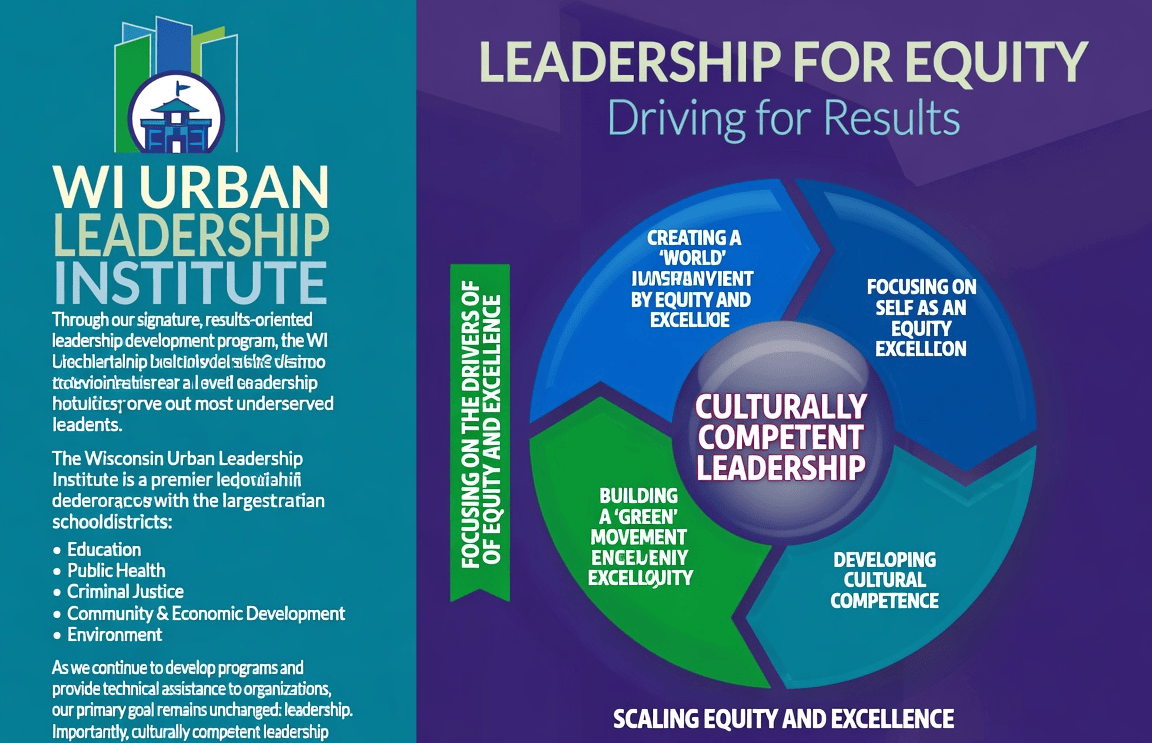
The Department of Public Instruction’s (DPI) own Wisconsin Urban Leadership Institute (WULI) started off as a noble endeavor, as most bureaucratic disasters do. It is an ongoing collaboration between DPI and Wisconsin’s five largest urban districts, Green Bay, Kenosha, Madison, Milwaukee, Racine — now six including West Allis-West Milwaukee.
Launched in 2018 and still fully operational, the program has trained more than 110 principals. Funded by taxpayers and run through DPI, it partners with outside equity consultants to deliver a highly selective, year-long “leadership development” experience. It trains urban principals and their coaches to become ‘equity champions’ (DEI) who then push the radical ideology into professional development sessions, coaching, policies, and school culture. The promise was “Racial disparities in academic achievement, discipline & attendance are reduced” within 3-4 years. That promise, much like Tony Evers and DPI’s other promises, never arrived.
From DPI’s own site and the 2019 Wisconsin Educator Effectiveness Research Partnership (WEERP) evaluation: Principals are positioned as “change-agents” to “disrupt the status quo that promotes inequitable educational opportunities for students of color.” They go through a year-long professional learning series. “Discovering Self as Equity Champion, Developing Cultural Competence, Building a Culture of Excellence with Equity, Designing a School Improvement Strategy for Results” with district-embedded equity coaching, and a required capstone project.
Throughout the entire program they are assigned dedicated equity coaches, the very same coaches evaluated under DPI’s mandatory rubric that ranks “Equity Mindset” and “critical consciousness” as the top job requirement. These coaches don’t just offer suggestions. They make sure the principals stay hyper-focused on the hard work of disrupting white supremacy culture, identifying their own biases, and pushing race-conscious policies back into their buildings. It’s not optional professional development. It’s ongoing ideological enforcement.
The Indoctrination Ritual: Mandatory Racial Narratives
Every capstone begins with the same mandatory exercise: a public “Racial Narrative” or “River of Life” in which principals must confess how their whiteness left them complicit in systemic racism or how they, nonwhites, were oppressed by systems of whiteness.
Michael Sheean delivered a chilling example:
“1984 Small town, middle class, white, two parents home at night / Norman Rockwell Painted my life… Turned out, money and race influenced place… Eyes opened to Ellison, Hughes, & Zora Neale, but it was Angelou that sealed the deal. What’s this?…NWA, holy shit… Civil Rights Act of 1964 yet still had Trayvon, Breonna, George and more… Small town, middle class, white… Turned out…….mostly white, was not always right.”
Jason Johnson went even further, “Our current world has also emboldened family and past co-workers to take their hate, prejudice and white supremacy and put it on display.” He described his radical allegiance to woke over his own family’s reaction to his BLM mask: “I have cut familial relationships. When wearing a BLM mask elicits such a strong negative response I knew there was no going back on who I am and who I want to be.”
Other participants echoed the script. Melinda Kapinos spoke of her “rural upbringing, lacking in diversity. My parents expressed a level of fear…” Melissa Heffernan admitted, “Growing up in a predominantly white community in Wisconsin, I rarely thought about racial differences… despite my initial fear of saying the wrong thing.”
They Literally Grade Themselves on Wokeness
WULI doesn’t stop at confession, they literally have participants grade themselves on wokeness. It demands measurable ideological progress through the Equity Self-Assessment Tool (ESAT). Principals proudly publish their before-and-after scores across four themes.
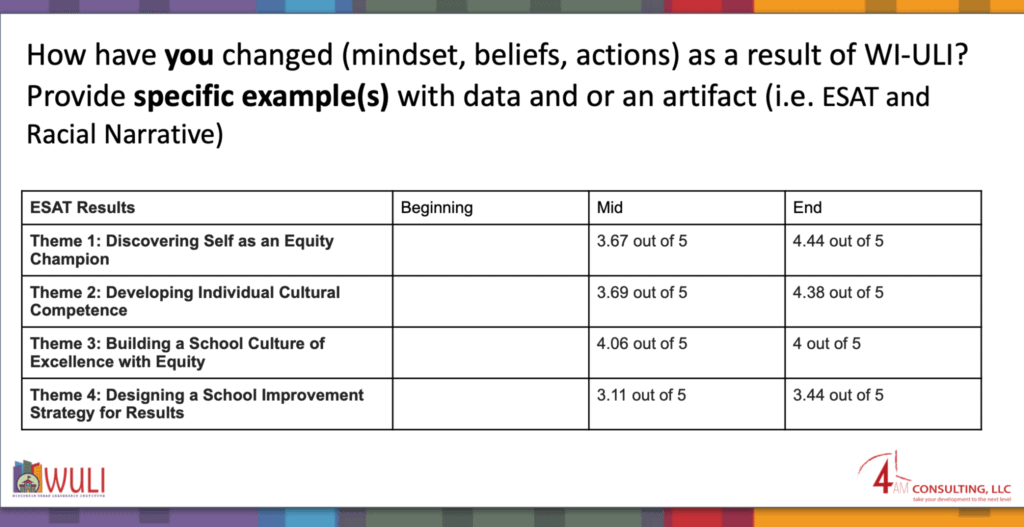
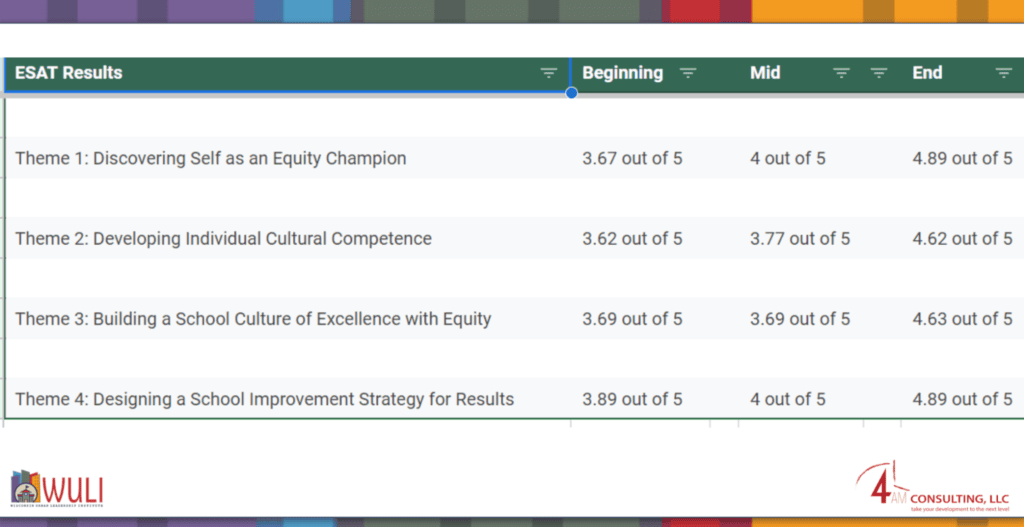
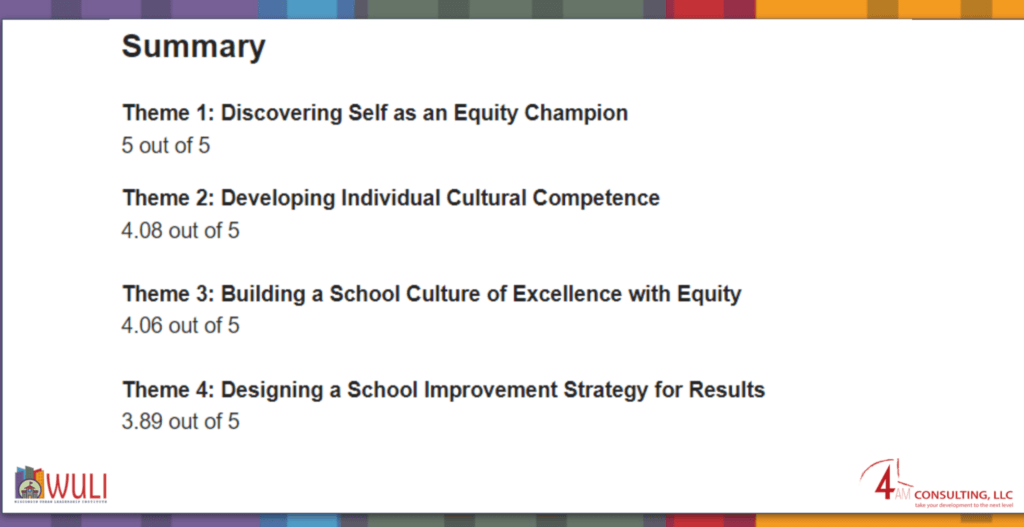
Lisa Lipp, Amy Kallioinen, and Cindy Olson’s personal ESAT assessments.
The official Equity Mindset rubric — the same one used for DPI coaches in DPI Coach Evaluations — makes clear what “Distinguished” looks like: actively disrupting “white supremacy and the history of whiteness,” coaching others to do the same, and creating decision-making spaces only for “marginalized” groups. Anything less is rated unsatisfactory.
“Courageous Conversations” Become Concrete Policy and Practice
WULI does not end with confession, scoring, and critical race theory indoctrination. They require action and demand clear initiatives and goals.
Melissa Heffernan describes “Craft a district strategic plan, that specifically calls out a focus on equitable access to resources.” Greg Lundin proclaims “Increasing collaboration between our SEL (Social Emotional Learning) team that plans lessons for our advisory time and our Anti-Racist Educators group. Courtney Kuehn tied every 100-day cycle to “Closing the Attitude Gap” and “equity for all learners.” Tanya Fenner implemented “small group work for our ‘targeted’ student groups.” Cindy Olson listed her “intentionality”: share observations, be vocal about disproportionality, coach colleagues, and monitor compliance.
The 2019 WEERP evaluation openly celebrated that participants “successfully applied their learning to their schools through capstone projects.” The 2024-2025 capstones prove the DEI machine is still operating at full capacity.
Taxpayers are funding a state-run leadership academy that requires public school principals to confess their racial sins, grade themselves on ideological purity, and then return to their buildings to implement race-based policies and practices in the districts with some of the worst Black/White achievement gaps in the state. This is how Evers’ DPI — and its successors — turned our largest school systems in Wisconsin into DEI laboratories.
Meanwhile, Wisconsin still posts the nation’s widest Black-White achievement gap, 45 points in fourth-grade reading on the 2024 NAEP, with Milwaukee, Madison, and the other WULI districts driving much of that disparity.
The most tragic part is this program could have been truly transformational, focused on best practices in math and reading skills that actually help kids. Instead, it became a year-long ritual of oppressed vs oppressor self-evaluation and personal growth designed to produce “equity champions”.
And it all started with one “Courageous Conversation” and Tony Evers — and brought us to this very moment of WULI participant Dexter McNabb unapologetically declaring “Ultimately, there is no easy way to move forward in our culture unless we continue to dismantle systemic racism itself.”
Wisconsin deserves better.
