



“Here, HEAB has not even identified any objectives or benefits it hopes to promote or achieve
through diverse student bodies at private and technical colleges. Thus, it is left to argue that
diversity is a compelling interest in and of itself, a position that lacks support under current law.”
Konkanok Rabiebna v. Higher Educational Aids Board (HEAB), 2026 WI 20, ¶46.
The progressive Wisconsin Supreme Court unanimously – and begrudgingly – struck down a
DEI scholarship program and stopped Wisconsin from giving taxpayer-funded benefits based on
race. When I co-authored a bill this session to do what the Court just did, Governor Evers and his
allies spoke in platitudes of opposition against it. But contrary to what Democrats think, there is
a reason to oppose race-based discrimination.
Discrimination based on race has long been something the Court rightfully considers odious.
However, the government can do it as long as there is a compelling government interest and the
policy is narrowly tailored to that interest. Sometimes the “strict scrutiny test” can be met.
Wisconsin’s Higher Educational Aids Board (HEAB), however, did not specify the interest or the limited scope. The jig was up. When asked directly, HEAB had to remain silent because it knew that it was putting people into categories they didn’t choose and then prejudging them.
Diversity programs today claim a premise that diversity of immutable characteristic results in a
diversity of viewpoints. When the Left says “diversity is our strength,” they mean that having
certain body parts confers predictable personality traits. So, to them, having a variety of people
with different body parts will result in different perspectives. To them, that interaction of
physical characteristics will create some sort of ether from which the best ideas will manifest.
Rational people for years have recognized that it really only creates Progressive Leftist
organizations comprised of the ideologically uniform of all shapes and colors.
In other words, the premise argued from is one that prejudges and stereotypes people based on
their immutable characteristic. HEAB could not argue to support its position because it was in a
dilemma. It was either going to have to say without evidence that all individuals of a minority
group are a certain way, or that all individuals in a majority group are a certain way.
Democrats are philosophically and historically susceptible to the bigotry. It is the party of
slavery, the Klan, and Jim Crow. While it claims moral epiphany during the Civil Rights Era, it
really pivoted to a system of patronage starting in the time of the 1930’s Chicago Cermak
Coalition. If your demographic group provides votes, individuals in your demographic will
receive jobs and benefits. But, don’t forget, you are to be treated individually as if you are one
of those people with those physical characteristics just as always. Benefit distribution to
individuals will just be different than it was before statistically. The designated arbiters decide
what satisfies subjective preconceived equity score keeping notions of fairness among the
groups.
How did the Courts justify continued “odious” discrimination to begin with, then? It turns out
proving discrimination case by case is hard and requires evidence of intent often only in the mind of the discriminator. So, the US Supreme Court decided to presume motives and intent in Griggs
v. Duke Power Co., 401 U.S. 424 (1971), fighting discrimination with discrimination.
In Duke Power, the Court declared a plaintiff didn’t have to prove a discriminatory intent.
Instead, the plaintiff only had to show they did not receive a benefit and the defendant had
statistically fewer of the plaintiff’s demographic in relation to the general population. The Court
entrenched “implicit bias,” evidenced by statistical disparity. The burden shifted litigation from
a plaintiff having to prove discriminatory intent to a defendant having to prove a negative that
they did not intend to discriminate.
This decision had the desired rippling effect. Companies and governments desperately enacted
“anti-racist” policies to counter any presumptions of bias. They couldn’t merely accept the best
applicant if the current organization wasn’t diverse in immutable characteristics. Individuals
passed over, who possessed certain immutable characteristics, could sue and win on a statistical
disparity showing alone. To counter that presumption, organizations imposed mandatory
diversity trainings, “inclusive” policies, and race-based recruiting on the front end to
affirmatively argue no ill intent in court on the back end.
Grifters still abound selling struggle session seminars that amount to nothing more than lecturing people about having secret biases they themselves don’t even know they have. But, the grifter knows they have it through lived experience and introspectively “doing the work” of understanding unwritten social positions of
power among groups conveniently detailed in their book for sale in the back. It was not lost on
most of us that having someone tell us how a minority group acts so as to be inclusive is
unbelievably racist and stereotyping.
Colleges, likewise, needed to account for demographic disparity lest they be accused themselves.
At first there were too many men and Whites. The statistics alone proved the “system” had
discriminatory intent. To give scholarships based on race suddenly fit the strict scrutiny test
calculus. Odious “de jure” (by law) discrimination was permitted because there was a
compelling government interest to counter the “de facto” (in fact as applied) discrimination
manifest and presumed true by a statistical analysis.
55 years on, flaws in that legal theory cannot be papered over. Women make up most of the
college graduates. Colleges actively discriminate against minority groups like Asians and Jews
because there are too many according to statistical analysis. Policy proponents cannot rebut
simple arguments related to statistical disparity. For instance, if the criminal justice system is
racist because there is a statistical disparity among races, then isn’t the criminal justice system
misandrist since 9 of 10 inmates are men? American law is finally waking up to a realization it’s
rooted in a non-sequitur, that statistical disparity might have any number of causes and it’s not
alone proof of discrimination.
All that is not to say there aren’t legacy effects of previous discriminatory Democrat policies.
We need to simply and finally eliminate the sickness festering in law by making policies like
scholarships race neutral. If poverty is a legacy effect, make a scholarship helping the
impoverished. If being the first in your family to go to college is a legacy effect, make a
scholarship for those people. If graduating from a high school in a bad part of town is a legacy
effect, make a scholarship for those people. The effect will disparately benefit those actually suffering the effects of past racist policy instead of presuming someone is poor, ignorant, and
without opportunity by getting a good look at their physical characteristics.
Finally, we should not overlook Rabiebna v HEAB’s historical significance in relation to social
justice, critical theories and recently re-emergent neo-Marxism. It’s not an original tactic for
power seekers to create the us vs them dynamic. The modern incarnation was branded
“commutarian,” that being recognizing rights of the individual and of the group of which they
belong. With that premise, arguments follow that if the effect on one group as a whole is great,
then the individuals of another group can be discriminated against to balance it out. You hear
that in arguments claiming your “privilege” of being a member of a group means you
individually must be denied something. Group identity interchanges with previous categories of
proletariat and bourgeois and used in the same political strategy.
Evening scores on individuals who look like a perpetrator who harmed a person that looks like
you should sound familiar. It’s ethnic nationalism. Putting people involuntarily into race
categories and then dividing benefits based on presumptions about their group is exactly that
thinly veiled and rebranded. Politicians and grifters position themselves for money and power as
the supposed impartial arbiters among the groups keeping the score even.
Of course, leftists have to redefine the word “racism” to exclude their overt bigotry. To them, being bigoted to counter prior bigotry is “doing the work” and being “anti-racist.” Desiring race neutrality in policy to them is denying your “implicit bias” and having “false consciousness” about your true bigoted nature. To the modern left it’s okay to be bigoted so long as you accept and confess your original bigotry sin, then do the work to counter it with penitence and tithe to Non-Governmental Organizations they run. If we are not siloed into groups for politicians and grifters to even scores for, the intersectional coalition and group advocacy patronage system will break down and the NGOs will go broke. The situation is so dire for them that Southern Policy Law Center had to fund hate to fundraise off hate.
Konkanok Rabiebna v. Higher Educational Aids Board and AB669/SB652 represent more than simple compliance with a US Supreme Court ruling on equal protection. It chips away at a corrosive constantly rebranded centuries old paradigm from the Democrat Party that we can somehow justify presuming your personality traits by analyzing statistics of your imposed demographic. Republicans are right to fight against race-based policies, and we are on the right side of the issue legally and morally. Unfortunately, there are many similar policies throughout government beyond scholarships that need reform. And, like in generations past, Democrats will act like their very existence is threatened when Republicans stop them from treating people as just another member of their demographic. That’s because it is.
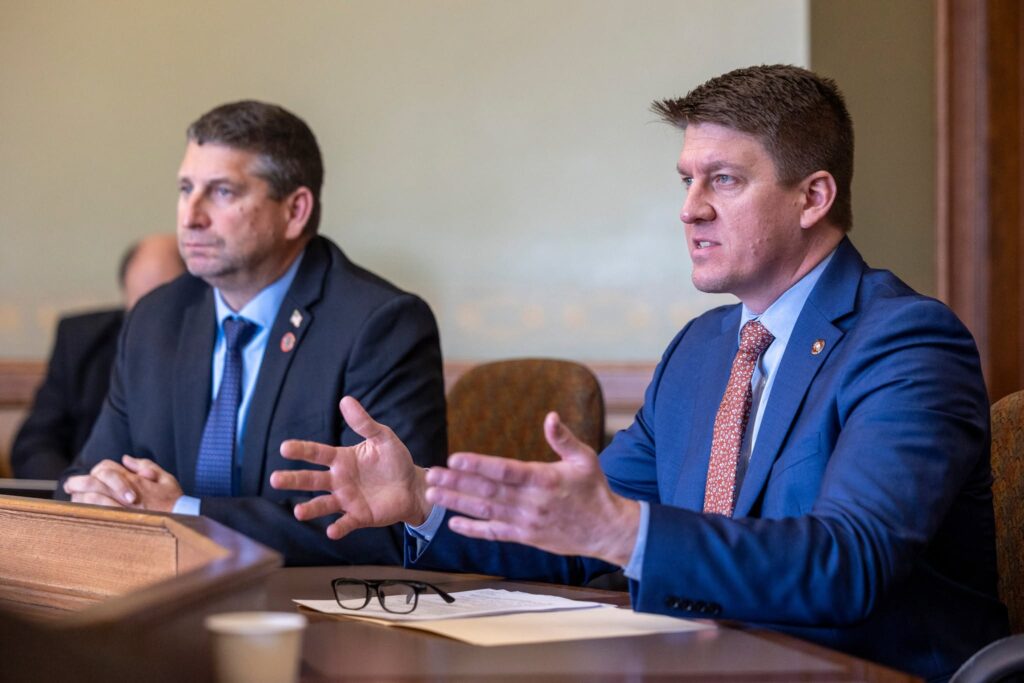
Senator Eric Wimberger represents Wisconsin’s 2nd Senate District in Northeastern Wisconsin. First elected to the State Senate in 2020, Wimberger is an attorney, small business owner, and previously served as a Captain in the United States Marine Corps. Currently, he operates his family’s candy store in Lakewood, WI.
