


Wisconsin has become America’s ultimate political battleground.
It is the state that has played a key role in deciding the last three presidential elections. It is home to two of the nation’s most competitive congressional districts, where Republicans Bryan Steil and Derrick Van Orden will once again be among Democrats’ top takeover targets. And this year, it is home to what has quickly become one of the most closely watched elections in the country.
Yet despite all of that national attention, there has been a stunning lack of reliable public polling.
Instead of giving voters a clear picture of where the Democratic primary stands, the polling vacuum has forced campaigns, political observers and voters to piece together an incomplete picture using months-old surveys, questionable online polls with opaque methodologies, or carefully selected internal polling released by the campaigns themselves.
Of course, polls don’t vote. Elections are decided by voters, not survey respondents. But good polling provides something equally important: a credible snapshot in time. It helps measure momentum, candidate viability, and the trajectory of a race—information that voters, campaigns, donors, and political observers all use to understand where the contest stands.
That uncertainty has only made an already chaotic Democratic primary even harder to decipher.
This week’s Marquette Law School Poll—widely regarded as Wisconsin’s gold standard for public polling—was supposed to bring some much-needed clarity. Instead, thanks to one of the wildest weeks in recent Wisconsin political history, it may ultimately serve as little more than a snapshot of a race that no longer exists.
The lack of recent polling is remarkable. Before this week, Marquette had surveyed the Democratic primary only three times–the most recent being before the April Supreme Court election, which feels like it took place an eternity ago.
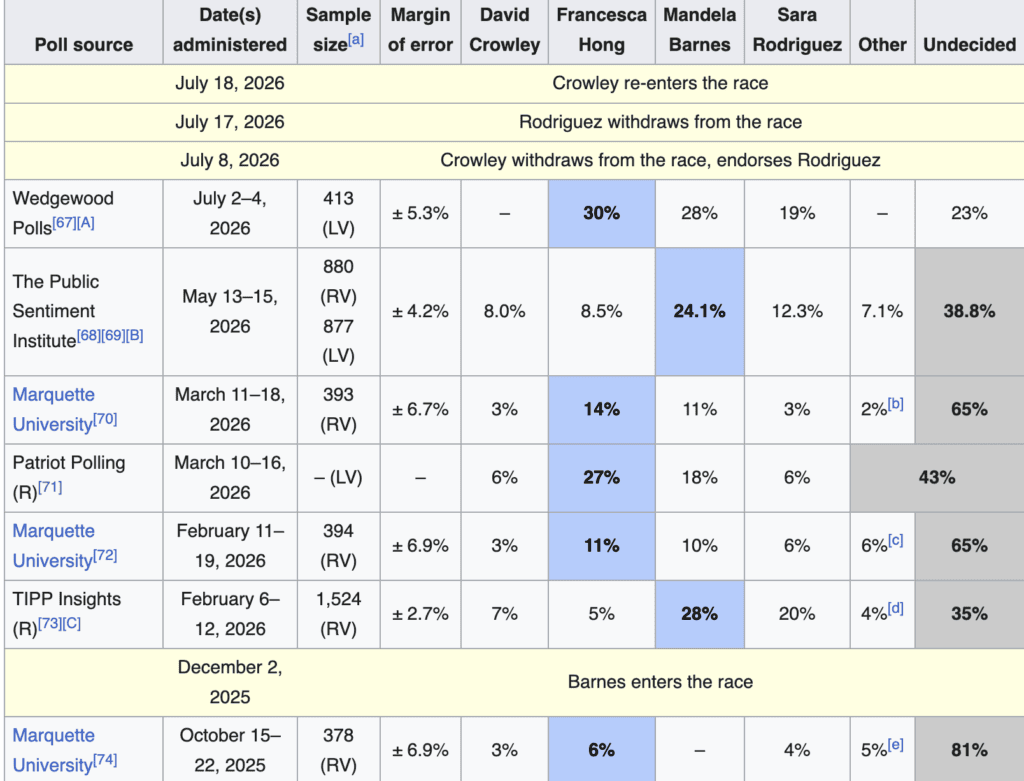
Its first poll, conducted in October 2025, found Democratic Socialist Francesca Hong leading with just 6 percent support, followed by Sara Rodriguez at 4 percent and David Crowley at 3 percent. A staggering 81 percent of Democratic voters remained undecided, while former Lt. Gov. Mandela Barnes had yet to enter the race.
By February, Hong still held the lead with 11 percent, Barnes debuted at 10 percent, Rodriguez sat at 6 percent, and Crowley remained at 3 percent. Even then, 65 percent of Democratic voters were still undecided.
One month later, Hong expanded her advantage to 14 percent while Barnes climbed to 11 percent. Rodriguez and Crowley were tied at 3 percent. Remarkably, the share of undecided voters remained virtually unchanged at 65 percent.
That Wisconsin’s most respected pollster has gone more than four months without publicly measuring what has become one of the nation’s marquee gubernatorial primaries is difficult to believe.The remaining public polling has done little to fill the void.
A February TIPP Insights survey showed Barnes leading with 28 percent, Rodriguez at 20 percent and Hong at just 5 percent—a result that stood apart from virtually every other public measure of the race and is now badly outdated.
Campaigns have also attempted to shape the narrative with selective internal polling. In early June, Rodriguez released survey results conducted for her campaign showing Barnes leading at 26 percent, Hong at 22 percent and Rodriguez trailing in third.
Internal polling can provide useful information, but campaigns control everything from question wording to which results they choose to release, making those numbers difficult to independently evaluate.
That’s precisely why high-quality public polling matters. Its purpose isn’t to tell voters who they should support, but to provide an independent snapshot of the race that everyone can evaluate using the same set of facts.
Much of the remaining polling has come from little-known online firms employing methodologies that vary widely and often produce dramatically different results. That is why this week’s Marquette poll carried so much weight.
With just over three weeks remaining before the Democratic primary, many viewed it as the survey that would finally establish which candidates remained viable and which campaigns had fallen too far behind.
Then came last week.
Just days after David Crowley suspended his campaign and endorsed Sara Rodriguez in an effort to consolidate establishment Democratic support against Hong, Rodriguez’s campaign imploded amid a shocking campaign finance scandal–just as Rodriguez was appearing to gain momentum.
The week-long saga culminated with Rodriguez dropping out of the race on Friday, David Crowley re-entering the contest, and Gov. Tony Evers finally breaking his long-held neutrality in Democratic primaries by endorsing Crowley—effectively anointing him as the Democratic establishment’s handpicked candidate to stop Francesca Hong.
In the span of just seven days, Wisconsin Democrats went from a crowded primary, to a narrowing field, to an all-out civil war between party insiders determined to stop Hong and grassroots activists determined to nominate her. It was the most dramatic week of the campaign—and arguably one of the wildest weeks in recent Wisconsin political history.
Unfortunately for anyone hoping this week’s Marquette poll would clarify the race, most of that upheaval won’t be reflected in the numbers.
On WISN’s UPFRONT, Marquette Poll Director Charles Franklin explained that interviewing concluded last Wednesday—before the full scope of Rodriguez’s finance scandal became public, before her withdrawal, before Crowley’s return, and before Evers’ endorsement.
While will still be valuable takeaways from the poll, including important insights into candidate recognition, ideological divisions within the Democratic electorate and the state of the race before last week’s political earthquake, the reality is that the timing of last week’s events make it impossible for the Marquette Poll to fully measure the race as it exists today.
Instead, campaigns will almost certainly seize on whichever numbers best fit their preferred narrative while voters attempt to interpret polling that reflects a political landscape already overtaken by events.
There is still time for another national pollster to survey the race before the Aug. 11 primary. But few organizations carry the credibility or Wisconsin track record of the Marquette Law School Poll.
Meanwhile, absentee ballots are already being cast, early voting is approaching, and Wisconsin Democrats are making decisions with remarkably little reliable public data about where their primary actually stands.
The Democratic primary has been a roller coaster ride full of unpredictable twists and turns. Reliable polling wasn’t supposed to determine the outcome—it was supposed to help explain the race. Instead, Wisconsin’s most important poll will likely provide nothing more than a snapshot of a Democratic primary that has already been turned upside down. As voters begin casting ballots, one of the country’s most consequential elections remains one of its least understood.
