


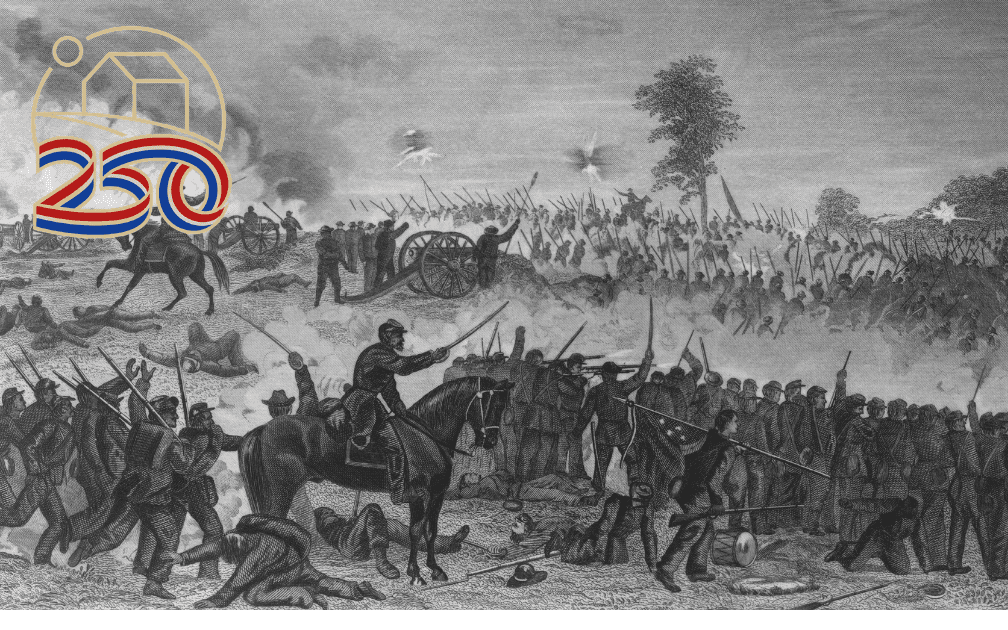
Dawn breaks on a warm July morning. A young soldier squints in the sunlight as he sees a cloud of dust rising from the road ahead. The Confederates are marching toward him.
Beads of sweat drip from his brow as grabs his corporal’s rifle and steadies it against a fence.
He steels his nerves, takes a breath, and squeezes the trigger. The Battle of Gettysburg has begun.
The Union Army was desperate to stop Robert E. Lee’s advance northward. Just months after President Lincoln’s Emancipation Proclamation freed all slaves in the Confederacy, it seemed that the dream of freedom in there was all but dead. If Lee advanced any further than Pennsylvania, he might force a Union surrender and, as Lincoln had predicted years earlier, the house divided against itself over the question of slavery would not stand.
Gettysburg would be the Union Army’s last stand. The fighting raged for hours as the air grew thick with cannon and rifle smoke and the anguished cries of the dying echoed through the battlefield. The hours became days. When the smoke cleared and the cries faded after the three-day battle, a third of the soldiers who fought in it were dead, injured, captured, or missing.
It was the deadliest battle America had ever fought—made even more heartbreaking because it fought against itself—but freedom always has a heavy cost. The Confederate Army was turned back and retreated south with the Union in hot pursuit. Gettysburg was the turning point in America’s Civil War, and the Confederacy surrendered less than two years later.
The world may little note nor long remember the young soldier who fired the first shot, Marcellus Jones, but he was the perfect man—the perfect American—to begin his nation’s final march toward freedom for all.
Why? Because he was an ordinary man who dedicated his life to the cause of liberty. He wasn’t of noble birth. He didn’t even have much education, but he was a hard worker and as a boy helped his father build wagons. He discovered a talent for building things and made his way to Weyauwega, Wisconsin to start a door-making business.
Marcellus might not have had much formal schooling, but he was a superb businessman and his company flourished. But in 1858, his wife died in childbirth and his factory burned to the ground. He was devastated, but not defeated. He moved to Illinois and started a contracting and carpentry business.
When southern states began seceding from the Union in 1860, though, Marcellus knew that war was inevitable. He joined the 8th Regiment Illinois Volunteer Cavalry, which was recruited at Lincoln’s personal request.
Marcellus knew the stakes, he knew what he was giving up, but he also knew that America and its promise of freedom for millions of slaves was worth fighting and dying for.
There have been throughout American history millions of Marcellus Jones’—ordinary men and women with an extraordinary willingness to bleed for the cause of freedom. It is a hallmark of a nation so dedicated to its founding ideals that it breeds generation after generation whose solemn duty is to uphold them no matter the cost.
Abraham Lincoln freed the slaves, but hundreds of thousands of Marcellus Jones’ fought for them, and hundreds of thousands died for them.
Throughout our history, it was the Marcellus Jones’ among us who have reaped the benefits of America’s meritocracy and free markets to create for themselves a better life than they might have dreamed, but when the nation calls them to lay that life aside to preserve freedom and self-governance, they willingly and lovingly do so.
We are as Americans, Wisconsinites, the descendants of Marcellus Jones revolutionary in our kindness, our compassion, and our commitment to our founding principles.
We are all one people with one common purpose, and while we are and never have been perfect (nor claimed to be), we are always at the ready to right our society’s wrongs. This in itself proves the rightness, the goodness of our society.
Throughout our history we have fought for that society, we have bled for it, and we have died for it. Because of the heroics of Marcellus Jones and the men who fought and bled and died at Gettysburg, President Lincoln said what is perhaps the truest, most eloquent thing ever said about this great nation:
Four score and seven years ago our fathers brought forth on this continent a new nation, conceived in liberty, and dedicated to the proposition that all men are created equal. Now we are engaged in a great civil war, testing whether that nation, or any nation so conceived and so dedicated, can long endure.
We are met on a great battlefield of that war. We have come to dedicate a portion of that field as a final resting place for those who here gave their lives that that nation might live. It is altogether fitting and proper that we should do this. But in a larger sense we cannot dedicate, we cannot consecrate, we cannot hallow this ground.
The brave men, living and dead, who struggled here have consecrated it, far above our poor power to add or detract. The world will little note, nor long remember, what we say here, but it can never forget what they did here. It is for us the living, rather, to be dedicated here to the unfinished work which they who fought here have thus far so nobly advanced.
It is rather for us to be here dedicated to the great task remaining before us, that from these honored dead we take increased devotion to that cause for which they gave the last full measure of devotion, that we here highly resolve that these dead shall not have died in vain, that this nation, under God, shall have a new birth of freedom, and that government of the people, by the people, for the people, shall not perish from the earth.
