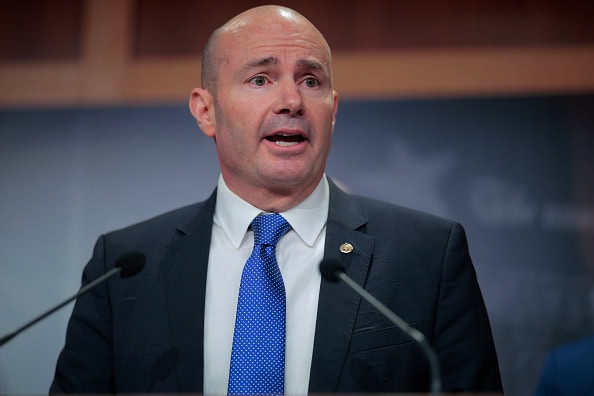


As America heads into August, Senator Mike Lee and other conservatives are sounding the alarm. Congress is set to flee Washington without addressing the Safeguard American Voter Eligibility (SAVE) Act, with lawmakers not planning to return until September 14. This is not just another case of legislative gridlock. It is a profound dereliction of duty at a moment when the integrity of our elections and the trust of the American people hangs in the balance.
As Senator Mike Lee rightly declared in his recent X post, “We have the time to pass the SAVE America Act. What we lack is the spine. But we can find our spine again, just as we can choose to stay in session as long as it takes to pass the SAVE America Act — even if that requires working through weekends and long-scheduled recess time.”
The SAVE Act is straightforward common sense legislation. It requires documentary proof of U.S. citizenship to register to vote in federal elections and a photo ID to cast a ballot. These are the kinds of basic safeguards that everyday Americans already navigate for everything from boarding a plane to buying a beer or opening a bank account. As expected, Democrats in the Senate have blocked it, and Republican leadership appears content to punt until after the August recess. This delay is unacceptable.
Polls consistently show overwhelming, bipartisan support for the SAVE Act. Gallup and Pew Research find roughly 80-84% of Americans favor photo ID requirements to vote, including strong majorities of Democrats (around 70%), independents, and voters across racial, geographic, and urban/rural lines. This isn’t a partisan issue — it’s an American one. Citizens of every background want confidence that only eligible voters decide our elections. Non-citizen voting, sloppy rolls, and mail-in ballot vulnerabilities erode that trust, as highlighted in places like Los Angeles County.
Failing to pass the SAVE Act before the midterms carries real consequences. We’ve already seen how lax standards fuel skepticism and potential irregularities. In high-profile races like the LA Mayoral election, questions about voter rolls, eligibility, and turnout have persisted. Without proof-of-citizenship and ID requirements, close races in battleground states could descend into recounts, lawsuits, and accusations that erode public trust long after polls close. This issue matters more than ever in a 50/50 swing state like Wisconsin. Conservatives have warned that secure elections are the foundation of self-government. Delaying this vote risks repeating the chaos of recent election cycles while signaling to voters that Washington elites care more about their summer plans than safeguarding the ballot box.
The voter rolls issue is particularly salient in Wisconsin, where the voter rolls have ballooned to roughly 8.3 million names as of mid-2025. At the same time, only about 3.7 million were classified as active registered voters — against a citizen voting-age population closer to 4.3–4.5 million. The nearly 4.6 million inactive records, many names lingering from those who have moved out of state, deceased individuals, or those who became ineligible, highlight the urgent need for robust list maintenance that the state has failed to address, despite available tools and federal requirements.
Passing the SAVE Act would deliver the proof-of-citizenship and photo ID safeguards needed to prevent ineligible voters from casting ballots, stop identities from being misused, reduce risks from outdated or duplicate records, and bolster confidence in mail-in and absentee voting.
Senator Lee’s push to pass the SAVE Act before the August recess demands urgency. Why recess when the House has already passed the bill and Americans are demanding action? The excuse of needing 60 votes falls flat and lacks credibility when core election integrity should surpass the filibuster debate and procedural games.
Why Not Revisit Healthcare Reform Too?
This foot-dragging raises another question — If Congress can’t muster the will for the wildly popular SAVE Act ahead of midterms, why not use the time productively by revisiting unfinished business on healthcare? Recall the 2017 “skinny repeal” effort — the Health Care Freedom Act — that Senate Republicans pursued to begin unwinding Obamacare’s failures. It fell short on a dramatic 49-51 vote, with the late Sen. John McCain’s thumbs-down joining Senators Collins and Murkowski against it, alongside Democrats. McCain cited process concerns as the reason he refused to pass the bill.
Republican failure to pass the 2017 healthcare form bill allowed for underlying issues to worsen. Skyrocketing premiums and out-of-pocket costs (especially after enhanced subsidies expired), persistent affordability issues, high hospital prices in states like Wisconsin, virtually zero competition and interstate options under the ACA framework, and the need for greater state flexibility and market-based reforms. These are problems both parties have acknowledged still plague the system today.
The Health Care Freedom Act of 2017 was modest. It wasn’t full repeal-and-replace, but a stepping stone to fixing the broken system. The individual mandate penalty was later zeroed out anyway via tax reform, and yet the core problems of the Affordable Care Act (ACA) program still persist.
After enhanced subsidies expired at the end of 2025, millions dropped or downgraded their coverage due to skyrocketing premiums. In states like Wisconsin, hospital prices far exceed Midwestern neighboring states (including Illinois), driving premiums higher and squeezing families and businesses.
Even President Obama acknowledged Obamacare needs to be fixed. Now the Affordable Care Act is still in place, and so is the ongoing affordability crisis, provider shortages, mandates discouraging competition, limiting consumer choice, and inflating premiums through heavy regulation and one-size-fits-all benefit requirements. (More to come on this topic).
Resurrecting the 2017 bill could deliver tangible relief in time for the midterms. Americans across the spectrum are feeling the pinch of high deductibles, out-of-pocket expenses and unaffordable plans. This would have a significant impact on midterms in swing states, particularly Wisconsin. Conservatives typically support market-oriented solutions over the existing top-down ACA model. If the Senate can’t pass voter ID, it should at least tackle healthcare before they take another vacation.
It’s time for Congress to cancel the extended break, pass the SAVE Act, and show voters they’re serious about reform. Midterms are coming — failure to act will be remembered at the ballot box.