


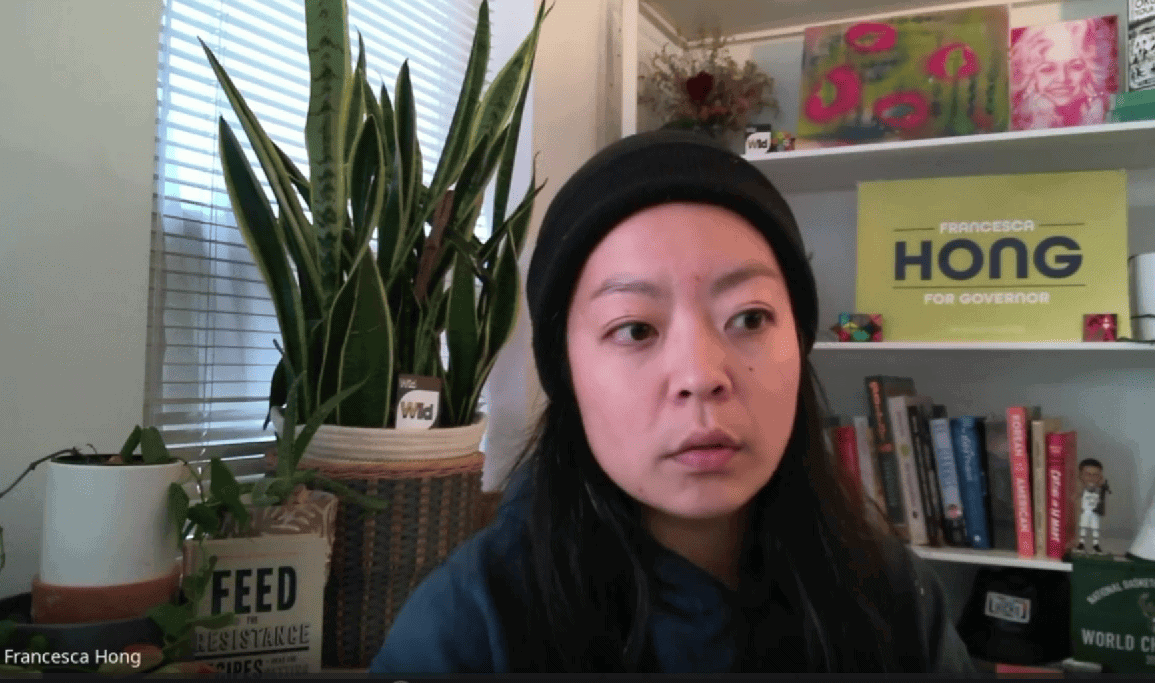
In Tuesday night’s Democratic gubernatorial debate, democratic socialist Francesca Hong reaffirmed her commitment to ending Wisconsin’s School Choice program. This position puts her at odds with the decisions thousands of black families in Milwaukee have already made for their children.
Hong has repeatedly called for “a responsible end” to Wisconsin’s voucher program, a position popular with many progressive activists and public school bureaucracies that oppose school choice. But for thousands of Milwaukee families, there is nothing responsible about dismantling the educational lifeline they have relied on for decades.
If Hong’s plan became reality, an estimated at least 15,000 Black students in and around Milwaukee would ultimately be forced out of the choice and charter schools their families selected and back into one of the worst districts in the country when it comes to educating black and brown children.
That is precisely why the Milwaukee Parental Choice Program was created.
Established in 1990 as the nation’s first modern school voucher program, the Milwaukee Parental Choice Program was designed to give low-income families—particularly Black and Hispanic families trapped in failing schools—another option. Today, roughly 30,000 Milwaukee students, nearly half of all school-aged children in the city, attend choice schools. Of those 30,000 students, nearly half of them are Black.
Families have continued choosing the program for one simple reason: opportunity.
The program has thrived since then, with choice and charter schools within Milwaukee consistently outperforming their traditional public school counterparts in the same neighborhoods. Enrollment has boomed, driven largely by black families who refuse to sacrifice their child’s future to a system that has failed them for generations. For many children and families, this program has been a lifeline–a second chance at escaping the vicious cycle of generational poverty, trauma, and incarceration that afflict so many in Wisconsin’s largest city.
Research has found that students participating in the Milwaukee Parental Choice Program are more likely to graduate from high school, more likely to attend college, and less likely to be convicted of crimes as adults.
Meanwhile, Milwaukee Public Schools continues to produce some of the worst academic outcomes in the country.
Just 5 percent of Black fourth graders in Milwaukee Public Schools are proficient in reading. Despite receiving roughly $24,000 per student in funding, the district continues to struggle with chronic underperformance, leaving thousands of children without the basic literacy skills they need to succeed in school and later in life.
The consequences extend far beyond the classroom. Children who cannot read proficiently by fourth grade are significantly more likely to drop out of high school, experience long-term poverty, and become incarcerated later in life. Educational failure does not remain confined to schools—it affects entire communities.
Yet Hong’s solution is to eliminate the very program many families have used to escape those outcomes.
During Tuesday’s debate, moderator Matt Smith pressed Hong on whether her plan would eventually eliminate School Choice even in Milwaukee.
“I believe that that is what bringing a responsible end to the voucher program is, Matt,” Hong replied.
Her comments immediately drew criticism from Milwaukee voices who support educational choice, including Black Democrats.
WTMJ host Kyle Wallace, whose program Truth to Power has interviewed every major Democratic candidate for governor, blasted Hong’s proposal as “a slap in the face to Black families.”
“Kelda Roys and Francesca Hong have no idea what’s happening in the City of Milwaukee,” Wallace said.
Wallace also rejected the argument that simply increasing funding for MPS will solve its longstanding problems, noting that the district already spends roughly $24,000 per student while continuing to produce dismal academic results. He concluded that voters who support School Choice cannot support Hong, Kelda Roys, or Mandela Barnes because all have pledged to eliminate or phase out the program.
Perhaps the greatest irony is that Hong frequently frames her campaign around racial equity. She has even described Wisconsin’s School Choice program as “inequitable.”
But what is equitable about forcing thousands of Black children back into schools their own parents have worked so hard to leave? For a candidate who so often speaks about systemic racism, Hong is willing to defend the very status quo that continues to perpetuate the disparities and inequities she claims to oppose.
For decades, Milwaukee families have voted with their feet. They have chosen schools they believe are safer, stronger, and more capable of giving their children a better future. Enrollment in the Milwaukee Parental Choice Program reflects that reality.
Before School Choice began in 1990, Black families in Milwaukee had one option: a broken system with no solutions. Thirty-six years later, that changed, and the Milwaukee Parental Choice Program opened the door to opportunities once thought to be unimaginable for thousands of Milwaukee families. Now that door is at risk of closing because of liberal politicians who care more about preserving their institutions than serving the students inside them.
Ending School Choice would not fix Milwaukee Public Schools. It would simply eliminate an option that tens of thousands of families have chosen for themselves.
The question is not whether politicians believe they know what is best for Milwaukee’s children. The question is whether parents should continue to have the freedom to make that decision for themselves.
On November 3, Milwaukee’s Black families will once again have a choice. They can support a candidate who believes parents—not politicians—should decide where their children go to school, or they can support a candidate who has pledged to end the educational opportunities that thousands of Milwaukee families have chosen for their children.
Frederick Douglass once wrote, “Education means emancipation. It means light and liberty… the light by which men can only be made free.” This fall, many Milwaukee families will decide whether that freedom remains within their reach.
