


As midterm elections were approaching, Senate Democrats blocked several House-passed bills addressing congressional stock trading, the risk that AI data centers shift electricity infrastructure costs onto ordinary ratepayers, and the reauthorization (and potential reform) of foreign-intelligence surveillance powers. The 60-vote threshold was used to deny Republicans legislative accomplishments rather than to negotiate stronger versions of the legislation that could actually become law.
Ratepayer Protection Act and Sen. Baldwin
The Ratepayer Protection Act (H.R. 9340) passed the House 417-3 on September 16. It would have required state utility regulators to consider a federal standard under which large-load customers, primarily data centers drawing 100 megawatts or more to pay the full incremental cost of generation, transmission, and distribution upgrades built to serve them, rather than socializing those costs across household bills.
It also called for financial assurances so ratepayers would not be left holding the bag if projects shrank or departed altogether. The bill did not mandate adoption by every state; it required commissions to take the standard up and decide.
On September 30 the Senate failed to invoke cloture, 57-43, three votes short of the 60 needed to pass the bill. Only four Democrats (Hassan, Klobuchar, Ossoff, and Warnock) joined Republicans. Wisconsin Sens. Ron Johnson (R) voted yes and Tammy Baldwin (D) voted no.
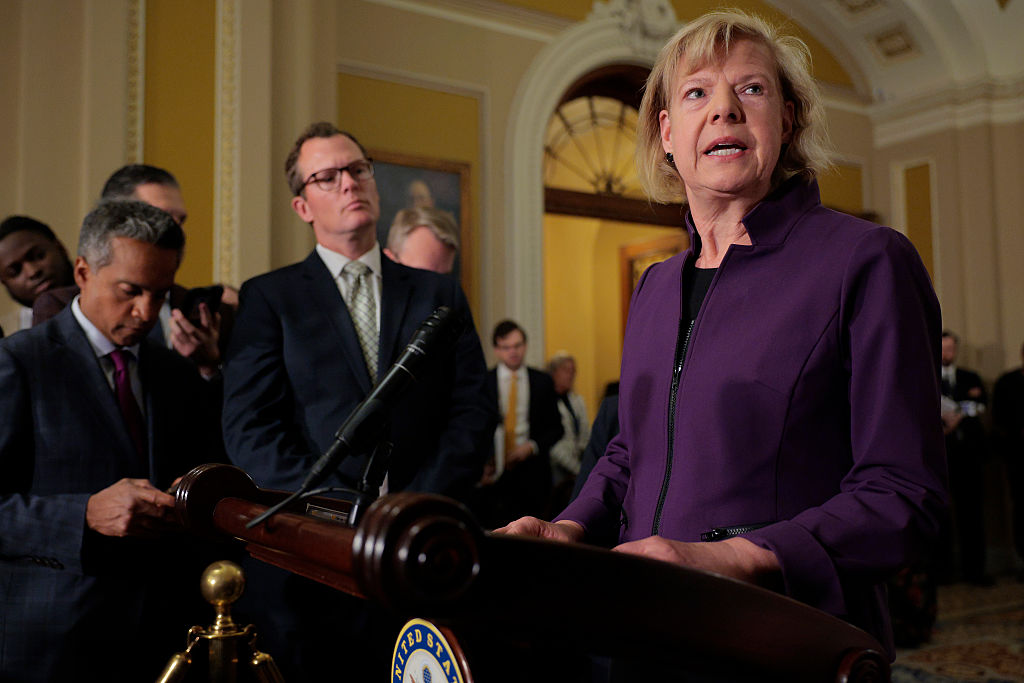
In a statement,Sen. Baldwin called the legislation “toothless,” arguing it merely asks regulators to “consider” protections and does not impose a binding mandate or cover every data center. She said she supports making data centers pay their own way but will not accept a voluntary framework.
Republicans and many House Democrats who supported the bill argued that the near-unanimous House vote offered the only realistic chance to place a national standard in front of state commissions before Election Day, especially in states already absorbing large hyperscale projects.
With multiple major data-center developments underway in Wisconsin, Baldwin’s decision to oppose the bill has been criticized as prioritizing the argument that the bill “doesn’t go far enough” over incremental protection for ratepayers.
Passing this bill was a step in the right direction, and Congress would have the opportunity to draft additional legislation to address the “not far enough” issues after the midterms. Instead, Senate Democrats tanked it altogether.
Stop Insider Trading Act
The same day, the Senate rejected cloture 53-47 on the Stop Insider Trading Act that was was introduced and led by Representative Bryan Steil, with every Democrat and both independents opposed. The House had passed the bill 232-198 in July, with 13 Democrats voting yes. The legislation would prohibit members of Congress, their spouses, and dependent children from purchasing new individual publicly traded stocks and would require public notice before sales. It left existing stock holdings largely intact.
Democrats argued the bill was inadequate because it did not force divestiture, “contained loopholes,” and was paired with voter-identification language they labeled a “poison pill.” Senate Minority Leader Chuck Schumer described it as a “permission slip for corruption” and “theatrical farce.”
Republicans argued that public polling has long shown overwhelming support for restricting congressional stock trading, that the House version already drew some Democratic votes, and that Democrats previously controlled the Senate for years without enacting a stronger ban.
FISA Section 702 and Court Reforms
Earlier in 2026, Senate Democrats (joined by a handful of Republicans) blocked procedural votes to reauthorize Section 702 of the Foreign Intelligence Surveillance Act (FISA) before its June 12 statutory expiration. Democrats and some Republicans opposed President Trump’s appointment of Bill Pulte as acting Director of National Intelligence, which was tied to the reauthorization of Section 702.
Some Republicans and civil-liberties advocates on both sides also objected to the absence of a warrant requirement before the government can query Section 702 data (wire tapping / electronic surveillance) for the communications of Americans “incidentally” collected while targeting foreigners.
Section 702 has long been criticized for enabling “backdoor searches” of Americans’ communications without obtaining a warrant or undergoing an individualized judicial approval process before the Federal Government could surveil Americans. The Foreign Intelligence Surveillance Court has issued opinions flagging compliance problems and improper searches, with at least one opinion detailing “serious abuses” that remains classified.
A warrant requirement for American searches was supported by a bipartisan group primarily led by Sens. Ron Wyden (D-OR) and Mike Lee (R-UT), and Reps. Zoe Lofgren (D-CA) and Warren Davidson (R-OH), and cosponsors Reps. Andy Biggs (R-AZ) and Thomas Massie (R-KY).
Blocking both clean reauthorization and versions of the legislation that included stronger reforms leaves the program operating under prior court orders preserving the status quo: Americans remain at risk of having the Federal government surveil them without a warrant under the current statutory framework.
